Give a vending machine a mobile phone subscription and you have performed a small miracle of bad accounting. The machine can tell you it needs replenishing. It can report a fault. It can also acquire a recurring expense absurdly out of proportion to the few scraps of information it sends. In the early days of Jasper, the obstacle to connecting ordinary objects was partly this prosaic: the network knew how to charge a human being.
- Jasper sells the software that manages cellular IoT connections.
- Its route to customers runs through mobile operators.
- Cisco announced a $1.4 billion deal for it in 2016.
- Today, its platform lives on as Cisco IoT Control Center.
Jasper’s founders saw an awkward gap between a network’s capabilities and a machine’s economics. A connected product needed coverage, certainly. It also needed a sensible tariff, an activation process, a way to diagnose silence, and someone to notice when usage became expensive. Those details sound like the appendix to an innovation presentation. In practice, they can determine whether the innovation earns any money.
The $50 problem
Jahangir Mohammed, Amit Gupta and Daniel Collins founded Jasper Wireless in 2004. In Sequoia’s account of the early company, ordinary GSM subscriptions costing $50 a month or more made machine connectivity difficult to justify. That figure describes the obstacle the founders encountered, rather than a Jasper price. A sensor was being asked to buy the wardrobe of a much more extravagant customer.
The founders chose to build the common infrastructure for connected services. They had to solve technical problems, including connectivity across carriers, while persuading partners that these strange new subscribers could be worthwhile. The idea required patience: Jasper started before the iPhone, when selling machine connections meant explaining both the service and why anyone should pay for it.
A hypothetical fleet of 10,000 devices at $50 per month. Arithmetic, not Jasper pricing.
That calculation is the point. A tiny message becomes a large expense when multiplied across a fleet. The same multiplication applies to a technician’s time. An activation that takes five minutes may be tolerable once. Make it a routine operation across thousands of devices and you have quietly recruited an entire department.
The carrier becomes the customer
Jasper originally offered multinational businesses connectivity through its Global SIM service, managing airtime across markets. By April 2009, contemporary reporting described a business-model change: network operators wanted a more visible role in the emerging machine-to-machine market. Jasper would keep hosting and managing the service while making the local network provider more prominent.
Here was the tension in the original approach: Jasper depended on networks whose owners also wanted the commercial relationship. The first thing to give way was the assumption about who should face the customer. The evidence supports a change of route to market, rather than a dramatic tale of a product collapsing overnight.
In May 2009, AT&T announced a multi-year agreement with Jasper. AT&T would use Jasper’s platform for emerging categories including navigation devices, e-readers, healthcare devices and tracking. At the time, it became Jasper’s exclusive US carrier. Operators’ growing interest changed the opportunity: the companies with the networks could become buyers of the software needed to run the new services.
The lesson is useful beyond telecoms. Before treating a powerful intermediary as an obstacle, ask what it would rather buy than build. Jasper’s expertise in provisioning, diagnostics and billing gave operators something more substantial than another reseller of their own airtime.
A car has more than one life
Consider a connected car. It passes through manufacturing, distribution, a dealership and ownership. The connection’s purpose changes along the way. Factory testing and a driver’s ongoing service are different commercial situations; treating them alike invites avoidable cost. Cisco’s connected-vehicle material puts lifecycle automation and flexible charging at the center of this problem.
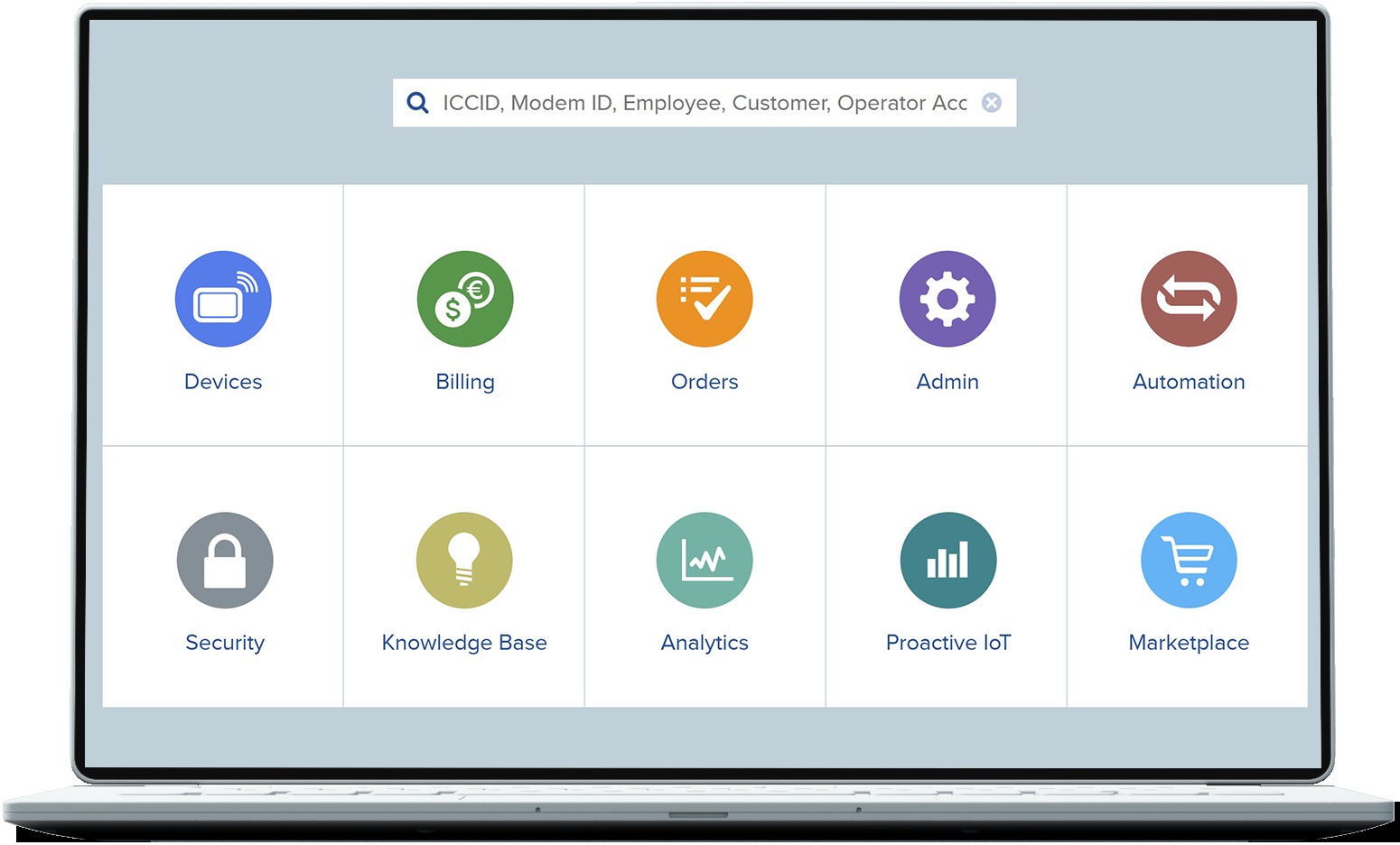
Control Center lets businesses define how connectivity should behave at different stages. Provisioning, usage monitoring and diagnostics make the connection observable and manageable. APIs let those operations participate in the company’s existing systems. A useful fleet console cannot depend on somebody copying the same information between screens all afternoon.
- 01PrepareConfigure the SIM and service rules.
- 02ActivateProvision when the device needs service.
- 03OperateMonitor usage and diagnose faults.
- 04AdjustApply the right lifecycle and billing policy.
A historical General Motors case study describes the use of Control Center for millions of vehicles, with automated management, real-time visibility and remote diagnostics. Its attraction is plain: fewer manual steps between a new service and its deployment. The software manages a relationship that persists long after the vehicle leaves the dealership.
The invoice gets a seat at the table
Cisco documents a pay-as-you-grow model with Essential and Advantage packages and optional add-ons. Essential is aimed at simpler uses such as sending small, periodic data packets. Advantage serves more demanding deployments, including highly mobile devices and higher data use. Enterprises access the platform through participating service providers, whose connectivity offers and commercial terms matter to the eventual bill.
The cost question therefore begins with the deployment. How many devices? How much traffic? Which markets? What happens to an inactive subscription? Cisco’s rate-plan API documentation describes monthly and prepaid structures, individual and pooled usage, tiers and overage charges. A tariff is a set of rules, and the rules are part of the product’s economics.
There is evidence that optimization can help. In a Cisco account of a beta deployment, telemetry and fleet-management company Astus reported data-plan savings of up to 20 percent. That is one customer’s reported result. A buyer should test the result against its own traffic patterns, negotiated rates and operational costs.
Reporting is equally practical. Dynamic Reporting provides usage, billing and device information, with scheduled reports and API access. Meanwhile, Dynamic Policy and Charging Service helps providers support enterprise subscription services with quotas and charging policies. Jasper’s place in the market is where connectivity becomes a service someone can sell and operate.
What $1.4 billion bought
In April 2014, Jasper announced $50 million in growth financing led by Temasek. It reported more than 1,000 enterprise customers using a partner network of 19 mobile operator groups. This was a distribution business as well as a software business: each operator relationship opened a route into more connected-service deployments.
By the acquisition announcement in February 2016, investor Gaurav Garg described more than 3,500 customer companies and a disciplined operation that had become operating cash-flow positive. Cisco’s announced $1.4 billion deal gave Jasper a home inside a supplier already selling networking, security and analytics. Cisco publicly announced completion in March 2016 and formed an IoT Cloud Business Unit.
In June 2017, Cisco reported 11,000 enterprises and 43 million devices and introduced Control Center 7.0. Its expanded tiers and premium services reflected a practical discovery: customers did not all need the same tools.
“companies have different needs at different stages of their IoT journey.”
Jahangir Mohammed · June 2017
A company sending meter readings and a company running mobile, data-hungry services can both need connectivity management. Their requirements still differ. Packaging that distinction gave Jasper a way to accommodate more of the market without asking every customer to buy an identical assortment.
The SIM learns to travel
The newer partnerships return to the original cross-border problem. In September 2025, Tata Communications announced a collaboration to embed its MOVE eSIM orchestration in Control Center. The intended benefit was simpler management across SIM providers, networks and standards.
On February 19, 2026, AT&T and Cisco announced a commercially activated 5G Standalone-native IoT platform integrating AT&T’s core with Cisco offerings including Control Center. On March 2, Tele2 IoT, IDEMIA and Cisco announced a commercial SGP.32 offering. It combines remote eSIM provisioning, Cisco orchestration and Tele2 connectivity, aiming to simplify global deployments around one platform and eSIM stock-keeping unit.
For a device maker, the appeal is less physical SIM handling and fewer regional variations to manage. That still depends on compatible hardware, supported networks and the commercial arrangement. The announcement describes an integrated offering; it does not make every existing connected device instantly interchangeable.
Copy the arithmetic before the ambition
Jasper has alternatives. Aeris took over Ericsson’s IoT Accelerator business in 2023. KORE acquired Twilio’s IoT business that year. Specialist services such as 1NCE offer their own connectivity and software packages. Buyers should compare coverage, provisioning, integrations and pricing at the level of the actual deployment.
Control Center makes particular sense when cellular connections are numerous, spread across markets or costly to administer by hand. It cannot create radio coverage where there is none, mend defective hardware, or supply a compelling application for an unwanted service. A small installation with modest needs may have little reason to adopt the same operating machinery as a multinational fleet. Those are engineering and purchasing judgments, not a ranking of company logos.
What a reader can copy is the habit of treating every repeated task as a unit cost. Measure activation effort. Check dormant subscriptions. Decide what usage deserves an alert. Test fault handling before expanding the fleet. Then ask whether the network operator is a competitor, a supplier or the customer for the tool you have built. Jasper’s story becomes more useful the closer you bring it to the invoice.
Open the control room
Explore Cisco IoT Control Center and its developer documentation. Follow the legacy Jasper profiles on LinkedIn, X and Facebook.
For recent developments, read the AT&T 5G announcement and the Tele2 and IDEMIA eSIM news; for ongoing discussion, visit Cisco’s service-provider blog.