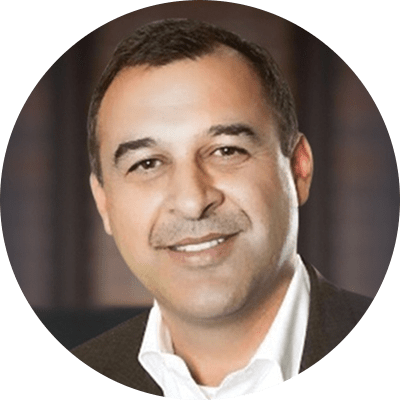
Every time a Volvo pings its location, a utility meter reports consumption, or an enterprise eSIM switches carriers mid-ocean to stay compliant with local regulations - something is making that happen. More often than not, that something is built on a platform Sunil Kaul runs from San Ramon, California.
Kaul is CEO of Airlinq, a company that has made a business out of the problem nobody else wanted to solve: not the IoT devices themselves, not the networks that carry their signals, but the invisible connective tissue between them. The SIM provisioning, the billing logic, the regulatory wrangling, the carrier relationships across dozens of countries. The part of IoT that is boring until it breaks.
He joined Airlinq in March 2019 as Chief Commercial Officer and was handed the CEO role two years later. Before that, a five-year stint at Globetouch as SVP of M2M and Americas. Before that, 13 years at Mobileum (then Roamware) in North American sales, climbing from Director to General Manager and VP. He is, by any reckoning, a career telecom operator - someone who learned the business from the inside and has been patient enough to watch the industry's center of gravity shift from voice minutes to connected devices.
"Global IoT scale is no longer limited by technology, but by regulation."- Sunil Kaul, CEO of Airlinq
The Regulation Problem
That quote is the key to understanding why Airlinq exists and why Kaul runs it the way he does. The company's core thesis is that connectivity is abundant - the bottleneck is compliance. Every country has its own rules about data localization, SIM registration, eSIM switching, and carrier certification. An automotive manufacturer shipping vehicles to 30 markets faces 30 different regulatory environments, each requiring a different configuration, a different carrier relationship, a different data residency posture.
Airlinq has spent years building carrier relationships and compliance infrastructure across those markets so its enterprise customers don't have to. When NTT DOCOMO BUSINESS announced a strategic partnership with Airlinq in March 2026, the logic was explicit: Airlinq brings the local carrier network and regulatory playbook; NTT DOCOMO BUSINESS brings the enterprise relationships and global reach. Neither company could do what the partnership does alone.
Kaul's background in M2M connectivity at Globetouch was not accidental preparation. Machine-to-machine communication - the predecessor to what we now call IoT - required exactly this kind of cross-border carrier negotiation. He spent five years building those relationships before Airlinq gave him the platform to scale them.
Four Products, One Platform
Airlinq does not sell a single product. It sells an ecosystem of four interconnected platforms, each aimed at a different vertical but running on shared infrastructure:
The architecture is deliberate. Automakers want connected vehicle software, not generic IoT tools. Utilities want meter management, not automotive telemetry. But the underlying connectivity infrastructure - the SIM management, the billing engine, the regulatory compliance layer - is shared. Kaul's strategic move was to build the platform once and sell four different front-ends to four different industries.
From NIT Karnataka to Silicon Valley
Kaul graduated from the National Institute of Technology Karnataka in 1992 with an engineering degree - one of India's premier technical institutions, where admission is fiercely competitive. His path into U.S. telecom followed the well-worn route of engineers who arrived in the 1990s and built careers in an industry that was transforming in real time.
He joined Roamware (later Mobileum) in 2001 as Director of Sales for North America. Roamware was in the business of helping mobile carriers manage international roaming - the routing of calls and data when subscribers crossed borders. It was technical, it was relational, and it required understanding both the carrier economics and the regulatory environment that governed them. Kaul spent 13 years there, eventually running North American sales as General Manager and VP.
That foundation matters. The skills that made a roaming solutions salesperson effective in 2001 - carrier relationship management, regulatory navigation, cross-border technical complexity - are exactly the skills that make an IoT platform CEO effective in 2026. Kaul has not pivoted. He has persisted, through a long arc of an industry that kept generating new names for the same underlying problem: how do you move data across borders, at scale, without breaking the rules?
Recognition the Market Gives You
Analysts track a narrow slice of the IoT connectivity management market, and Airlinq appears at the top of the list with unusual consistency. Kaleido Intelligence named the company a Champion in IoT Connectivity Management Solutions from 2022 through 2025. Counterpoint Research recognized Airlinq as a Leader in Connectivity Management Platforms in 2025. Frost & Sullivan handed over a Best Practices Competitive Strategy Leadership Award for North America Connected Vehicle Solutions.
Kaleido Intelligence Champion
IoT Connectivity Management Solutions - four consecutive years (2022-2025)
Counterpoint Research Leader
Connectivity Management Platforms - 2025 global rankings
Frost & Sullivan Award
Best Practices Competitive Strategy Leadership - North America Connected Vehicle Solutions
21 Patents Filed
Six patents granted across IoT connectivity, device management, and platform architecture
The customer list tells a similar story. Volvo, Verizon, NTT DOCOMO, Jio, Tata. These are not companies that buy from vendors they are uncertain about. They are companies with complex IoT requirements at massive scale, and they have chosen Airlinq to manage the connectivity layer underneath their connected products.
Building the Executive Bench
In September 2023, Kaul announced the appointment of Vangipuram Kishore as Global Chief Operating Officer. The choice was deliberate: Kishore had spent over two decades at Mobileum - the same company where Kaul spent the first 13 years of his career. When Kaul described the hire, he emphasized Kishore's depth in delivering complex software to telecom service providers. He was not looking for a generalist operator. He wanted someone who understood what it actually takes to ship technical products to carriers.
The executive team Kaul has assembled reflects the same philosophy. Board Chair William Hague is a former AT&T executive. Board member Mohan Gyani served as President of AT&T Wireless. Marni Walden spent her career at Verizon. Vice Chairman Ori Sasson is a former CEO of Genesys with deep enterprise software experience. Kaul has surrounded himself with people who understand the industries Airlinq sells into - because in enterprise IoT, the relationships and the domain credibility matter as much as the technology.
What Comes Next
The NTT DOCOMO BUSINESS partnership announced in March 2026 points to Airlinq's next chapter. The deal covers the full IoT lifecycle - from pre-deployment regulatory planning to post-deployment operations - across mobility sectors including automotive, construction machinery, and agricultural equipment. It is, in scope, a statement that Airlinq intends to be the connectivity management layer for global industrial IoT, not just connected cars.
Kaul's thesis on regulation-as-bottleneck implies a specific kind of competitive moat. The technology can be replicated. The carrier relationships, the compliance infrastructure, the country-by-country regulatory playbooks - those take years to build and are not easily acquired. Every new market Airlinq enters deepens the moat. Every enterprise customer that goes live in a new geography adds to the network of carrier relationships that makes the next deployment cheaper and faster.
For an engineer who graduated in 1992 and has spent over three decades in one industry, Sunil Kaul has placed a very specific bet: that the most valuable company in IoT will not be the one that builds the best device or the fastest network, but the one that makes it possible for devices and networks to work together across every border on earth. He is running that company now, from a headquarters in San Ramon, California, while living 20 miles away in Pleasanton. The geography is unglamorous. The ambition is not.