The smallest computer in Roger Dewey's professional life is the size of a clipped fingernail. It has memory, a processor and a secure place inside billions of cellular devices. Most people know it as the plastic-and-metal ticket that tells a phone which network it belongs to. Dewey looks at the SIM and sees a neglected piece of computing real estate.
That difference in perspective explains Able Device, the Raleigh company Dewey founded in 2010. Its core technology, SIMbae, lets software run inside a SIM or eSIM. The chip can store and update credentials, inspect information from a device, apply rules and help manage which network the device uses. The proposition sounds almost mischievous: telecom installed a standardized computer everywhere, then mostly asked it to show identification.
Dewey's wager is that the SIM can do more useful work. A connected payment terminal moving between public and private networks, an industrial sensor far from a technician, or a vehicle with several possible connections all face small, urgent choices. Which network should I trust? Has my credential changed? What should happen when coverage weakens? Sending every question to a remote cloud adds time, dependencies and cost. Put a policy in the secure element already inside the device, and at least some answers can happen where the problem occurs.
He learned the network before questioning it
Dewey did not arrive at this idea from outside telecom. He had spent years inside its operating machinery. In Stockholm, he was vice president and general manager for marketing and sales in Ericsson's Mobile Internet Applications business unit, with global responsibility for applications and infrastructure platforms. From 2001 through 2006, he moved through executive roles in Sony Ericsson's machine-to-machine communications unit, including responsibility for the Americas and for global business and product strategy.
This was before the phrase Internet of Things became a conference-room reflex. The trade called it M2M, and the work was literal: make one machine communicate with another without asking a person to mediate. Telemetry, fleet tracking and automated meter reading were not lifestyle accessories. They were operating systems for physical businesses.
At Sony Ericsson, Dewey helped shape the business unit's divestiture, which ended with its acquisition by Wavecom in 2006. That same year he became president and CEO of Telit Americas. He established operations in the United States and Brazil and developed channels across the region, concentrating on telematics, fleet management and meter reading. In a 2007 partnership announcement with Jasper Wireless, he described the objective in practical terms: break down the barriers to deploying connected machines worldwide.
The industry noticed his part in that early market. M2M Magazine named him an Industry Pioneer in 2004, while he was at Sony Ericsson, and again in 2008, during his Telit tenure. Telematics Update gave him its Leadership Award in 2005. The dates matter because they place his interest well before today's excitement over edge intelligence. Dewey has watched the same underlying problem pass through several generations of branding.
A founder's detour, then a return
After Telit, Dewey founded M2MV, an international M2M strategy consultancy that he managed from 2009 to 2011. He started Able Device in early 2010, then took what looks, in retrospect, like a deliberate detour. For three years he served as co-founder and executive vice president at Device Cloud Networks. In December 2014, he returned to Able Device.
The company he came back to was pursuing a compact architectural insight. US Patent 8,180,402, issued in 2012 with Dewey listed among the inventors, describes a SIM storing and executing instructions to control a computing device. Patent prose has all the swing of a parking regulation, but the idea underneath is lively: the identity chip can become an actor.
The edge loop
From observation to action, without a scenic cloud detour
Able Device's most charming proof arrived at Mobile World Congress Shanghai in 2018. Working with Taiwan Mobile, the company demonstrated a traffic light controlled by an application embedded on a SIM. Another demonstration updated a security credential in an industrial device. A traffic signal is a fine prop for invisible infrastructure: familiar, consequential and extremely unamused by jargon.
Dewey argued that a SIM could remove the need for a separate security chip in some designs. It was standardized, remotely updateable and already attached to the mobile network. More important, compromising one device would not automatically hand over an entire fleet. His recurring phrase, “the only logical place,” carries the brisk impatience of an operator who believes the spare part is already on the bench.
The unglamorous half of intelligence
By 2026, Dewey's language had moved from M2M security to autonomous networks and AI. His complaint was precise. Models can analyze conditions and recommend an action, but a recommendation is not the same as reliable execution. A network still needs a trusted point that can apply the decision predictably. Able Device positions the SIM and eSIM identity layer as that point.
In May, the company announced an evolution of SIMbae designed to execute AI-driven connectivity decisions inside the secure element. In June, Dewey published an essay arguing that the industry need not wait for 6G to build intelligent networks. The capabilities he described - observation, policy and local action - are available before the next generation number arrives with its banners and tote bags.
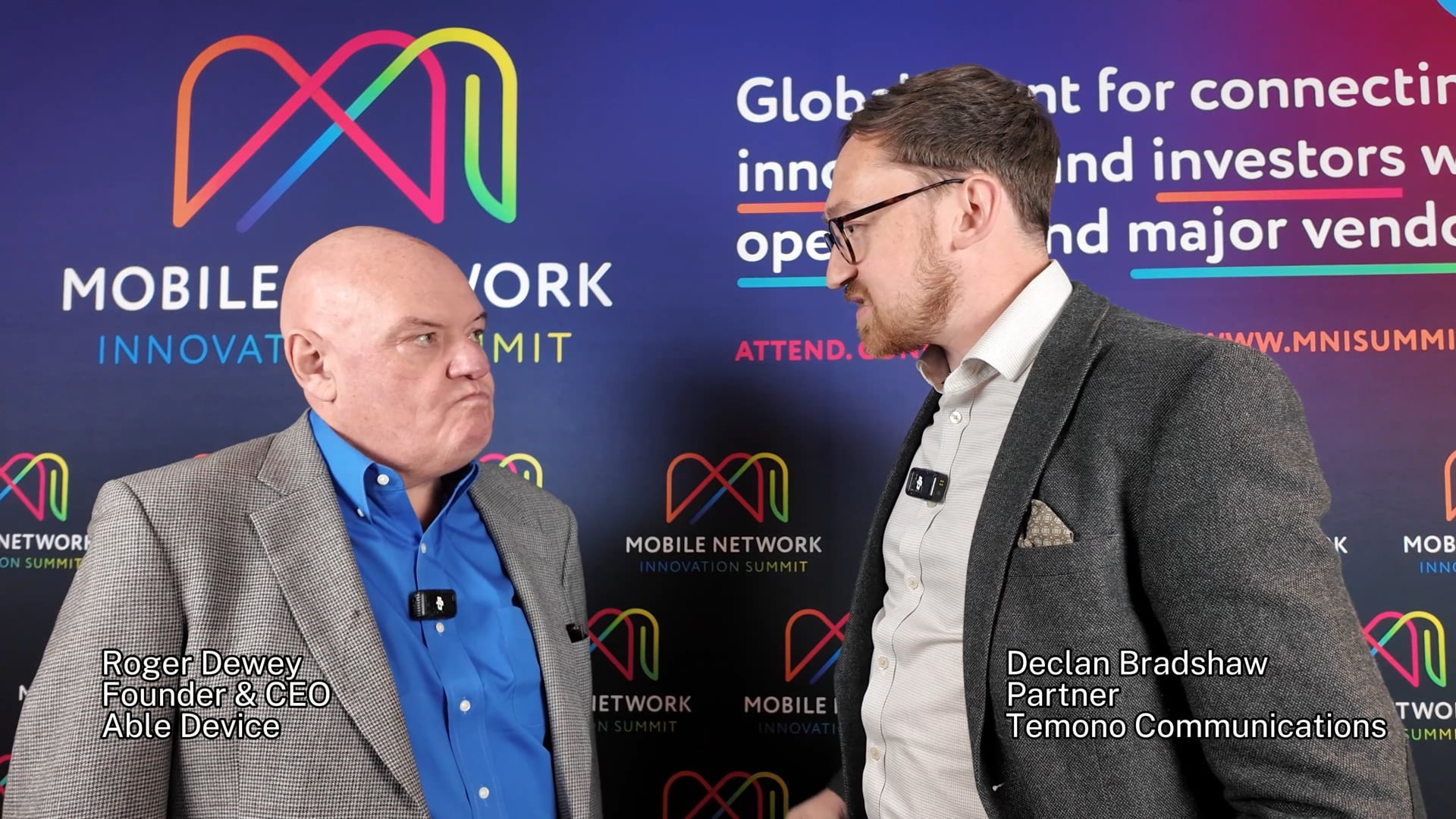
That stance reveals the most consistent quality in his public work: an attraction to implementation. At the 2026 Mobile Network Innovation Summit, he described the SIM applet as a missing link for autonomous control of connectivity and quality of service. His writing keeps returning to the seam between deciding and doing. AI gets the keynote. Enforcement gets the pager when something fails.
The problem becomes clearer when a device moves. A factory scanner may use a private network inside a plant and a public network outside it. A connected vehicle can encounter terrestrial and satellite options. A terminal may know several networks but still need a deterministic rule for choosing among them. The conventional answer often relies on distant orchestration or on the behavior of the device operating system. Dewey's proposed answer places the rule lower in the stack, where an enterprise policy cannot be casually overridden by an application update or a user's setting.
His travel has kept that thesis attached to customers rather than diagrams. After spending much of September 2025 meeting companies and other telecom participants across the European Union and the United Kingdom, Dewey wrote that enterprises were ready to shape connectivity around their own requirements. The practical demand was not simply for more coverage. It was for devices that could move across public, private and other networks while preserving an organization's cost, security and service policies.
This is where the SIM's boring uniformity becomes useful. Phone models vary. Operating systems vary. Industrial hardware can remain deployed for years after its original software stack looks antique. The SIM remains a common, managed element. Dewey's case depends less on novelty than on reach: put a modest capability in the one place a cellular fleet is already designed to recognize.
Sony Ericsson M2M strategy and leadership, followed by the sale of the unit to Wavecom.
Built Telit Americas across the United States, Brazil and regional channels.
Founded Able Device around programmable intelligence in the SIM.
Demonstrated SIM-based security and traffic-light control with Taiwan Mobile.
Extended the thesis to AI execution and autonomous connectivity.
The lesson hiding in plain sight
Dewey's story offers a useful way to look at infrastructure. New products do not always begin with new components. Sometimes they begin when someone audits an old component without the old assumptions. The SIM's constraints - small, standardized, secure, remotely managed - are precisely what make it interesting. Its limitation is also its discipline. You do not put an empire on a SIM. You put the few decisions that must happen close to the device.
This helps explain why Dewey's career has remained coherent while the industry's nouns changed. Ericsson called the territory mobile internet applications. Sony Ericsson and Telit called it M2M. The market later preferred IoT, then edge computing, private networks and autonomous connectivity. Beneath each label sits a fleet of devices trying to behave properly when the environment changes.
Able Device is a small company taking on that large systems problem from Raleigh. Its pitch is neither that the cloud disappears nor that every device becomes a genius. It is that judgment should be distributed. Central systems can analyze and improve. The secure element can apply a known rule now.
There is something pleasingly proportionate about Dewey's chosen battleground. The telecom industry builds towers, satellites and vast core networks. He keeps pointing to the speck inside the device. The SIM began as proof of who you are. In his version of the network, it also knows what to do next.