Somewhere between a company asking for a private connection and that connection actually working, modern networking takes a small vacation in 1998. A fiber owner checks its footprint. Another carrier joins the email chain. Somebody requests a letter of authorization. Engineers compare VLANs. The customer waits. The physical network may be capable of moving data at 100 gigabits per second, but the commercial network surrounding it proceeds at the speed of a politely forwarded spreadsheet.
MaiaEdge, a Burlington, Massachusetts startup founded in 2024, has built its company around that mismatch. Its founders call the territory between enterprise endpoints and data centers the “big middle”: regional carriers, fiber owners, meet-me rooms and private networks that carry the traffic but rarely behave like one programmable system. MaiaEdge wants to make that layer act less like a collection of bilateral favors and more like infrastructure.
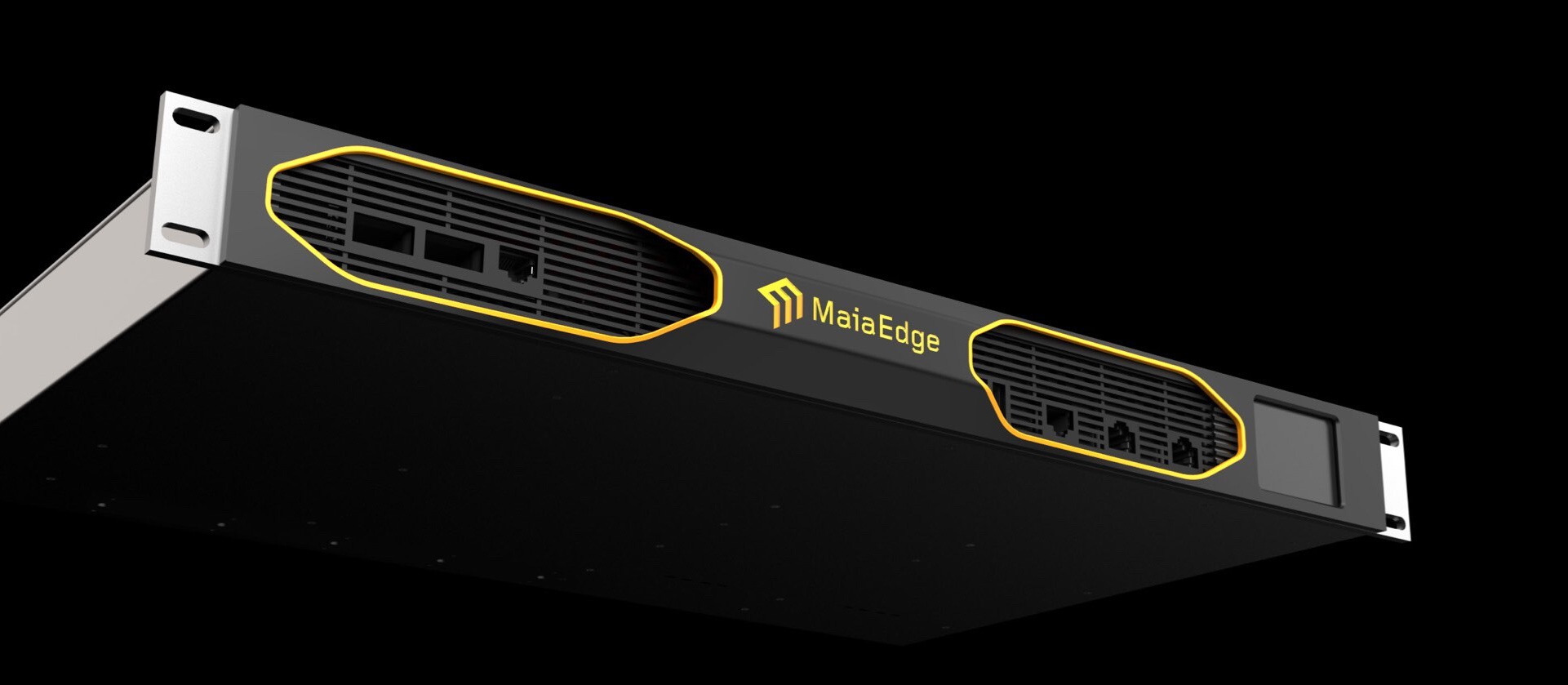
The product is refreshingly physical. A compact, 1RU Path Border Controller, or PBC, sits at the edge of an operator’s network. A cloud-based Path Computation Engine, or PCE, calculates and provisions an end-to-end path. Together they can create private Ethernet connections across fiber, dedicated internet access and partner networks, while reporting latency, loss and jitter hop by hop. MaiaEdge says a new site or network-to-network interconnect can be activated in minutes.
The trick is who keeps the invoice
The cleverest part of the pitch is not raw speed. It is sovereignty, a word MaiaEdge uses to mean that an operator keeps its customer, brand, policies and service-level agreement even when the path crosses infrastructure it does not own. Network-as-a-Service companies such as Megaport and Equinix operate fabrics and sell connectivity. MaiaEdge instead sells the machinery to the operator. Those companies can be alternatives, but they are also integrations: a MaiaEdge customer can use Equinix Fabric or Megaport APIs to offer AWS, Microsoft Azure and Google Cloud connections under its own name.
That distinction points directly at MaiaEdge’s buyers. Regional fiber companies want to sell beyond the streets where they have glass in the ground. Service providers want an off-net circuit to feel like an on-net product. Colocation facilities want the self-service interconnection experience of a large exchange without funding a long internal software project. AI infrastructure operators increasingly need private, low-latency paths among distributed GPU sites, customers and clouds.
The business model bundles appliance and orchestration into a subscription. Publicly listed choices run for one, three or five years, at 1G, 10G or 100G throughput. The actual dollar amount is quote-only. So the honest answer to “what did it cost?” is: MaiaEdge has published the meter, not the rate. For a buyer, the meaningful comparison is not merely another box. It is the subscription against engineering hours, delayed revenue, manual tickets and the cost of building a fabric internally.
This also explains where MaiaEdge sits in a crowded networking market. Cisco, Juniper and Ciena sell broad routing, switching and optical systems. PacketFabric, Console Connect, Megaport and Equinix offer various forms of on-demand connectivity. An operator can also assemble orchestration around its existing stack or keep provisioning by hand. MaiaEdge narrows the job: automate deterministic private paths at and beyond the operator’s edge, without becoming the carrier of record. That focus makes the product easier to understand, though it also means MaiaEdge must prove it can coexist with nearly everything already in the rack.
“The internet connected applications and users, but it left networks negotiating by spreadsheet.”Abilash Menon, CEO and co-founder
What failed first: the handoff
MaiaEdge’s origin story is less garage revelation than accumulated professional irritation. CEO Abilash Menon worked on MPLS architecture at Cisco, large-scale networking at Juniper and SD-WAN at 128 Technology. Co-founder and chief revenue officer Tim Ziemer built sales organizations at Acme Packet, Oracle, 128 Technology and Juniper. Around them is a conspicuous reunion of network veterans, including Acme Packet and 128 Technology co-founders Patrick MeLampy and Andy Ory as board members.
Their observation was that enterprise endpoints had become easier to connect, but automation stopped at the network boundary. The first thing to fail was visibility: traffic crossed into a partner domain and the original operator could no longer see or control every hop. Then coordination took over - contracts, letters of authorization, VLAN alignment, router configuration and the traditional conference call where every participant’s equipment is apparently fine.
What changed their mind about this being merely an annoying fact of telecom life was the repeated pattern. Menon has said work on branch and data-center connectivity revealed a larger unsolved problem in the middle. Cloud adoption raised customer expectations. Distributed AI made the gap harder to ignore because inference can spread across smaller sites near users, data and available power. One giant pipe to one training cluster is a familiar design. Many private paths across many owners are a coordination problem.
fiber or DIA
computes and encrypts
or cloud on-ramp
A box that refuses to rip and replace
MaiaEdge avoids one of enterprise technology’s least charming habits: demanding that a customer replace everything first. The PBC sits alongside existing routers and backbone infrastructure. It blends Layer 2 switching and Layer 3 routing for transport flexibility, while the PCE presents path creation through a dashboard rather than a fresh round of BGP, OSPF or MPLS configuration. Paths use line-rate AES-256-GCM IPsec encryption, according to the company.
At a colocation site, a Port Extender adds 48 tenant ports managed through the same interface. A provider can offer tenant-to-tenant links, data-center interconnect and cloud access through a white-label portal. Partner networks stay out of the customer view. That last detail is not cosmetic. It turns federation from a threat to the operator’s account into a method for serving the account.
The first public proof points are promising but still early. IENTC Telecom says it is deploying PBCs globally and asking interconnection partners to install them. Regional provider Arvig appears in MaiaEdge’s customer material about faster fiber and cloud service delivery. IENTC founder Carlos Arguimbau describes the motion simply: “We plug it in and start passing traffic in minutes.” MaiaEdge has not published a customer count, revenue or valuation.
For customers, the immediate benefit is time to revenue. A circuit waiting sixty days is not just an operational nuisance; it is a product the provider cannot bill. Spare capacity has the same problem. Fiber in the ground is valuable in theory, but capacity that is hard to discover, package and connect behaves like inventory in a locked warehouse. MaiaEdge’s commercial claim is that automation can make those assets easier to sell repeatedly, including through partners whose footprints fill the gaps.

The useful idea to steal
There is a playbook here for founders nowhere near a router. Look for the boundary where a customer’s automation abruptly ends. It may sit between a hospital and an insurer, a retailer and a warehouse, or a bank and a payment rail. The incumbent system on each side can work perfectly while the handoff remains email, tickets and tribal knowledge. The opportunity is often not to replace either core. It is to make the boundary observable, programmable and commercially safe.
MaiaEdge adds a second useful constraint: do not improve the workflow by taking ownership away from the buyer. Its operator-first model lets customers keep the visible relationship and resell the capability. That makes adoption less existential. Equinix and Megaport are not erased; their reach becomes an ingredient. Existing routers are not condemned; they remain in place. MaiaEdge inserts itself where the old system is weakest.
Where the model bends
- It cannot manufacture physical capacity where no usable fiber, DIA or partner route exists.
- Federation gets more valuable as partners participate. A lonely PBC is automation, not an ecosystem.
- Operators seeking a fully outsourced connectivity service may prefer NaaS rather than owning another control layer.
- Procurement, contracts and local physical cross-connects do not vanish just because provisioning is automated.
- Quote-based pricing makes the economics deployment-specific and difficult to judge from the outside.
Those conditions matter because the hardest part of federation may be social rather than technical. Independent operators need shared expectations, incentives and enough installed endpoints to make instant interconnection routine. MaiaEdge’s work with Mplify Alliance, formerly MEF, is therefore not conference decoration. Standards can reduce the custom work that turns every partnership into its own snowflake.
The company raised a $20 million Series A in February 2026, led by executive management alongside G20 Ventures, with individuals and employees participating. The money is earmarked for carrier deployments. That is appropriately unglamorous. MaiaEdge is not trying to teach consumers a new habit. It needs appliances in meaningful locations, integrations that survive production traffic, and enough operators willing to federate without surrendering their identity.
If it works, the payoff is not that anyone notices the box. A fiber operator sells capacity that previously sat idle. A colocation tenant gets a private cloud path without a small archaeological dig through support tickets. A regional provider reaches a customer beyond its footprint and still sends the invoice. The “big middle” remains big, but it stops being a waiting room.