Network engineers have long endured an awkward joke. The servers they connect can be rented in minutes, but the private lines between those servers may arrive after a procession of quotes, forms, tickets and calendar invitations. Console Connect exists to shorten the punchline. Its portal lets a customer choose two places, set bandwidth and provision a private connection. The same work can be called through an API. Bandwidth can be increased for a migration, then turned down when the boxes have stopped moving.
The proposition sounds like SaaS, right down to the dashboard. Underneath, however, sits something considerably heavier: PCCW Global's international network. That pairing is the important fact about Console Connect. It is not an app pretending the physical world has disappeared. It is a control layer attached to switching, routing, fibre systems, cloud on-ramps and data-centre ports that already exist.
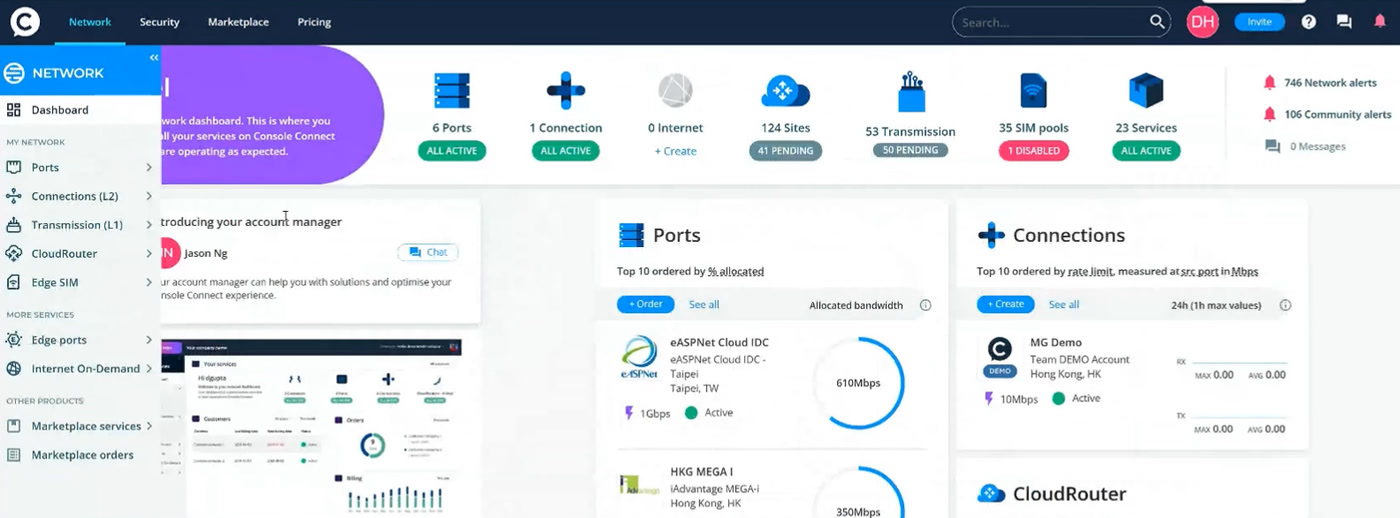
For enterprises, carriers and managed service providers, the appeal is control. A network team can connect offices to AWS, join Google Cloud to Azure through a private Layer 3 router, add internet transit, or send cellular device traffic toward a cloud workload. The work that once bounced among provider desks appears in one interface with monitoring and a pricing calculator. In the best cases, waiting becomes clicking.
The software survived the company
Console Connect began in 2011 under founder Al Burgio, originally carrying the IIX name. Venture investors liked the thesis that cloud infrastructure needed a neutral connection layer. New Enterprise Associates led a US$10.4 million Series A in 2014. A US$26 million Series B followed in 2015 from investors including NEA, Formation 8 and AME Cloud Ventures. With debt and earlier seed rounds, the original business raised more than US$50 million.
Then came the unusual part. In 2017 the company was split. HKT and PCCW Global bought the Console Connect brand, proprietary platform and technology team led by CTO Paul Gampe. Stephen Wilcox, whose IX Reach business Console Connect had acquired in 2015, bought certain network assets and customer contracts and resumed operating them as IX Reach. The startup, as a single corporate package, was over. Its software got a larger network.
Al Burgio founds the interconnection company that becomes Console Connect.
PCCW Global acquires the software, brand and technical team; other assets separate.
An announced Infratil transaction ends before closing.
Private Label launches while new data-centre sites and cloud on-ramps join the map.
PCCW Global then laid a software-defined overlay across its network and automated switching and routing. In a 2021 account of the build, Console Connect put the platform at 1.3 million lines of code. The underlying Layer 1 network then counted 135 points of presence, 46 terabytes of transmission capacity and 67 international subsea cable systems. Those figures will evolve, but they reveal the scale of the object behind the browser window.
“Until now, you could only access this kind of high-performance network through expensive long-term contracts.”Gregory Gundelfinger, CEO of Telna, in a Console Connect case study
A shopping cart for serious plumbing
The catalogue starts with an Access Port, the doorway into the platform. Once connected, a customer can create Layer 2 circuits between two endpoints. CloudRouter handles Layer 3 routing among several clouds or locations without requiring the customer to install another physical router. Internet On-Demand adds Tier 1 internet access. Edge SIM extends the model to cellular devices. The Marketplace gathers cloud providers, internet exchanges, SaaS companies and network partners.
Data centre
Edge SIM
control plane +
PCCW network
SaaS partner
Another site
The console handles ordering and orchestration. Ports, fibre and cloud on-ramps still carry the packets.
The business model follows the cloud metaphor. Customers pay for ports and connectivity, with flexible bandwidth, usage-based options and longer terms depending on the service. Console Connect does not publish a simple universal price card; it sends prospects to a logged-in calculator because location, route, capacity and access method matter. Its more defensible cost claim is comparative: a private cloud connection may reduce hyperscaler data-egress charges, and the company says savings can reach 50 percent in suitable cases.
There is also a wholesale trick. PartnerConnect gives resellers commissions, preferred pricing, deal registration and support. Private Label, launched in May 2025, lets providers put their own brand over a hosted version of the platform, then quote, order and monitor Console Connect services for customers. This turns the interface itself into a distribution product. A regional provider does not have to build a global orchestration stack before selling NaaS.
The customer is buying back time
Telna provides a clean example. The cellular connectivity company needed more capacity among its global sites but did not want another inflexible backbone contract. In February 2021 it deployed four 10G Console Connect ports across Europe, Asia, Latin America and North America. Its team could create virtual connections and flex bandwidth from the portal. The raw capacity mattered; the ability to alter it without reopening a procurement exercise mattered more.
Acquire BPO had a related problem. Its contact-centre operation depended on highly available links, while 1Gbps Ethernet circuits were running out of room. It wanted faster provisioning, central monitoring and an on-demand model as it expanded. Console Connect became part of a global WAN upgrade. For an operation with thousands of employees serving customers across several continents, network delay is not a technical footnote. It is a staffing and revenue problem.
A later Digital Realty integration produced the most theatrical number. A Hong Kong-based manufacturer establishing infrastructure in Singapore reportedly used ServiceFabric and Console Connect to set up ports and virtual cross-connects in 15 minutes, reducing provisioning time by 99 percent. Another customer ordered a 500Mbps dedicated AWS circuit through the API. These are vendor case studies, not controlled trials, but they show exactly what buyers are meant to copy: pre-position access, standardise common routes and automate the order path.
Cloud migration
Raise bandwidth for a large transfer, use private cloud routes, then scale it back.
Multi-cloud
Route among cloud providers without sending every exchange across the public internet.
Global WAN
Add sites and capacity from one operating view instead of juggling carrier portals.
IoT
Use Edge SIM and private routing to bring device traffic closer to applications.
Where the edge really lies
Console Connect sits among Megaport, Equinix Fabric, PacketFabric, Digital Realty ServiceFabric, Alkira and other software-defined interconnection services. It also competes indirectly with traditional carriers, cloud providers' own networking products and SD-WAN or SASE vendors. The choice is rarely settled by the prettiest portal. Buyers look at which buildings are on-net, which clouds have local on-ramps, the route between them, service guarantees, support, price and whether a supplier creates an uncomfortable dependency.
Its distinction is ownership and integration. Equinix can lean on the density of its data centres. An independent fabric can advertise neutrality across facility operators. Console Connect can point to a carrier backbone that its parent operates, including strong reach between Asia, Europe, the Middle East, Africa and the Americas. That can improve control and economics on routes where PCCW Global is well placed. It can be less compelling when a customer's estate sits mostly in a rival ecosystem or outside the available edge.
Where the proposition is strongest
The limit deserves equal billing with the promise. NaaS is fast when the physical pieces are ready. If an office needs a new last-mile circuit, a rack needs cabling, or a building lacks a Console Connect port, people still have to survey, schedule and install things. Capacity can be elastic only after access exists. A company with one cloud, one data centre and stable traffic may find its native cloud connection or incumbent carrier simpler. Highly regulated buyers may still prefer fixed contracts and tightly prescribed change control.
The sale that never happened
In July 2023, infrastructure investor Infratil agreed conditionally to buy 80 percent of Console Connect from HKT for US$160 million. The plan paired that purchase with up to US$295 million of joint investment by Infratil and HKT over two years, aimed at subsea systems, network development, sales and research. The announced price implied 3.4 times Console Connect's 2022 revenue. It looked like a clean endorsement of the idea that automated connectivity could be carved out and funded as a growth platform.
It did not close. On October 31, 2024, Infratil said conditions precedent had not been satisfied within the agreed timeframes, so the parties would not proceed. The accurate lesson is less dramatic: announced transactions are not ownership changes. Console Connect remained part of PCCW Global and HKT.
The platform kept moving. In 2025 it announced collaborations with Connectbase and Zenlayer, deepened the API integration with Digital Realty, won a Juniper Research award for network virtualisation and released Private Label. In 2026 it added locations in Lisbon, Miami and London, while expanding or upgrading cloud access in Johannesburg, Ashburn, Paris, Frankfurt, Hong Kong, Dallas and Queretaro. The steady accretion of endpoints is not glamorous. For a network marketplace, it is the work.
What can another company borrow? Start with a process customers hate because it is slow, repeatable and full of handoffs. Automate the operational core, expose the safe controls, make the price legible early and give partners the same machinery. Console Connect's history adds one warning: the interface gains its force from infrastructure and relationships accumulated over years. You can copy the control plane. You cannot summon a global backbone with a button.
The clever bit is not making cables vanish. It is making installed capacity behave like software.
Keep the console open
Explore the product, watch it work, or follow the additions to the network map.