The lease is signed. The desks are ordered. Someone has even remembered the coffee. Then comes the least photogenic part of opening an office: finding an internet provider, buying a firewall, choosing switches and access points, hiring an installer, arranging cabling, and hoping all these strangers have the same definition of “ready.” Meter was built around the suspicion that this ritual is absurd.
- What it does: builds and runs business networks, from hardware and software to ISP coordination and support.
- How it charges: one recurring fee based largely on floor area; installation depends on the subscription tier.
- Who buys it: offices, schools, warehouses, retailers, campuses and venues with more pressing work than babysitting Wi-Fi.
- The bigger bet: internet becomes a building amenity, ready when a tenant arrives.
Anil and Sunil Varanasi founded Meter in 2015. Anil became CEO, Sunil CTO. Their first answer to the office-network problem was not a clever sales deck. They spent roughly a year and a half in China learning how to make networking hardware, then rebuilt that hardware repeatedly. By 2019 they were installing a more complete package for business customers: their own devices, software, design, installation and ongoing operations. The company has pursued a stubbornly physical version of a software idea. If cloud computing spared teams from owning servers, perhaps a network subscription could spare them from assembling a local network.

The square foot and the small print
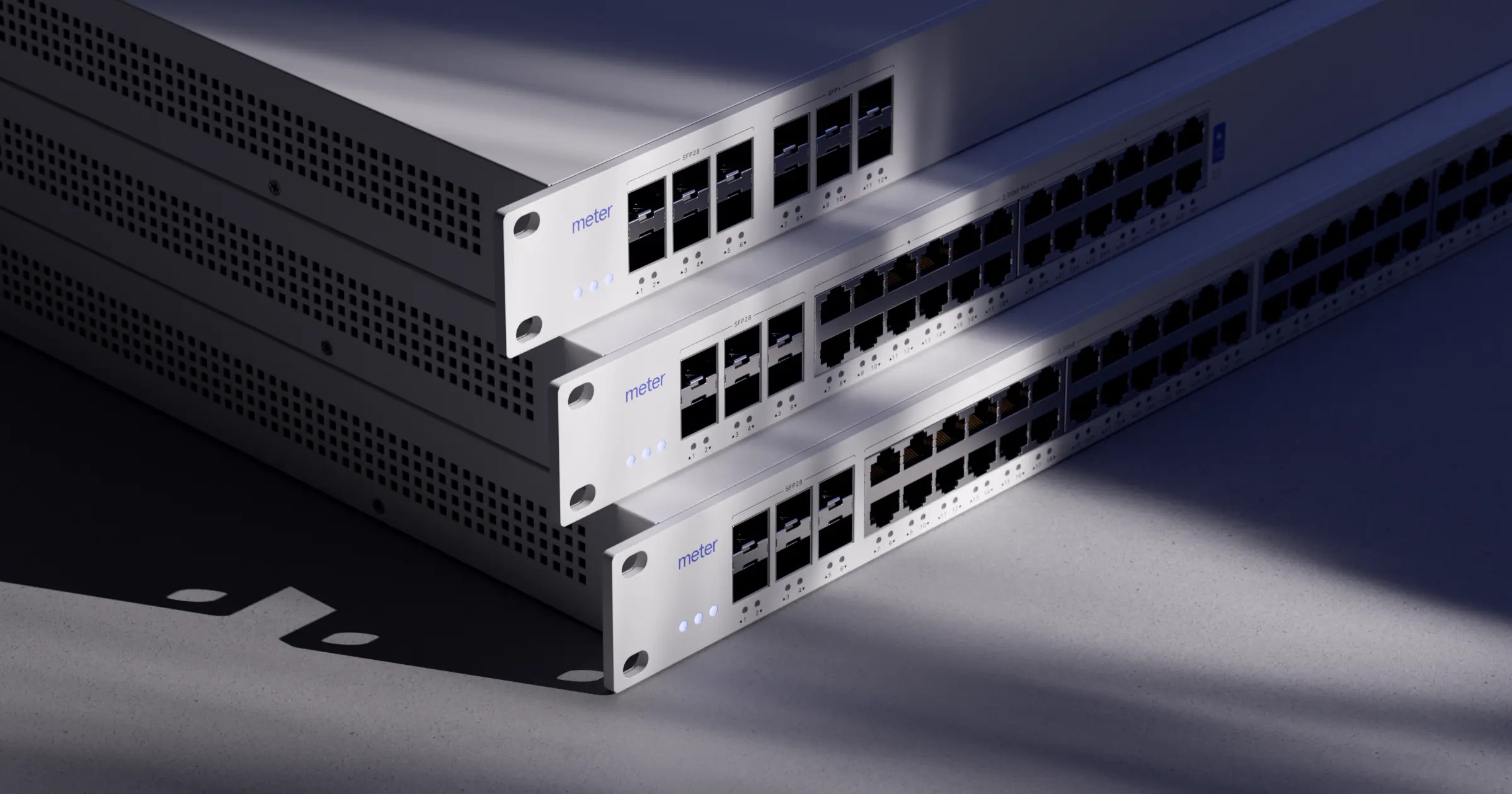
Meter is not an internet service provider. It arranges and manages the ISP relationship, while supplying the local network that distributes connectivity through the building. Its equipment includes firewalls, switches and wireless access points. Its cloud dashboard gives IT teams visibility and controls; its operations team handles design, deployment, monitoring and maintenance. Meter Command adds a natural-language interface that can answer network questions and assemble custom dashboards. Meter Cellular extends the offer to indoor mobile coverage.
The bill is unusually legible: a recurring charge based on square footage, adjusted for the work and contract term. Meter’s current Professional tier includes equipment, software, security, design, ISP management and support, while customers arrange their preferred installer. Premium adds Meter-managed installation and rollout. Hardware refreshes and routine support are included. Meter does not publish one universal price per square foot, so a useful comparison requires a site-specific quote and a full-life cost calculation.
The customer buys a working outcome across the equipment’s life, rather than a fresh shopping list whenever a device ages.
That is Meter’s distinction in a market crowded with capable equipment makers. Cisco Meraki, Aruba and Juniper can supply powerful network stacks; installers and managed service providers can put them together and keep them running. Meter tries to put the interfaces, hardware, installation economics and operating responsibility under one roof. The wager is that fewer seams mean fewer chances for a problem to ricochet between vendors.
The useful test is a customer’s headache
Consider Thumbtack’s 20,000-square-foot “Library” office. Its IT team priced a familiar combination of Aruba wireless gear and a Palo Alto Networks firewall. According to Meter’s customer case study, that hardware-and-installation quote was more than three times Meter’s upfront price. Over the life of the lease, Thumbtack reported threefold savings with Meter and an 80% reduction in on-call network tickets. Those are Thumbtack’s reported results for one project, not a promise that every office gets the same arithmetic.
The more interesting number may be the tickets. A cheaper box would merely improve a budget line. Fewer network interruptions give a small IT team its time back. Erik Wooding, Thumbtack’s IT systems engineering manager, put it plainly: “What I get the most excited about, the part I share in my community of network engineers, is the ease of use and peace of mind that Meter brings.” That is a narrower and more credible claim than saying a network can run itself.
There is another example in a sublease. When Pave made part of its Meter-equipped office available to AtoB, Meter created a separate wireless network and VLAN, with firewall policies that kept the tenants apart. The new occupant did not need another pile of boxes. This is the building-as-utility idea in miniature: network infrastructure stays useful even when the names on the doors change.
First the hardware, then the hand-drawn map
A company that promises to absorb complexity cannot afford to export its own mistakes to the installation crew. Meter’s 2026 engineering account describes a telling bottleneck: deployment engineers had been drawing network topologies by hand in Lucidchart. A complicated school campus could take tens or hundreds of hours. A changed requirement meant relabeling downstream devices and reconciling a static diagram against a live system. A wrong port or surplus device could delay shipment and installation.
Meter’s response was a rules-based topology designer in its Dashboard. An engineer enters the site’s needs, including hardware counts, port demand and ISP handoffs. The software generates the network and power layout, wiring labels and rack plan in seconds. Meter says fewer than one percent of generated topologies need changes afterward. This is a useful lesson for any service company selling simplicity: write down the experienced operator’s decisions, make them testable, and let software handle the repetitive drawing.
“Until recently, our deployment engineers created network topologies by hand in Lucidchart.”Meter engineering, September 2026
Command, Meter’s AI-flavored interface, gets more attention because a network you can question in plain English is an easier demonstration. The topology designer reveals something deeper about its expertise. Meter’s advantage depends on knowing what should be installed before anyone asks a chatbot what went wrong. The physical network has to be right first.
A landlord enters the room
Meter raised $38 million in a 2022 Series B, added $35 million in 2024, and announced a $170 million Series C in June 2025 led by General Catalyst. The later round reportedly valued it above $1 billion. The money has helped widen the offer and the routes to market: partnerships with Microsoft, Lumen and distributors; an in-building cellular product; a $100 million partner fund announced in 2026. The San Antonio Spurs also chose Meter for wired and wireless infrastructure at their venues. Meter says it now covers tens of millions of square feet.
Its March 2026 acquisition of WiredScore makes the original ambition easier to see. WiredScore grades buildings for digital connectivity; Meter builds the network serving occupants. The acquired company is to remain independent as a rating business. For Meter, the deal creates a bridge from the tenant’s IT closet to the landlord’s decision about what a building should already provide. For a prospective tenant, the interesting question becomes less “Which access points shall we buy?” and more “Does this place work on day one?”
The model is not equally compelling everywhere. A company with a sunk investment in working network gear, specialist staff who need direct control, or a tiny space with modest demands may find a conventional purchase cheaper. A complicated building still needs cabling, carrier availability and a real site survey; a subscription cannot wish away construction. And because Meter quotes by scope, a buyer should compare the whole contract term, service levels, installation responsibilities and exit terms against the ownership alternative.
Yet Meter’s question travels well beyond networking. Which parts of a workplace are so essential that asking every new occupant to build them from scratch has become a kind of inherited nonsense? Electricity settled the matter long ago. Office internet is still arguing with the installer.