A warehouse is a terrible place to guess. In the L’Oréal facility described in Ekahau’s customer story, aisles stretch beyond 100 meters, ceilings rise to 13 meters, and metal shelves hold liquid products. An inventory scanner moving through that landscape needs a connection that follows it. The building has several opinions about how easily this should happen.
Ekahau gives engineers a way to investigate those opinions. It makes software for planning wireless networks and hardware for measuring what the radio signals actually do. Its customers include enterprise IT departments, consultants and systems integrators responsible for offices, hospitals, hotels, universities and industrial sites. Their problem is wonderfully unglamorous: people expect the network to work wherever their work takes them.
- Design before installation: model access-point locations, coverage and capacity requirements.
- Measure the building: collect Wi-Fi and interference data with Sidekick 2.
- Reuse the evidence: optimize existing equipment and plan upgrades from survey data.
- Budget for the workflow: the full software suite and hardware start at $7,490 for year one at published US prices.
The supporting tool gets the leading role
Ekahau began in 2000 with University of Helsinki research. Henry Tirri, Petri Myllymäki and their colleagues worked on probabilistic methods for positioning. The company’s eventual Wi-Fi specialty had roots in machine learning long before “AI” became a fashionable addition to a product name.
The early cellular-positioning opportunity weakened after the technology bubble burst. Ekahau turned to indoor Wi-Fi tracking. Then an internal survey tool became a commercial product: Ekahau Site Survey, launched in 2003.
According to investor Nexit’s retrospective, the tracking market disappointed. Financing in 2013 diluted nonparticipating shareholders; a subsequent cost-cutting effort reduced staff from about 100 to just over 50. Ekahau sold its tracking business to AiRISTA in early 2016, leaving 32 employees in the focused survey company. Ookla bought that company in October 2018.
Calling this a clever pivot leaves out the bill. Fewer jobs and diluted ownership financed the change. The useful business lesson is narrower: look at the tool customers already use, even when the original plan gives it a supporting role.
The building has a vote
Consider the decisions involved in a new wireless network. An engineer must choose access-point models, locations, antenna orientations and channel settings. A floor plan gives the room dimensions. It does not, by itself, provide all the information needed to predict radio behavior.
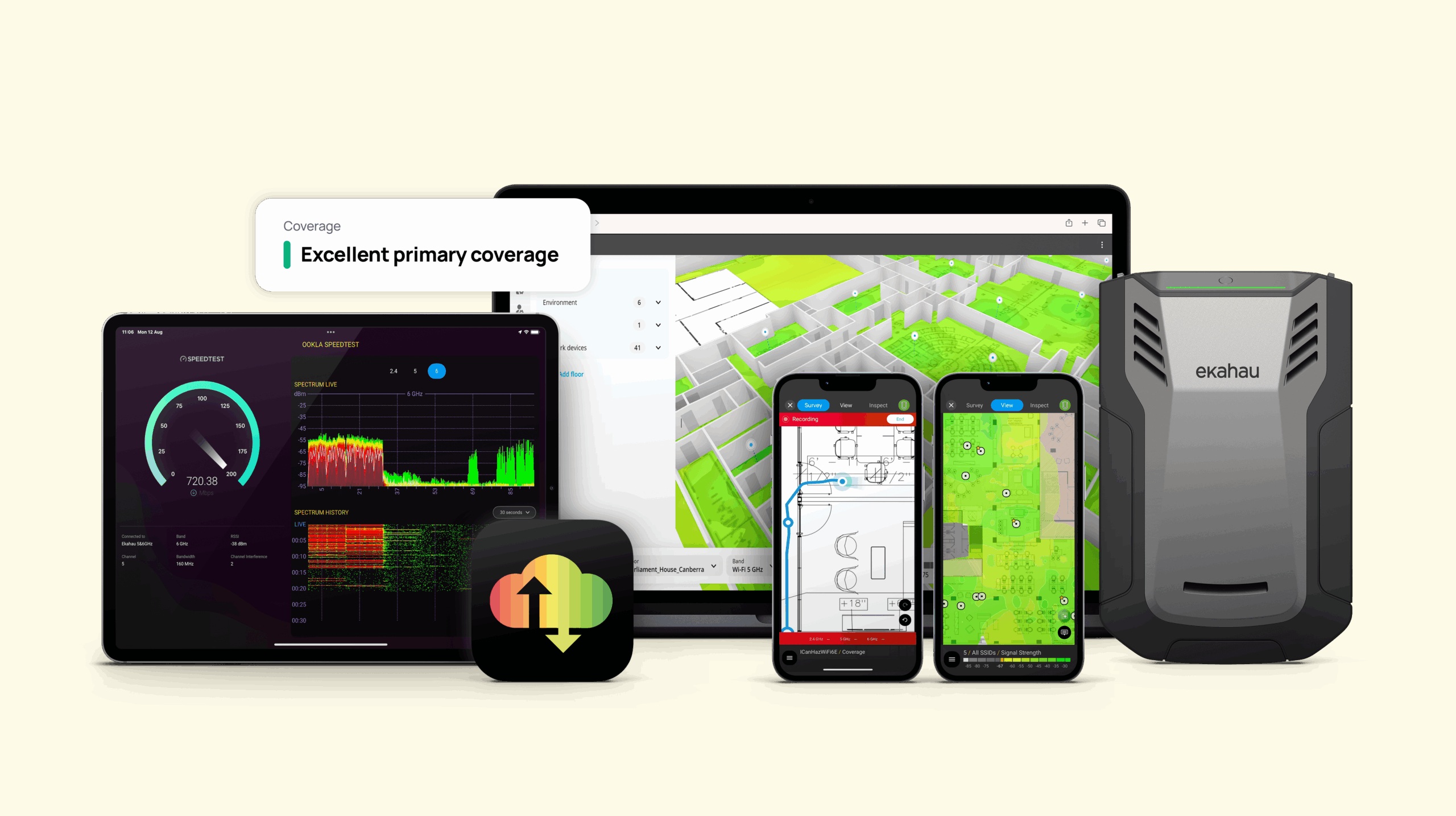
AI Pro and AI Pro Online help turn those decisions into a model. Engineers set performance requirements, select hardware and inspect predicted coverage and interference. The online product can detect walls and areas from imported plans, assist with access-point placement, and use collected survey data to construct an RF propagation model. It also supports planning for private cellular, Bluetooth Low Energy, Zigbee and ultra-wideband networks.
The attraction is practical. Move a proposed access point on the screen before arranging a cable run. Try an upgrade scenario before ordering equipment. Produce a bill of materials and an installation report from the design. This is where Ekahau fits in the market: between a building’s physical conditions and the equipment that will serve it.
Sidekick 2 supplies the measurements. Introduced in July 2022, it has four tri-band Wi-Fi radios, nine custom wideband antennas and a spectrum analyzer scanning at 50 sweeps per second. It covers 2.4, 5 and 6 GHz. The accompanying Survey and Analyzer apps let field staff collect data and investigate network conditions using mobile devices.
Sidekick 2’s measurement kit: 2.4 / 5 / 6 GHz
That combination explains why the hardware matters. A standardized, calibrated measurement device makes survey results more repeatable across teams and sites. Spectrum analysis helps reveal interference beyond ordinary Wi-Fi traffic. Analyzer adds client diagnostics and packet capture, including capture on up to four channels simultaneously. A help-desk complaint can become a specific engineering question.
One walk, three useful answers
L’Oréal’s warehouse case makes the workflow tangible. The team wanted reliable coverage, roaming for forklift inventory pickers, redundancy if an access point failed, and a design that supported 6 GHz. The facility covered more than a million square feet. Optimism would have been a poor surveying instrument.
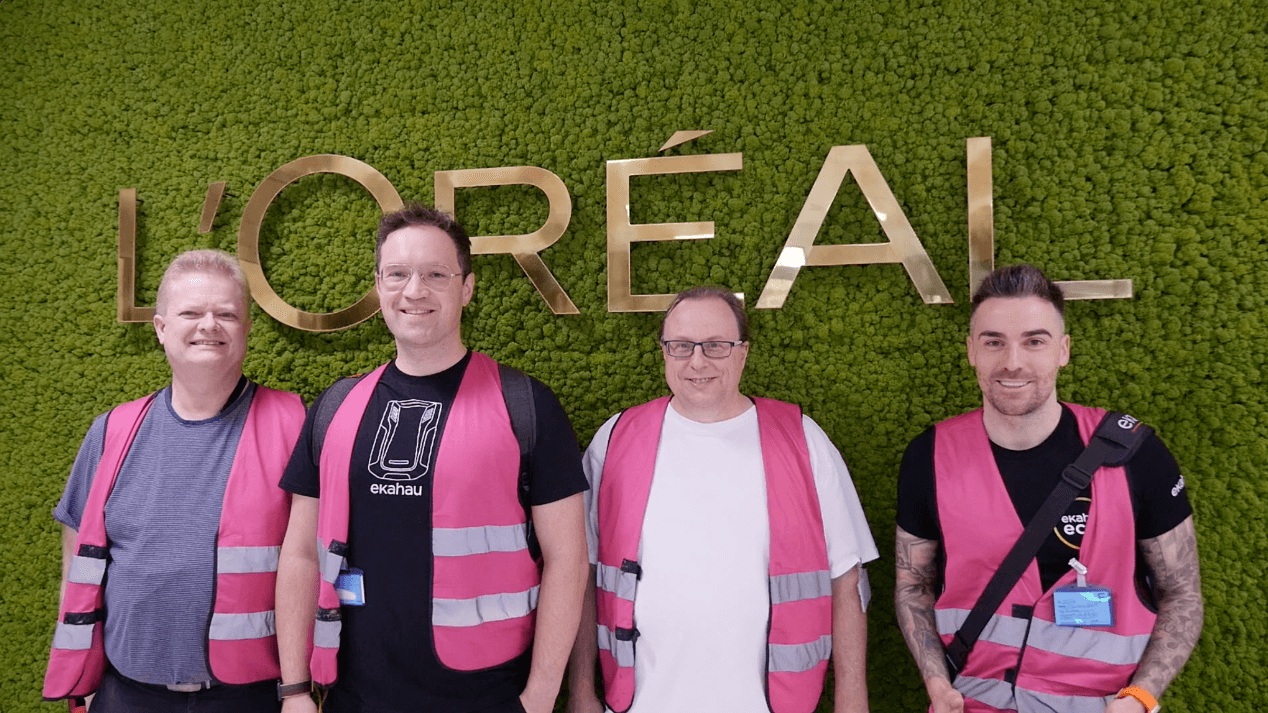
Staff walked the site with Sidekick 2 and collected existing radio conditions. They recorded primary and secondary coverage, attenuation and interference, while documenting constraints such as mounting heights and cable runs. Daan Piek, a technical support engineer, described his first attempt in admirably plain terms:
“I was able to capture accurate survey data my first time trying.”Daan Piek / L’Oréal technical support engineer
The collected data did three jobs. Optimizer exposed configuration changes for the existing network while an upgrade was being planned. The Meraki integration used measured access-point locations to populate the network map. AI Pro supported a new design using Meraki 9166D1 access points with directional antennas. Each use gave the survey another reason to exist.
L’Oréal’s published workflow. A process diagram, not a performance benchmark.
The price of looking properly
Ekahau’s business model charges for software, measurement equipment and training. Its current subscriptions also acknowledge that collecting measurements and interpreting them are different jobs. Plan serves designers and architects; Measure Pro serves field technicians. Shared cloud projects connect the people doing those jobs.
At the US prices published when this profile was checked, Plan costs $1,495 a year and includes design and optimization without measurement capabilities. Measure Pro also costs $1,495 a year and requires Sidekick 2. The combined Software Suite costs $2,495 a year. Sidekick 2 costs $4,995 separately.
Suite + Sidekick 2: $7,490 for year one, before taxes, training and other costs. Subscription costs recur.
The buying decision depends on frequency and responsibility. A team designing many sites may value a dedicated remote designer and local surveyors. A consultant handling the entire process may want the combined suite. A small office with an occasional complaint has a different calculation. Ekahau also offers perpetual AI Pro licensing with separate Connect subscription options.
Expertise remains part of the purchase. The four-day ECSE Design course combines wireless fundamentals with the tools. Advanced and troubleshooting courses extend that training. Ekahau’s careers page describes learning by doing, teamwork and remote work across international offices. Those are the employer’s stated values; the product’s dependence on skilled interpretation is visible in the workflow itself.
A model still needs a witness
Hamina’s planning and on-site survey tools are an alternative. The sensible comparison involves supported hardware, project workflow, vendor integrations and the engineers who will use the system. Ekahau’s distinctive proposition is the combination of its calibrated measurement hardware, predictive modeling, mobile diagnostics and configuration recommendations in one connected toolkit.
There are conditions under which that toolkit will disappoint. A predictive design based on incorrect dimensions or misunderstood materials can produce an attractive answer to the wrong problem. A survey measures conditions along a particular route at a particular time. An upgrade plan still needs validation after installation, and a troublesome client may require investigation beyond a coverage map.
The tools have explicit boundaries, too. Plan cannot collect Wi-Fi measurements. Measure Pro requires Sidekick 2. Some optimization features depend on survey data, and live remote analysis varies by access-point vendor. Teams should establish those requirements before procurement. Paying for the full suite will not make an unsupported integration appear.
A bigger home for a very specific job
On June 17, 2026, Accenture completed its acquisition of Ookla, bringing Ekahau into its network-intelligence portfolio alongside Speedtest, Downdetector and RootMetrics. The announced $1.2 billion transaction covered Ziff Davis’s Connectivity division. It was not a standalone price for Ekahau.
For a prospective user, the lesson from the warehouse remains more immediate than the ownership chart. Define what the moving devices need. Collect evidence from the building. See whether the existing equipment can improve. Then test the upgrade plan and check the installed result. The expensive mistake is allowing the purchase order to settle questions the survey should answer.
For a founder, Ekahau offers another question: which part of your company has already earned the right to become its future? Sometimes the answer is the modest tool you built while trying to sell something grander.
Go for a closer look
Explore the tools, watch the workflow, or follow the company.