A phone call is a merciless test of a network. A file can arrive late and still be a file. A sentence that arrives in fragments becomes a small social disaster. For an enterprise trying to substitute ordinary internet connections for expensive private circuits, this is where the spreadsheet meets the human ear.
- Silver Peak made enterprise applications work across imperfect WAN links.
- EdgeConnect combined traffic steering, routing and security, with optional acceleration.
- HPE acquired the company in 2020 in a deal announced at $925 million.
- The practical lesson: test application behaviour before buying bandwidth.
A phone call is a merciless test
At architecture firm LEO A DALY, network engineering manager Tim Heinzen had already experimented with commodity internet. Voice quality kept disappointing him. After evaluating Riverbed, Cisco iWAN and Silver Peak, the firm chose EdgeConnect, whose path conditioning helped make calls over broadband acceptable. Orchestrator’s view of traffic also influenced the decision.
The December 2018 vendor case study reported a 40-fold improvement in branch-to-branch throughput and a 45% reduction in monthly WAN costs. Those are one customer’s reported results, not a promise for the next buyer. The revealing detail is what changed Heinzen’s mind: cheaper connections became useful when their behaviour improved.
The cloud moved. The network had to follow.
David Hughes founded Silver Peak in 2004. Its original territory was WAN optimization: helping data and applications travel more efficiently between distant locations. The enterprise customer already had a network; Silver Peak improved what could be done with it. That put the company close to the friction of everyday computing, where slow transfers and troublesome connections turn into support tickets.
By 2015, Hughes was describing a broader opportunity. Applications were moving into the cloud, while software was changing how networking products could be deployed. Silver Peak launched EdgeConnect in June that year, adding a branch-connectivity product family alongside its optimization business. This was an expansion of its ambition, built on a problem its engineers already knew.
“Helping people with their WAN challenges is where I see us going forward.”David Hughes / 2015 Network World interview

The distinction matters. Accelerating traffic on an existing network solves one class of problem. Helping a company decide how to connect its branches solves another. EdgeConnect gave Silver Peak a role in the architecture of the network itself. For a buyer, the conversation could now include transport choice and control as well as speed.
Three jobs, one edge
The product names can sound like the cast of an industrial opera. Their jobs are more straightforward. EdgeConnect sits at the network edge as a physical or virtual appliance. Orchestrator lets administrators manage the fabric and its policies centrally. Boost, now described in HPE’s portfolio as optional WAN optimization, adds acceleration where the workload justifies it.
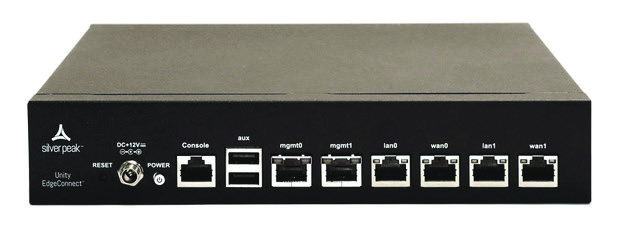
HPE’s current solution description explains the central idea through Business Intent Overlays. Administrators group applications and give those groups different requirements. The overlay specifies priorities, service quality, transport choices and topology. EdgeConnect then steers traffic across the underlying connections, which can include broadband, MPLS and cellular service.
Path conditioning addresses dropped packets and packets arriving out of order. Tunnel bonding makes multiple connections available within a logical overlay. Together, these features help explain why the proposition goes beyond connecting a second internet circuit. The administrator is choosing how applications should behave when the underlying links misbehave.
Orchestrator provides the interface for configuring gateways, applying policies and inspecting network statistics. That makes this an enterprise operations product. Its natural customers are distributed organizations and service providers responsible for many locations, application requirements and changes. It is particularly relevant when the branch network has become difficult to manage as applications spread across cloud and on-premises environments.
The bill has more than one line
Silver Peak sold through partners, and deployments could combine appliances, software and outside expertise. Today, HPE’s reference design describes per-gateway subscription licensing with terms of one, three, five or seven years. Buyers choose a feature tier and bandwidth allowance; optional WAN optimization adds another purchasing decision. A cheaper carrier connection does not make those costs disappear.
First Bank supplies a useful example of the arithmetic. Partner Secure Data Technologies described an EdgeConnect deployment across 168 sites using DSL, broadband and LTE in place of MPLS. The reported available bandwidth increased from 3 Mbps to 200 Mbps. The case projected $1 million in annual savings against the previous MPLS network. Projected savings belong in a forecast, not in the column marked cash already recovered.
TCV’s strategic investment in 2018, backing Silver Peak’s expansion before HPE’s acquisition.
The investment illustrates the commercial stakes. Silver Peak’s announcement said the money would accelerate its go-to-market expansion. Contemporary reporting also described investment in sales, the channel, support and research. Selling a network change requires more than a clever appliance: someone has to size it, deploy it and support the customer when an ordinary Tuesday becomes an incident.
A specialist joins a larger house
HPE announced the Silver Peak acquisition in July 2020 and completed it on September 21. The announced transaction value was $925 million. HPE’s later financial reporting put acquisition-date fair value consideration at $879 million, a separate accounting measure. Neither number is a subscription price or a tally of venture capital raised.
The strategic fit was concrete. Aruba already served campus, branch and remote-worker networking needs. Silver Peak brought its SD-WAN and optimization capabilities into that portfolio. Hughes joined as senior vice president of the WAN business within Aruba. HPE was buying both technology and an established way of approaching the enterprise WAN.
Before the acquisition, Silver Peak announced Leader placements in Gartner’s 2018 and 2019 Magic Quadrants for WAN Edge Infrastructure. That recognition helped establish its market position. It does not settle an individual purchase. The more informative comparison is the customer evaluation: what happened to real applications, what operators could see, and what the deployment cost.
Borrow the experiment, not the promise
A buyer can copy that method. Select a troublesome application, establish its baseline and test it under congestion, packet loss and a failed link. Include the people who take the calls when performance deteriorates. A successful demonstration should reveal what changed, including any capacity spent protecting traffic and any extra licenses needed to deliver the result.
HPE’s overlay design guide makes one tradeoff unusually explicit. Its high availability bonding policy sends a copy of each packet on another transport through 1:1 forward error correction. The guide says this reduces effective bandwidth to 50% and recommends the policy for real-time traffic. Reliability has a bandwidth cost; applying the same treatment to every workload would miss the point of application-specific policies.
There are physical limits, too. Two circuits sharing a vulnerable route may fail together. Software cannot make a disconnected site connected. As a purchasing inference, a small operation with simple traffic and satisfactory existing connectivity may have little reason to add a separately managed SD-WAN platform. The question is whether its actual problems repay the equipment, licensing and operational effort.
Security also needs a design. Zscaler publicly demonstrates an integration between EdgeConnect, Orchestrator and Zscaler Internet Access. That is a useful example of the wider ecosystem around the product: steering traffic and inspecting it can involve several systems. Buyers need to determine which policies run at the branch and which services inspect traffic elsewhere.
The name changed. The work continues.
HPE’s current documentation identifies EdgeConnect and Orchestrator as formerly Silver Peak products. In September 2026, it published the Orchestrator 9.7.1 user guide; earlier that summer it added guides for ClearPass and SD-Branch integration. The acquisition is part of the history. EdgeConnect remains part of the present product portfolio.
Silver Peak’s useful insight survives the corporate name change. A network earns its keep through the applications people can use on it. Buying more capacity is one answer. Deciding which traffic matters, managing imperfect paths and proving the result under stress can be a better place to begin.