A grocery store is an unforgiving place to discover that your computing system is interesting. The queue lengthens. The cashier waits. Somewhere, an IT manager receives the sort of call that makes every other item on the calendar look wonderfully optional. Scale Computing sells infrastructure for businesses that would prefer their technology to be less eventful.
- Local applications, distant specialists. Scale combines storage, computing and virtualization for stores, branches and other sites with limited IT staff.
- Fewer moving parts to manage. HyperCore runs the cluster; Fleet Manager gives teams a view across locations.
- A wider business since 2025. The Acumera combination added managed networking, security and application orchestration.
The server room meets the shopping trolley
Jeff Miller, director of IT at Jerry’s Foods, liked what he saw when he encountered a demonstration of hyperconverged infrastructure. There was one difficulty: the equipment was too large. His reaction, recalled in a 2020 Network World interview, was wonderfully practical.
“I thought, ‘that’s perfect, except I need it about 10 times smaller.’”Jeff Miller · Jerry’s Foods
The eventual answer was Scale’s HE150, a compact appliance built around Intel NUC hardware. An Intel case study described a retailer with 50 locations and five full-time IT staff. That is a revealing ratio. Buying another system does not buy another person to understand it.
Size mattered because the infrastructure had to live in shops. Simplicity mattered because the people responsible for it were elsewhere. A rack that is perfectly reasonable in a data center can be a rather demanding houseguest in a grocery store.
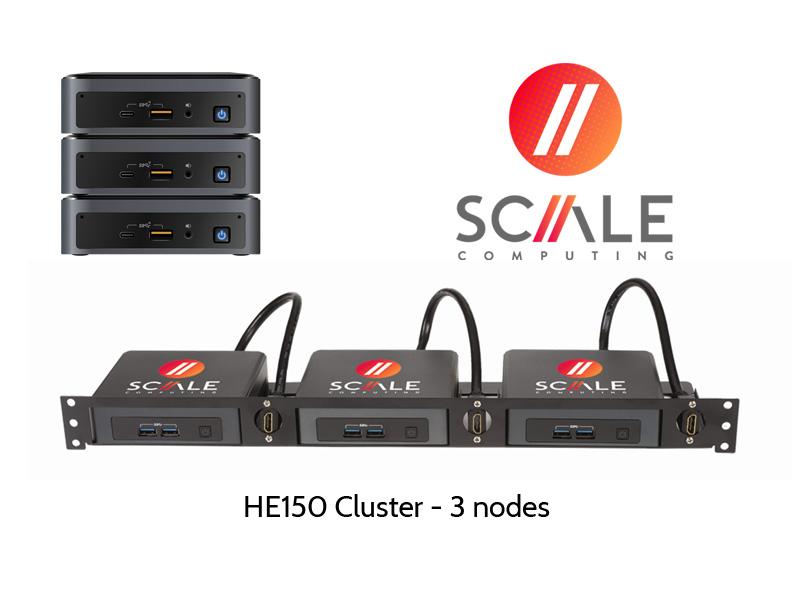
The company’s appeal starts here, with the physical and staffing conditions under which technology actually gets used. It serves organizations that need applications close to the work, but cannot put an infrastructure specialist beside every checkout, classroom or branch office.
Three jobs, one set of machinery
Virtualization lets several software-defined computers share physical hardware. Hyperconvergence brings the storage and computing into the same coordinated system. Scale’s HyperCore uses a KVM-based architecture integrated with its SCRIBE storage layer, rather than requiring a separate VMware hypervisor and shared storage system.
For a buyer, the attraction is having fewer systems to configure and reconcile. The cluster pools resources. The platform includes snapshots and replication, and automates parts of infrastructure maintenance. Scale’s documented design also allows differently sized appliances to coexist, giving customers a way to expand and replace equipment without rebuilding everything at once.
HyperCore cluster
HyperCore cluster
HyperCore cluster
Manage the fleet centrally. Keep the work close to where it happens.
Fleet Manager is the cloud-hosted management layer. That distinction is useful: a cloud dashboard does not mean every application has moved into a remote cloud. Scale’s security documentation says HyperCore does not require Fleet Manager communication to function or take self-corrective action.
Local infrastructure therefore has a role even in an organization enthusiastic about cloud services. Applications can run where the business needs them, while administrators supervise multiple clusters from elsewhere. The architecture separates the location of the work from the location of the person managing it.
The second box was the better lesson
Delhaize offers a more instructive example than a tidy product demonstration. Its stores had accumulated equipment for different jobs. The retailer selected integrated infrastructure developed with Scale and Lenovo, tested it in stores and began a rollout in 2018. The project later won a DCD Award in 2021.
The first “1-Box” design combined three servers and a firewall in a compact rack. But franchises introduced another constraint: even that rack could demand too much space. The design changed. Smaller HE150 appliances replaced traditional rack servers; a physical Fortinet firewall replaced the virtualized F5 arrangement, and its ports removed the need for separate switches.
Test the actual store.
Evaluate applications before committing to a rollout.
Change the footprint.
A successful design still has to fit the next location.
Remove another box.
Consolidate only where the replacement does the required job.
What gave way first was the assumption that the original arrangement would suit the next group of stores. This was a redesign prompted by operating conditions, not a documented collapse of HyperCore. The distinction matters. A sensible procurement process permits a successful prototype to be revised.
The transferable idea is to standardize the outcome, then test how much of the hardware can be standardized. Shops differ. A system that looks elegant in a lab still has to accommodate awkward cupboards, existing applications and people whose primary occupation is selling groceries.
Count the visits, not just the cores
Scale’s cost argument includes the labor attached to infrastructure. In Intel’s Jerry’s Foods case study, the retailer reported a 50% cut in cost per instance and estimated a 50% reduction in time spent managing infrastructure. Those are results from a particular deployment, not a price promise for every customer.
Lower cost per instance
A customer result. Hardware, workloads and comparison baseline affect the outcome.The bill for a new deployment has more entries. Scale’s published licensing comparison describes annual subscriptions, one-, three- and five-year terms and a per-core metric, with differences by edition. Hardware, support, migration and external software rights belong in the calculation too. Its NVIDIA licensing FAQ explicitly separates HyperCore from licenses for Microsoft, Oracle and NVIDIA software.
The comparison is consequently about a complete operating arrangement. VMware, Nutanix, Microsoft and Proxmox offer alternative routes to virtualized infrastructure. A buyer has to compare the storage design, management effort, backup support and applications as well as the hypervisor. A cheaper line item can be an expensive weekly appointment.
Scale’s current Velocity Partner Program reflects that reality. Resellers and managed service providers receive training and certifications, with pricing incentives and deal protection tied to capability. The channel helps turn a software purchase into a designed, deployed and supported environment.
A company that changed the size of its problem
Founded in 2007, Scale first shipped scale-out storage in 2009. HC3 arrived in 2012, bringing storage, servers and virtualization together. The progression is telling: the company widened the set of infrastructure jobs it could take off the customer’s hands.
It also needed capital. Funds managed by Morgan Stanley Expansion Capital led a $55 million financing in July 2022. The stated uses included people, research and development, and debt restructuring. The company’s ambitions extended beyond putting another appliance in another server room.
On July 31, 2025, Acumera acquired Scale Computing. The combined company kept the Scale Computing name. This brought together virtualization with Acumera’s managed connectivity and security, and Reliant’s edge application orchestration. The backing came from Oaktree Capital Management.
The result is a broader portfolio. HyperCore and Fleet Manager sit alongside AcuVigil, Reliant and Connect. In September 2026, the company highlighted convenience and fuel retailers using that range: Royal Farms for infrastructure and fleet management, RaceTrac for Reliant. Scale reported that Royal Farms had increased deployment pace from 11-12 to 20-25 stores a week. Again, that is a company-reported customer outcome.
It is a coherent expansion of the original problem. A store needs computing, but it also needs applications deployed, networks managed and security maintained. Combining those capabilities creates more purchasing options; it does not mean every customer needs the whole collection.
Rehearse the Tuesday nobody wants
A useful pilot should include an ordinary day and an unpleasant one. Run the applications, exercise the backup process, remove a node under controlled conditions and measure recovery. Check which operations need connectivity. Decide what a store employee can realistically do when the remote team asks for help.
That is editorial advice rather than a claim about a particular customer’s test. It follows from the job being purchased: continued service with limited local expertise. A working virtual machine proves less than a checkout application restored within the business’s tolerance for disruption.
Compatibility deserves the same attention. Veeam supports HyperCore through a plug-in, but its September 2026 documentation specifies supported platform versions and additional requirements for application-aware processing. Buyers should match their actual software versions and restore needs. An integration logo is a starting point for that conversation.
Compact local infrastructure fits some workloads better than others. Heavy video storage, demanding computation or specialized application requirements may call for a larger configuration. Local redundancy also cannot substitute for a separate disaster-recovery plan when an entire site is lost.
The useful thing to copy from Scale’s retail story is the discipline of reducing the work around the work. Choose where applications belong. Test the environment they will inhabit. Count the effort required to keep them there. A supermarket has quite enough interesting things in it already.
Explore the machinery
Products, practical demonstrations and the people building them.