In enterprise storage, the sales pitch usually arrives on a pallet. A faster array, a larger chassis, a fresh maintenance contract - and an awkward migration away from the expensive machine bought a few years earlier. DataCore Software has spent nearly three decades arguing that the pallet is not the point. Put software above the hardware, it says, and old Dell, HPE, IBM or NetApp equipment can sit beside whatever comes next. The customer gets one pool, one set of data services and a little more leverage when the vendor calls with another refresh proposal.
Founded in Fort Lauderdale in 1998, DataCore was early to commercial SAN virtualization. Its flagship SANsymphony platform sits between applications and physical storage, presenting virtual disks while handling caching, tiering, replication, failover and migration underneath. That abstraction is the company’s real product. The hardware can change; the control plane remains.
The disaster nobody noticed
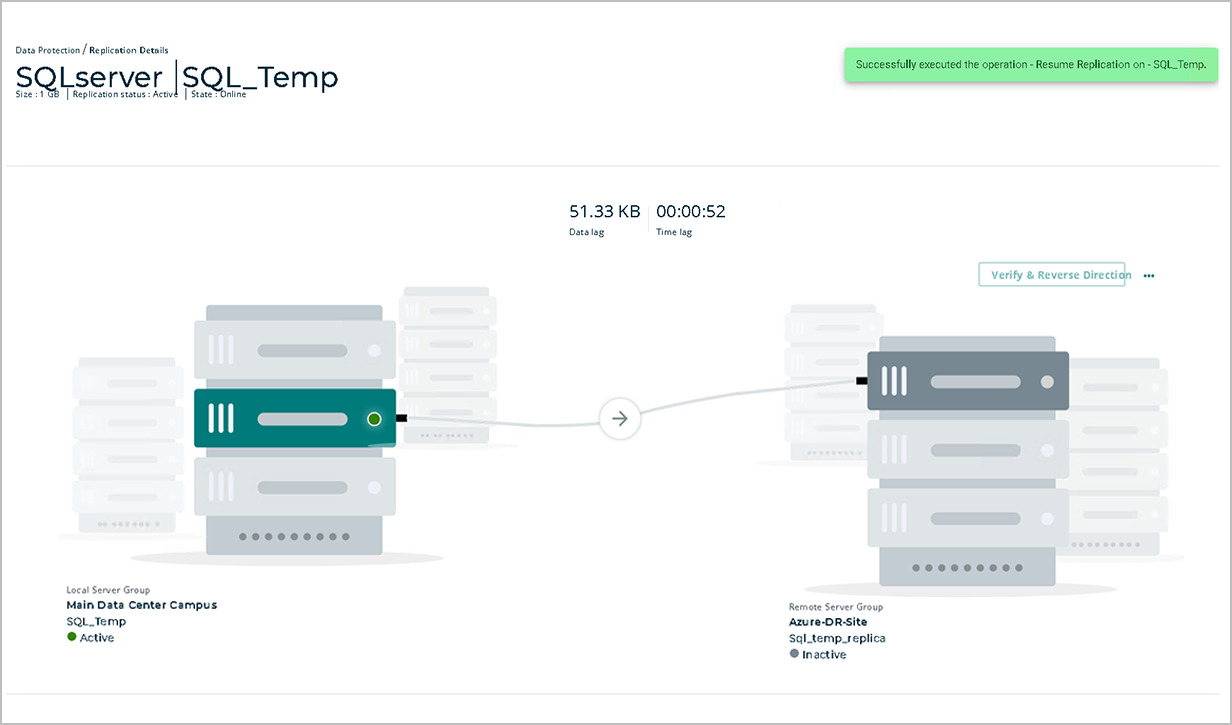
The cleanest explanation comes from Carmel, Indiana. The city runs more than 80 virtual servers for departments including police and fire. Its VMware environment stretches across two sites, with DataCore nodes mirroring data between them. According to the city’s published case study, a construction contractor once cut fiber. Access shifted to the second site and ordinary users did not know there was a problem. The first thing to fail was physical connectivity; the storage service did not follow it down.
“If one site goes down, the city can still function, and end users don’t even know there is a problem.”Rebecca Chike, systems supervisor, City of Carmel
The same deployment answers the money question with unusual specificity. Carmel says extending equipment from the normal five-year cycle to eight or nine years saved an estimated $75,000 in hardware costs. That is not the price of DataCore, which the company does not publish as a simple menu. SANsymphony uses term licensing that varies by managed capacity, edition and support. It is the cost avoided: one refresh cycle deferred for more than 50 TB mirrored between two locations.
This is where DataCore differs from an array maker. Pure Storage, Dell, HPE, NetApp, IBM and Hitachi Vantara sell integrated systems whose software and hardware arrive together. DataCore’s historic advantage is promiscuity: it can pool unlike systems and let each generation retire on the buyer’s schedule. That freedom has a cost of its own. Another software layer must be designed, monitored and understood. A small team seeking a turnkey appliance or a fully managed cloud disk may sensibly choose simplicity instead.
One idea, five data shapes
DataCore is no longer only SANsymphony. A sequence of acquisitions widened the map. Caringo, bought in 2021, brought Swarm, an S3-compatible object store for archives, backup targets and large unstructured datasets. Object Matrix added media-archive expertise. The ArcaStream file-system business became part of the high-performance file push now represented by Nexus. StarWind, acquired in 2025, extended hyperconverged infrastructure to small businesses, remote offices and edge sites.
Block storage and HCI for mixed data-center hardware, with availability, acceleration and migration services.
S3 object storage for active archives, backups and long retention, including immutability and disk power-saving options.
Persistent Kubernetes volumes with NVMe performance, replication, observability and backup integrations.
High-performance file workloads at one end; compact edge and remote-office HCI at the other.
Puls8 is the newest test of whether the original philosophy travels. Kubernetes treats containers as disposable, but databases and other stateful applications need their data to persist when pods move or fail. Puls8 provisions and replicates volumes through Kubernetes APIs and adds snapshots, encryption, metrics and backup workflows. The buyer is not necessarily the SAN administrator anymore. It may be a platform engineer who expects infrastructure to be declarative.
What changed the buyer’s mind
TodoEnCloud, a Spanish cloud provider, offers a useful comparison. Its managed Kubernetes service spans three data centers and supports electronic signatures, document automation and AI workloads. In DataCore’s case study, standard NFS-based CSI drivers failed its IOPS and scaling requirements. Longhorn performed well in tests but was judged not ready for this production environment. Portworx was evaluated extensively and fell short on technical and operational consistency. Puls8 won the proof of concept.
The provider reported a 10 percent total-cost reduction against the alternatives and plans to expand from three data centers toward ten Kubernetes clusters. The detail worth copying is the proof-of-concept sequence. It did not buy a category promise. It wrote requirements around latency, availability, scaling and operations, tested several approaches, and kept the human support relationship in the decision. Infrastructure buyers should steal that scorecard, regardless of vendor.
Another customer, the City of Heidelberg, supplies the long view. It tested SANsymphony for six months around 2000. The original pool held just over 100 GB; the city now reports roughly 350 TB, more than five generations of storage hardware and three data-center moves without an operational interruption. Every two years, it says, alternatives are reconsidered. None has yet won technically and commercially. That is a better description of enterprise retention than “sticky”: the incumbent has to survive a recurring trial.
The expertise behind that retention is less fashionable than an AI demo and harder to fake. Storage software has to understand Fibre Channel and iSCSI, Windows and VMware, cache behavior, failure domains, recovery objectives and the unpleasant edge cases created when old firmware meets new equipment. DataCore’s value is partly accumulated operational memory: support engineers and partners have watched combinations of hardware fail in production for years. That also explains the conservative buyer. Hospitals, universities, city governments, manufacturers, media archives and service providers do not adopt storage because a dashboard photographs well. They adopt it when a proof of concept survives a pulled cable, a dead node, a maintenance window and the finance team’s spreadsheet. DataCore’s customer culture is built around that long audition.
The business behind the abstraction
DataCore sells B2B term licenses, generally shaped by capacity and product edition, with support and updates attached. For SANsymphony, price per terabyte declines as consumption grows; public-sector and education discounts are available. DataCore Insight Services, the analytics layer, is offered with annual or multiyear SANsymphony terms. The company routes much of the sale and implementation through resellers, integrators and service providers in its Freedom360 program.
That channel matters because heterogeneous storage is not a one-click purchase. Partners assess fabrics, servers, failure domains, backup tools and the hardware already sitting in the building. DataCore then cooperates with the very ecosystem it helps customers avoid depending on: Cisco, Dell, Lenovo, Microsoft, VMware, Veeam, Rubrik and others. Its site claims more than 10,000 customers, 99.6 percent customer satisfaction and an NPS of 73. Those are company-reported figures, but they explain the emphasis on training and support awards.
Growth capital has helped turn the product into a portfolio. Vistara Growth provided $60 million in July 2024. DataCore followed with the ArcaStream file-system deal and StarWind acquisition in 2025, then commercially launched Puls8 in January 2026 and a Swarm appliance in March. The strategic logic is clear: block, file, object, containers and edge, all under a “control your data” banner. The integration risk is equally clear. A broad catalog can become five separate products wearing one badge.
What readers can steal
First, build around the customer’s sunk cost instead of demanding a clean slate. DataCore turns yesterday’s hardware purchases into the reason to buy today’s software. Second, sell negotiating power. The ability to mix equipment is valuable even before a migration because it changes the next vendor conversation. Third, make resilience concrete. “High availability” is wallpaper; “a contractor cut fiber and nobody noticed” is a story an operations team can repeat.
Best conditions
Mixed vendors, valuable existing hardware, strict uptime, expensive migration, multiple sites and staff comfortable operating storage infrastructure.
Likely poor fit
A tiny clean-slate deployment, no storage expertise, cloud-native simplicity prized above control, or workloads satisfied by a managed provider’s standard disks.
The approach will not work everywhere. Software cannot rescue weak architecture, a single failure domain or undisciplined operations. Savings disappear if licensing and specialist labor cost more than the refresh being avoided. Object storage is not a drop-in replacement for every file system. Kubernetes persistence still demands testing under the buyer’s own failure and latency patterns. And if one integrated vendor already delivers acceptable economics, adding abstraction for its own sake is merely another thing to page someone about at 2 a.m.
DataCore fits between storage hardware and the applications that cannot afford to care which box is underneath. Its quiet achievement is keeping a 1998 argument relevant: hardware ages faster than data, and control should outlive the chassis. The company’s next challenge is proving that this argument stays coherent when the “chassis” is a Kubernetes node, an edge appliance or an archive spread across petabytes. Boring? Certainly. But boring infrastructure is often what keeps the exciting parts of a business open.