Somewhere in a dentist’s office, a laptop is refusing an update. At a small manufacturer, a server is filling up. An accounting firm has clicked something it should not have. The person responsible for all three problems may work miles away, at a managed service provider, looking at a screen that compresses dozens of clients and thousands of devices into a queue of colored warnings. N-able makes that screen - and much of the machinery behind it.
This is infrastructure with a low public profile and an expansive blast radius. N-able says its software delivers business resilience to more than 500,000 organizations and protects more than 9 million endpoints. Its direct customers are mostly managed service providers, or MSPs: outsourced IT departments that monitor networks, patch machines, answer help-desk calls, sell security and restore data for other businesses. N-able’s users are technicians. The beneficiaries are everyone trying to open a spreadsheet on Monday morning.
The company’s ambition has widened. Remote monitoring and management remains the foundation, but the sales pitch is now three verbs: manage, secure, recover. N-able calls the umbrella Ecoverse, an open platform intended to link endpoint management, security operations, data protection and third-party products. It is a bid to become the control plane for the full life of an incident, from shrinking the attack surface to containing an intruder to restoring the last clean copy.
The multiplication problem
An internal IT team manages one company. An MSP manages many, each with its own people, contracts, policies and peculiar old machines. That makes multi-tenancy more than a feature. It is the organizing fact of the business. A useful MSP platform must separate customers cleanly while letting one technician act across them: discover devices, deploy software, run scripts, find missed patches, document passwords, open tickets, start remote sessions and prove the work was done.
N-central serves larger, growing providers and complex estates. N-sight is positioned for smaller MSPs and IT departments that want to get running quickly. MSP Manager handles ticketing and billing; Take Control handles remote sessions; Passportal stores credentials and documentation. Mail Assure and DNS Filtering guard common entry points. Each is a tool, but together they answer the economic question MSPs live with: how can a fixed team care for more machines without turning every additional client into additional chaos?
“N-able is the foundation of our organization. It allows us to manage automation and efficiency, and to secure our clients effectively.”Scott Warner, N-able customer
Automation is the lever. N-able advertises more than 700 recipes that can be deployed without writing a script, alongside AI-assisted scripting for custom work. The mundane examples matter most: restarting a failed service, applying a patch, finding a configuration drift, opening a ticket when a backup misses its window. A technician who does not have to touch every machine can spend time on the exceptions. In managed services, that reclaimed attention is margin.
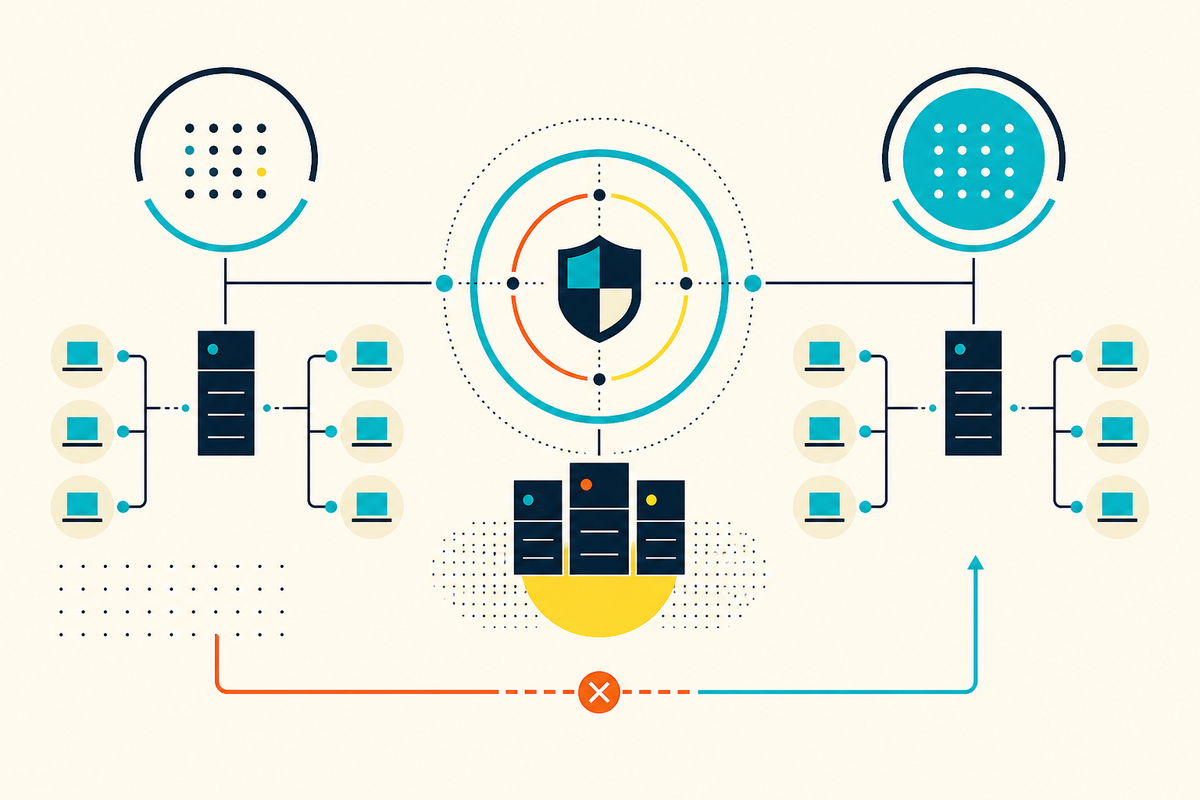
Before, during, after
Cybersecurity pushed the company beyond maintenance. Endpoint tools see machines continuously, which makes them natural places to harden configurations and spot vulnerabilities. N-central and N-sight can automate patches and deploy security software. N-able’s EDR product watches for malicious behavior. The 2024 acquisition of Adlumin added cloud-native extended detection and response, managed detection and response, and a round-the-clock security operations center. Cove Data Protection supplies the third leg: isolated, immutable cloud backups and recovery testing.
Reduce exposure
Inventory assets, harden endpoints, patch vulnerabilities and filter common attack routes.
Contain the threat
Correlate signals, investigate behavior and respond with automation plus a 24/7 SOC.
Restore operations
Recover servers, workstations and Microsoft 365 data from protected cloud copies.
The combination is N-able’s clearest point of difference. Competitors approach the market from different directions: ConnectWise and Kaseya have broad MSP suites; NinjaOne has gained ground in endpoint management; Veeam is a familiar backup alternative; Huntress, Sophos, CrowdStrike and SentinelOne compete across security. N-able argues for strong products across the incident lifecycle, connected through open APIs rather than a closed bundle. An MSP can use N-able’s core and still bring preferred third-party tools.
That openness is not philanthropy. MSPs inherit client technology rather than designing every environment from scratch. A platform that insists on purity is awkward in a market built from accumulated choices. N-able’s Technology Alliance Program connects companies including HaloPSA, ScalePad and Xurrent. Its Cat-MIP project, introduced in 2025 with a board that included HaloPSA, Auvik Networks, SecurityBiaS and ScalePad, attempts something more unusual: a vendor-neutral dictionary so AI systems and MCP servers interpret IT instructions consistently.
That sounds fussy until an AI agent confuses a vendor’s word for “device,” “customer” or “isolate.” In a chatbot, ambiguity is annoying. In a management console with permission to change thousands of machines, ambiguity is an incident. Cat-MIP is therefore a standards play disguised as vocabulary work - a useful thing others can borrow if the collaboration remains genuinely neutral.
A subscription engine with old roots
N-able began in Ottawa in 2000, founded by Mark Scott at a moment when “managed services” still needed explaining. SolarWinds acquired the business in 2013. Eight years later, its MSP division separated and reclaimed the N-able name, beginning independent trading on the New York Stock Exchange in July 2021. The corporate structure is young; the product lineage and channel relationships are not.
Those relationships produce unusually clean software economics. N-able recorded $511.4 million in 2025 revenue, up 9.7 percent. Subscriptions contributed $506.2 million, or 99 percent. By March 2026, annual recurring revenue had reached $548 million, up 11.2 percent from a year earlier. The company counted 2,710 customers producing more than $50,000 in ARR; together, that cohort represented roughly 62 percent of total ARR.
The model mixes hosted SaaS with self-managed deployments. Contracts may be monthly, annual or multi-year, and some services add usage revenue. This flexibility reflects the customer base: a small provider may value a low-friction entry, while a larger MSP needs deployment choice and predictable commitments. It also makes retention revealing. Dollar-based net revenue retention was 106 percent for the 12 months through March 2026, meaning the existing subscription base expanded after contraction and cancellations were included.
N-able had 1,863 employees at the end of that quarter. Its 2025 report describes a global organization - roughly half of annual revenue came from outside the United States, and about four in five employees were abroad. The culture turns the hyphen in its name into company values: “N-rich Lives,” “N-spire Others” and “N-joy the Journey.” The wordplay is cheerful enough to survive a corporate handbook. More concrete signals include employee communities, learning programs and two paid volunteer days; staff reported more than 3,000 nonprofit hours in 2025.
The credibility loop
A cyber-resilience vendor eventually has to demonstrate resilience in circumstances it did not choose. On July 31, 2026, N-able says its Adlumin MDR detected suspicious activity in a customer environment and identified exploitation of previously unknown N-central vulnerabilities. The company issued updates and, on August 10, urged customers to apply a second hotfix. The episode is not a side note to the platform story. It is the story under pressure: detection feeding investigation, disclosure feeding patching, customers deciding how quickly to act.
N-able’s own risk disclosures make the stakes plain. It competes in crowded categories, depends on subscription renewals and must integrate Adlumin without confusing customers or weakening its brand. An open ecosystem also creates seams. Every integration can save work, but each dependency must be governed. AI raises the same tension at higher speed: better automation can reduce toil, while an inaccurate instruction can propagate an error across tenants.
Still, the market position is coherent. Small and midsize businesses need enterprise-grade defenses but rarely have enterprise staffing. MSPs aggregate that demand. N-able supplies the management layer, security operations and recovery capacity that let one provider serve many organizations. It is enterprise software distributed through a channel, with each MSP effectively turning the platform into a local service.
That channel also changes how products spread. N-able does not need to persuade every veterinary clinic, law office or machine shop to build a security stack. It needs to help the provider those firms already trust package the tools into a service, price it and operate it profitably. Training, peer events and partner-success programs are therefore part of the product in practice, even if they never appear in a console.
The beneficiaries may never say “N-able.” They will notice that the patch installed overnight, the suspicious login was contained, the deleted folder returned and the help-desk technician already knew which laptop was calling. This is not glamorous work. It is repetitive, permission-heavy and easy to appreciate only after it fails. N-able has made a durable business from giving that work a system.