The cleanest way to understand Adaptiva is not through the vocabulary of cybersecurity, where every noun eventually acquires the adjective “autonomous.” It is through a deletion. When engineering giant AECOM combined operations after buying rival URS, its endpoint estate sprawled across roughly 1,500 offices in 150 countries. The conventional plan called for at least 1,200 additional distribution-point servers on top of 300 already in place. With Adaptiva's OneSite software, AECOM says it instead managed 85,000 endpoints from four primary Configuration Manager servers and ultimately removed the need for about 1,500 servers worldwide.
That is a satisfyingly physical result for a software product: fewer boxes humming in remote closets, fewer operating-system licenses, fewer machines to nurse. Adaptiva's founding insight was that a large company already owned a distributed computing network. It was hiding in plain sight on employees' desks. OneSite lets endpoints share software and patches with nearby peers, using spare memory, storage and network capacity while adapting traffic to local bandwidth. The endpoint fleet becomes part of the delivery infrastructure.
The original trick
Make the edge carry the boxes
Founder and CEO Deepak Kumar knew Microsoft's endpoint machinery from the inside. Before starting Adaptiva in 2004, he was among the designers of Microsoft's SCCM, later folded into Microsoft Endpoint Manager. His résumé has a few delightful left turns: he trained as a doctor, moved into computer science, earned five Microsoft-related patents and wrote a Thinkweek paper for Bill Gates that became Project Greenwich, an ancestor of Skype for Business and Teams.
The company began with the unglamorous physics of enterprise IT. Central management tools could tell thousands of machines what to install, but getting a large operating-system image or application package to a remote branch could choke a narrow link. The usual cure was another local server. That solved delivery while creating a second problem: server sprawl, with hardware, licenses, storage, maintenance and staff attached.
“Humans should define strategy and process, and software should do the rest.”Adaptiva's operating philosophy
OneSite's peer-to-peer architecture elects devices to source content locally and manages bandwidth so a deployment does not flatten the business network. Cloud Relay extends delivery to machines outside the corporate network. Smart Storage and what Adaptiva calls a memory pipeline are meant to keep large transfers moving efficiently. The proposition is not that servers are evil. It is that installing one at every branch is an expensive way to move the same bytes.
What broke first
The patch process became the bottleneck
Content distribution was only the first act. The more revealing customer stories begin when people enter the loop. AECOM had five deployment systems after its acquisition; software delivery was slow, reimaging one PC took about four person-hours and the wide-area-network impact was difficult to control. At an unnamed U.S. federal agency, manual health checks and delivery methods meant an urgent zero-day patch could take more than a month to reach a fleet of more than 215,000 devices. Vertu Motors' engineers spent over 10 hours each week on manual patching while trying not to interrupt sales staff across 190 dealerships.
The first failure, in other words, was not necessarily the patch file. It was the handoff: research the update, package it, decide who needs it, find an acceptable window, approve it, send it, watch it, chase failures and prove compliance. Automating only the final installation leaves a long queue of human errands.
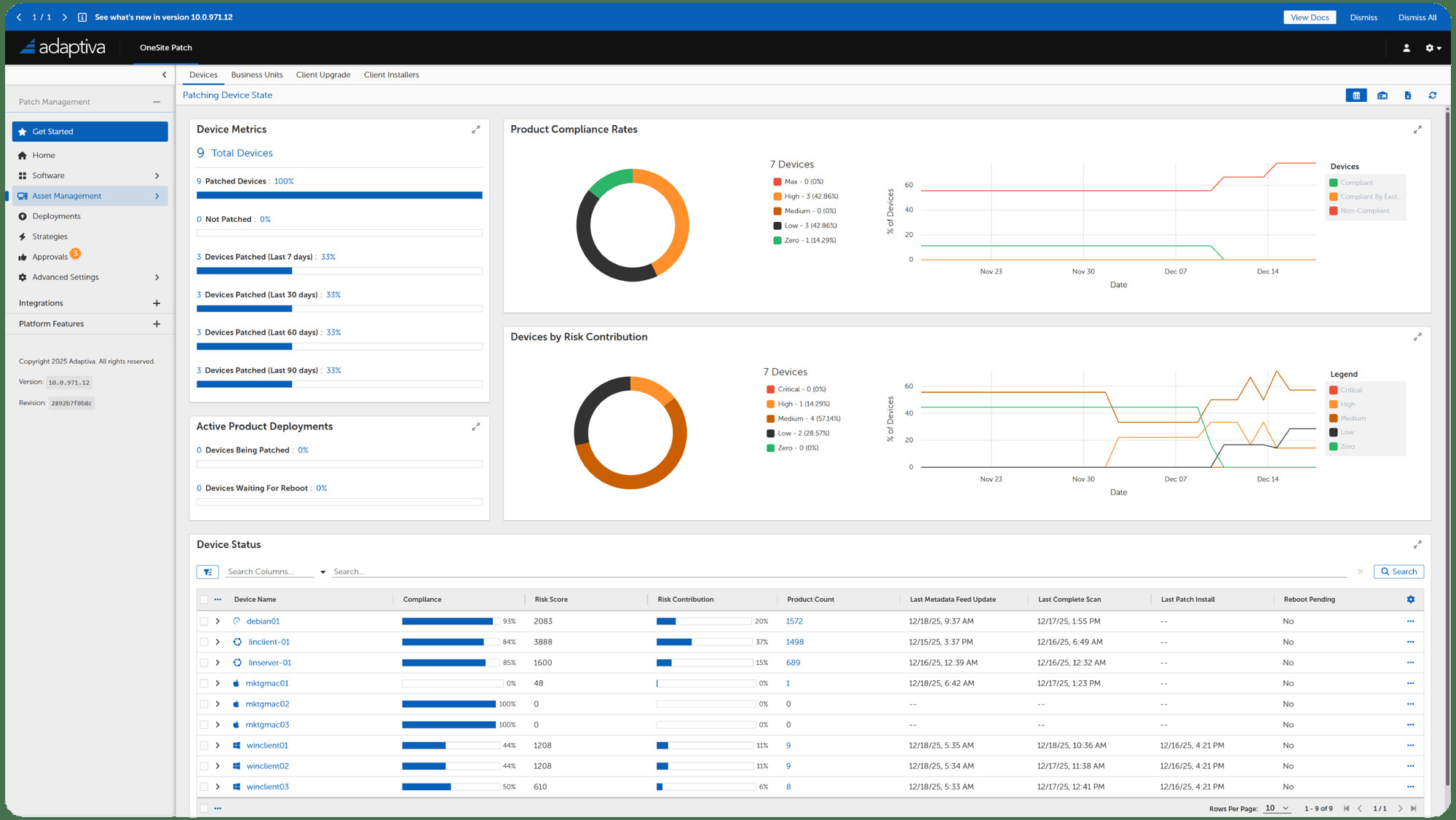
Adaptiva's answer was OneSite Patch, launched in 2022 and built to automate the whole cycle. Its catalog now covers more than 20,000 operating-system, application, driver, BIOS and firmware products. Adaptiva researches, tests and packages the content. Customers define strategies by business unit, urgency or exposure; deployments can move in phases through test groups; administrators keep approval, exception, maintenance-window, pause, cancel and rollback controls.
This is also what changed the company's market posture. Adaptiva stopped presenting itself mainly as a useful add-on for Microsoft Configuration Manager and put autonomy at the center. Kumar has described the tipping point as moving beyond isolated workflow automation to continuous endpoint management. The product now supports Windows, macOS and Linux and meets vulnerability platforms where they live. Integrations with Microsoft Defender, CrowdStrike and SentinelOne can turn exposure findings into prioritized action. Tenable went further in late 2024, selecting Adaptiva as the OEM engine for Tenable Patch Management.
What it costs
The price is a quote; the sale is avoided work
Adaptiva does not publish list pricing. It sells enterprise software directly and through resellers, managed-service providers and OEM relationships, with the commercial shape likely depending on selected products, endpoint count, support and deployment needs. That makes a universal dollar comparison impossible from public material. The company instead sells against costs already buried in the customer's estate: remote servers, WAN capacity, packaging labor, service tickets, patch delays and audit effort.
Its public case studies supply the arithmetic. The federal agency says OneSite Anywhere and OneSite Health removed 700 distribution points and 14,000 configuration boundaries, pushed patches to 90 percent of more than 215,000 devices in under four days and saved over $8 million across five years. Vertu Motors reports saving more than 10 engineering hours per week and moving critical patches in under 24 hours across 5,500 endpoints. These are customer claims published by the vendor, not controlled comparisons, but they reveal what buyers are meant to put into the spreadsheet.
The part worth copying
- Measure the whole remediation chain, not merely installation time.
- Turn policy into reusable rules before adding more automation.
- Roll out in rings, keep a kill switch and define when software must ask for help.
- Count the infrastructure and labor you can remove, not just the license you add.
Where it fits
Between the smoke detector and the sprinkler
The endpoint market is crowded: Microsoft Intune and Configuration Manager, HCL BigFix, Tanium, Ivanti, Automox, NinjaOne and ManageEngine all approach pieces of device management, patching or remediation. Adaptiva's sharper claim is architectural. It couples a peer-assisted delivery layer proven in very large environments with a policy engine that tries to close the gap between discovering a weakness and fixing it.
That bridge explains the partnerships. Exposure-management platforms are excellent smoke detectors. Adaptiva wants to be the sprinkler system that activates under a plan. Insight Enterprises uses OneSite Patch inside its Managed Endpoint service, where customers had been stuck on what an Insight executive called the patching “hamster wheel.” The catalog, customization and rules let the provider patch beyond a small core of applications without repackaging every update by hand.
In January 2026, Adaptiva was placed in the Leaders quadrant of Gartner's inaugural Magic Quadrant for Endpoint Management Tools. The company says more than 250 enterprise customers license its products across over 10 million endpoints, with environments ranging from about 40 devices to more than 400,000. That is meaningful scale. It also comes largely from the company and its commissioned materials; Adaptiva is private, discloses no valuation and has not announced conventional venture rounds. An outside estimate supplied for this profile puts annual revenue near $20 million, but the figure is not company-confirmed.
The new frontier
AI can answer. Air gaps still need a courier.
Adaptiva's 2026 additions show two different edges of the same problem. Aida is an AI advisor that lets administrators ask natural-language questions about patch posture, risk and compliance, then produce charts and reports. Adaptiva says the language-model microservice is controlled by the company and does not share customer data externally. For now, the clearest value is interpretation; the roadmap points toward mitigation and orchestration. The useful discipline is that the model sits on live endpoint data instead of pretending a generic chatbot understands the fleet.
AirGap for OneSite Patch travels in the other direction, into networks intentionally cut off from the internet. An offline server generates a simple request that can leave on USB media, an external drive or even as a handwritten note. An online server retrieves the patch packages; staff can inspect and scan them before carrying them back inside. Once imported, the usual policies, approvals and maintenance windows apply. It is automation with a deliberately manual airlock.
There are conditions where Adaptiva's playbook loses force. A small, cloud-only fleet with fat connections and basic application needs may not have enough server sprawl or bandwidth pressure to justify another platform. Peer delivery offers less advantage when devices rarely overlap on reachable networks. Highly bespoke software still needs testing and packaging outside any general catalog. And autonomous execution is dangerous when an organization has not defined device groups, ownership, rollback criteria or escalation boundaries. Bad policy delivered at machine speed is merely a faster incident.
“The decision to involve a human should itself be part of autonomous behavior.”Dr. Deepak Kumar, founder and CEO
That sentence is the grown-up version of “set it and forget it.” Adaptiva's product is most convincing not when it removes people, but when it removes the repetitive decisions that exhaust them and preserves the consequential ones. The customer can copy that distinction without buying a single license: establish the rules, instrument the result, automate the boring middle and keep interruption cheap. Adaptiva simply built an enterprise-sized machine to do it.