A computer can be perfectly serviceable and still find itself on the wrong side of a purchasing decision. The screen works. The keyboard works. What has changed is the work, the software bill, or the trouble involved in keeping the machine under control. AmZetta has built part of its business around that distinction. Before buying another computer, it suggests, consider giving the one you own a narrower job.
- Keep compatible PCs working. SnapOS turns them into centrally managed endpoints.
- Control the journey to the application. zWAN handles connectivity; zAccess handles private-resource access.
- Buy against a real workload. Storage, support, licensing, and network behavior belong in the same conversation.
That makes AmZetta an interesting company to examine when the glamour of a new machine has worn off. It sells the less photogenic parts of enterprise computing: endpoint software, thin clients, network equipment, access controls, and storage. These are the products people tend to discuss most urgently when something stops working. A useful way to read the catalog is as a sequence of questions. Where does the work run? How does the user reach it? Who controls that connection? Where does the data stay?
01 A second career for the PC
SnapOS is the endpoint operating system at the center of AmZetta’s current pitch. A thin client leaves much of the application work to another system and provides the user’s way in. AmZetta’s earlier SnapOS brochure explains the attraction of moving computational demands into a virtualized environment instead of repeatedly replacing the device on the desk. The desktop becomes an access point with a particular assignment.
Today, the company specifies x86-64 UEFI hardware or a virtual machine, with access to environments including Citrix, Omnissa Horizon, Microsoft Azure Virtual Desktop, and Amazon WorkSpaces. Its Windows migration tool offers two routes: replace Windows, or keep it alongside SnapOS during a phased transition. Keeping a familiar route available while testing a new one is a small concession to a large truth: employees still have work to finish during an IT project.
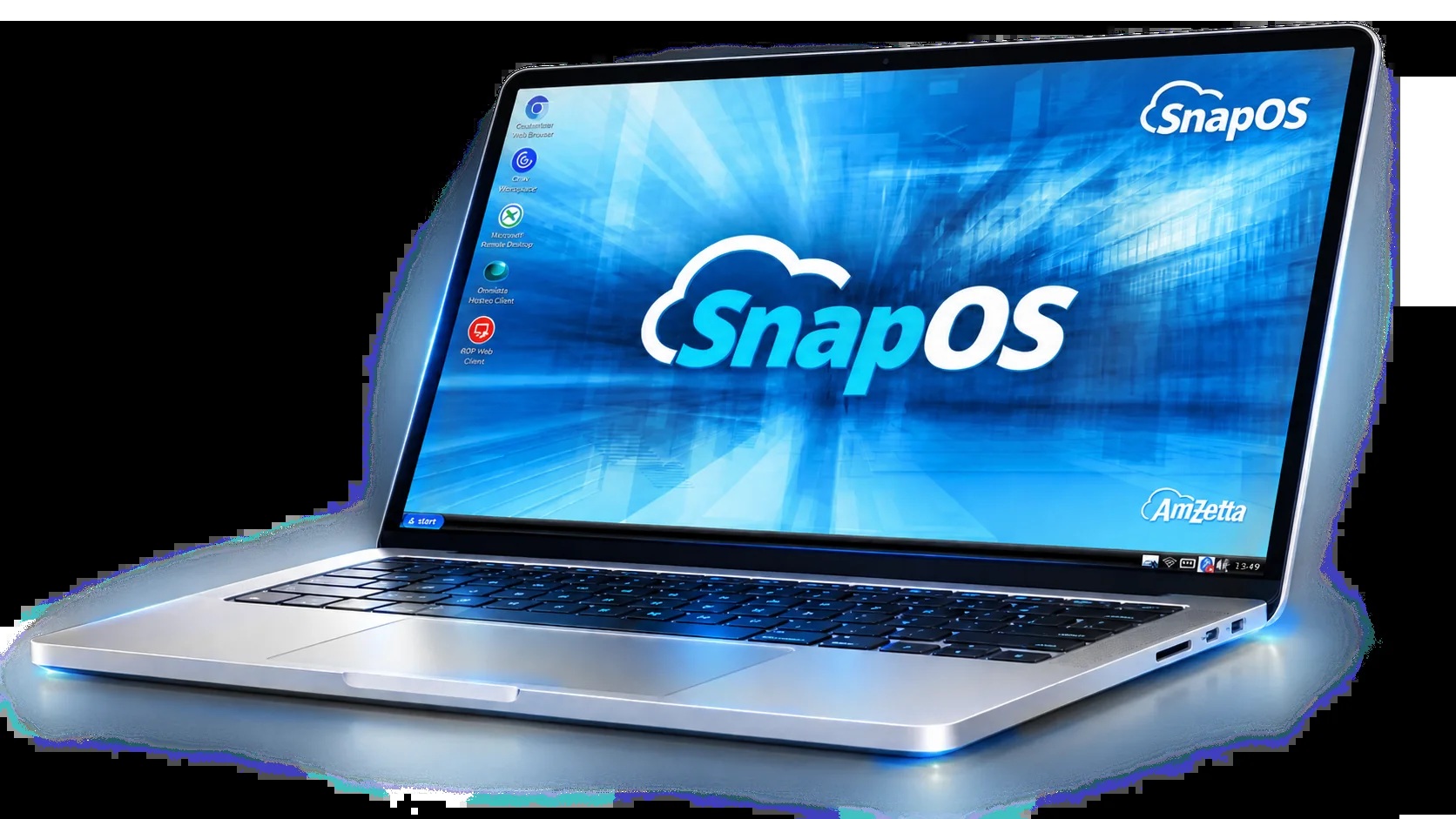
The audience includes organizations using virtual desktops, cloud workspaces, shared devices, and browser applications. The proposition is strongest when a general-purpose desktop has become more complicated than its job requires. It is weaker when the job still depends on local software or a peripheral that the new environment cannot support. Hardware age alone is a poor purchasing criterion. The work is the better one.
02 The console is part of the purchase
A connection client solves an individual user’s problem: reaching a desktop or application. Fleet management solves the administrator’s problem: making many endpoints behave consistently and helping the ones that do not. AmZetta’s zMAN Director handles that second job, covering configuration and fleet control. The company’s homepage lists enrollment, profiles, certificates, firmware, repositories, and remote diagnostics among its functions.
That distinction explains the commercial offer. zMAN Director comes with SnapOS under both licensing routes. A perpetual license is purchased once, with an annual maintenance contract required to keep updates and support active. Subscription terms run for one or three years, with the monthly fee covering licensing, management, and support. Prices depend on fleet size and term. The choice gives buyers two ways to arrange the expense; it still demands a calculation of the whole bill.
Perpetual license
+ maintenance for active support and updates
Monthly fee
License, management, and support bundled
AmZetta also sells zTC devices for buyers who want dedicated endpoint hardware. Windows and Linux options, remote support, and selected MiniPC-style models broaden the possible assignments. The practical question is whether standardizing a device makes the support routine simpler enough to justify buying it. A small box still deserves a serious evaluation.
03 The cloud has a last mile
Move the application away from the desk and the path to it becomes more important. This is where zWAN enters the story. The secure SD-WAN platform connects branches, remote users, clouds, and datacenters through centrally governed networking. Director sits at the management center. A physical Gateway Router serves a branch; a Windows-based virtual edge controller serves a remote user; a virtual gateway serves a cloud or datacenter hub.
Multi-WAN connectivity, traffic steering, load balancing, and LTE or 5G backup are among the advertised capabilities. Application policies can give voice, video, or business software a different priority from other traffic. Integrated firewall controls add another decision at the edge: which traffic should be allowed through at all?
There is a separate question of who operates the system. AmZetta offers managed, on-premises, and co-managed options. Its secure SD-WAN material describes MSP delivery for organizations handing off implementation and administration, and a co-managed arrangement involving AmZetta-hosted infrastructure with customer control and training. Ownership matters because someone must answer when the backup link becomes the only link.
04 Permission is smaller than a network
zAccess addresses a different boundary. A user may need one private application without needing broad access to the surrounding network. AmZetta positions the product around least privilege, using identity, device context, applications, location, and policy to shape access. The company lists client paths for Windows, Linux, Mac OS, Android, and iOS.
The distinction is useful for distributed workforces, application owners, and security teams. Networking provides a route; access policy decides what the person at the other end may use. Treating those as separate questions makes a pilot more precise. An administrator can choose one protected application and one group of users, then check permitted access, denied access, logging, and support. That is an editorial prescription grounded in the product’s focused evaluation approach.
05 A hospital bought a way out of a bottleneck
The most revealing customer example comes from storage. In a 2022 AmZetta case study, Apollo Hospitals needed a new array for its picture archiving and communication system, or PACS. This is infrastructure connecting diagnostic images and information with the doctors who use them.
The previous proprietary appliance had developed operational limitations. Upgrade and support costs were high; deeper support depended on resources outside India, while the local team was constrained by first-line support. Growth in facilities and data increased the pressure. Apollo’s requirements covered capacity, performance, and protection. The case study reports that StorTrends improved performance and operating costs while supplying dependable service.
It is a vendor account, so its reported benefits deserve that attribution. The purchasing lesson remains concrete: a storage appliance is also a relationship with the people who maintain it. A specification sheet can describe throughput. It cannot, by itself, settle how quickly a difficult support problem reaches the right engineer.
StorTrends spans unified block-and-file storage, NAS, and IP-SAN appliances. AmZetta also offers an iDATA tool for measuring capacity utilization, IOPS, bandwidth, servers, and applications. Measuring the workload before sizing the array is a sensible habit to copy. It is cheaper to discover a mistaken assumption in a measurement than after a migration.
06 The engineer came with a history

AmZetta launched in 2019 as a spinoff from American Megatrends. Founder Subramonian Shankar had spent decades in a business associated with BIOS, firmware, and infrastructure. That background helps explain a portfolio concerned with the machinery underneath everyday computing.
A January 2021 interview adds a less tidy detail. AmZetta included younger AMI business units that had yet to gain market traction. Products were repurposed during the pandemic, while physical demonstrations and meetings became difficult. Engineering experience did not exempt the new company from the problem of getting people to try unfamiliar products.
“Everything else should follow.”Subramonian Shankar, on making the product stable before other priorities, January 2021
The channel program reflects that need to get technology into buyers’ hands. AmZetta calls it PROFIT and offers evaluation equipment and licenses, deal registration, technical representatives, and joint marketing. A 2022 announcement also describes collaboration with Tenet Networks on Credo WAN. Partners are part of how the products reach customers and acquire local operating context.
07 Start with one stubborn problem
AmZetta sits across several established markets. IGEL offers a managed endpoint operating system; Fortinet offers secure SD-WAN. AmZetta’s particular pitch combines an endpoint reuse option, bundled management, access controls, networking, and storage in one supplier’s portfolio. That breadth gives a buyer several entry points. It does not make every product the right answer for every environment.
A useful evaluation starts with a stubborn problem: a PC fleet that needs simpler administration, a branch whose connection keeps interrupting work, or a storage system whose support arrangement has become intolerable. Pick one. Record the existing costs and behavior. Test the replacement against the real applications, peripherals, identity rules, and failure conditions. Include the people who will support it.
The old PC may deserve another assignment. The new software should earn that assignment first.
Products, people, and a closer look at the machinery.
Visit AmZetta ↗Explore SnapOS ↗Infrastructure articles ↗Request a product demo ↗Watch: zTC thin-client overview ↗AmZetta on YouTube ↗LinkedIn ↗X ↗Instagram ↗Facebook ↗