The internet does not always have the decency to fail. Sometimes it merely gets weird. A voice call chops. A card terminal waits. Microsoft 365 spins while a status light insists everything is fine. For the person running IT at a pizza franchise, a medical office, a warehouse or a dozen branch locations, that half-alive circuit is worse than a clean blackout: it creates a mystery, and mysteries consume afternoons.
Bigleaf Networks built its company around removing that mystery. The Tigard, Oregon business sells a managed connectivity layer that sits between a customer's internet lines and firewall. Its on-site router watches the health of every connection, while Bigleaf's cloud access network controls the other end of the path. When latency, jitter, packet loss or congestion appears, traffic can move to a healthier circuit without changing the customer's public IP address or dropping an active session.
The practical result is less dramatic than the machinery: the call continues. The order lands. The cloud app keeps responding. This is a company whose ideal success story is an incident nobody noticed.
The outage that fails first is often not an outage
Conventional backup internet tends to wait for a blunt event: line one is dead, so switch to line two. Business connections fail in subtler ways. A cable circuit can remain technically up while congestion ruins a video meeting. Packet loss can make hosted phones unintelligible. A route somewhere beyond the local ISP can make one cloud service crawl while ordinary web browsing looks normal.
Bigleaf's system says it checks each circuit ten times a second. It identifies application traffic, measures conditions across the route and applies quality-of-service rules dynamically. Sensitive traffic such as voice, payments and operational software gets priority over a bulk download or guest Wi-Fi. If prioritization is not enough, the service moves flows between as many as four connections. Fiber, coax, LTE, 5G and satellite can all become ingredients in the same hybrid WAN.
“Our team gets to focus on finding innovative new solutions instead of playing whack-a-mole with Internet issues.”Grant Zondervan, DP Fox
That focus on degraded service, not merely dead service, is the useful distinction. It also explains why two ISP contracts alone do not produce resilience. If both enter the building through the same conduit, if the backup needs a manual switch, or if applications receive a new IP address and reset their sessions, the second bill buys less protection than it appears to.
measures + steers
controls both directions
The firewall and LAN stay in place. Bigleaf's appliance is installed outside them, preserving security policies while the overlay handles path quality and failover.
A box designed to avoid a project
SD-WAN can be a sprawling category. Large enterprises use it to connect private sites, enforce security rules, steer applications and replace expensive MPLS networks. Bigleaf chose a narrower job: make the public internet dependable for cloud-bound traffic, then make deployment boring.
The router arrives preconfigured. A customer plugs internet circuits into it, places the existing firewall behind it and points the firewall at the supplied Bigleaf network details. There is no required change to LAN architecture and no library of routing policies to write. The service learns the circuits and begins operating automatically. A dashboard provides multi-site health, analytics and alerts, while network specialists remain available around the clock.
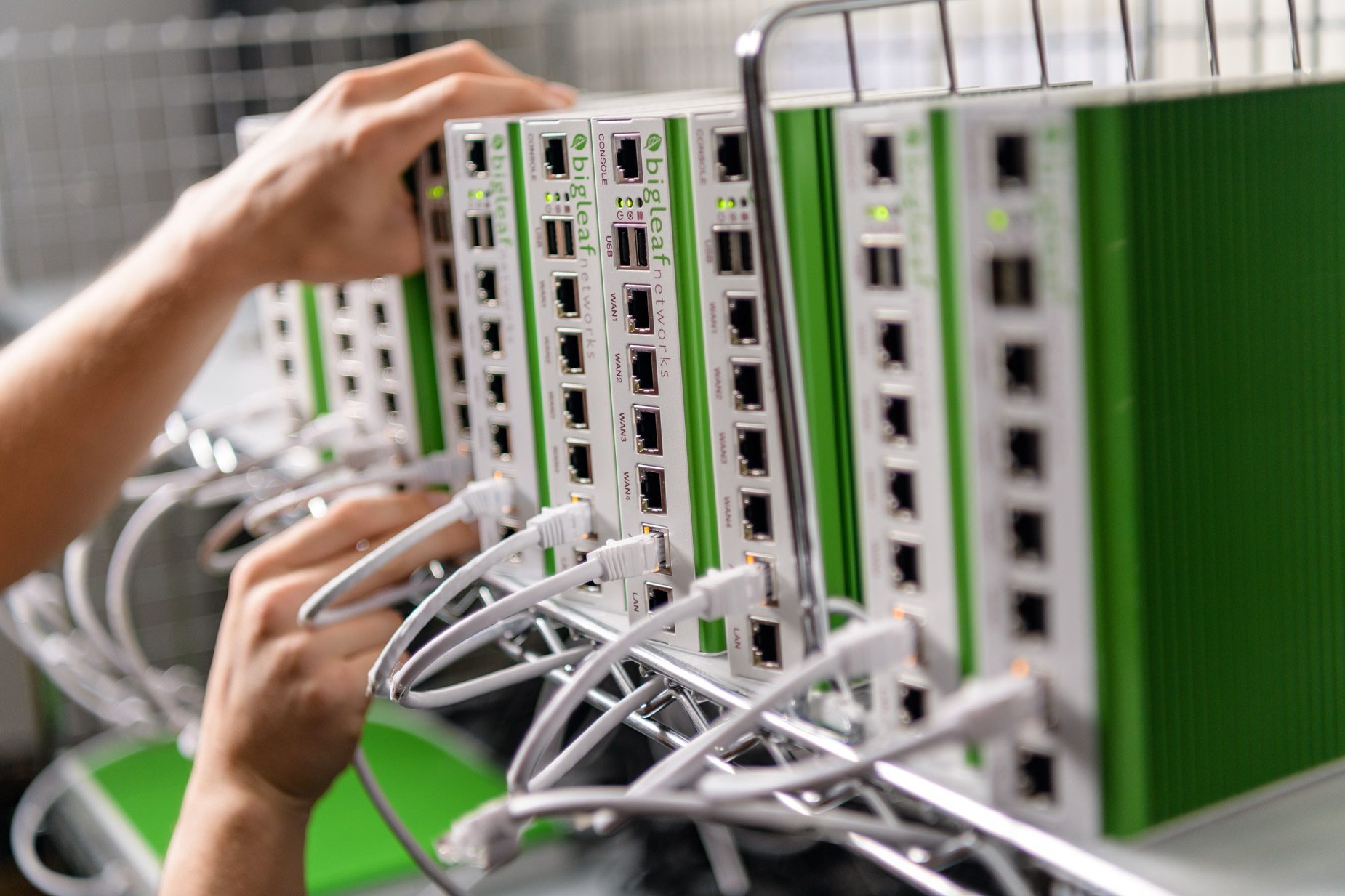
This is the company's most copyable idea. Products for overstretched operators win when they respect the stack already installed. Bigleaf does not ask a customer to abandon its ISP, firewall or applications. It wraps the unreliable part with measurement, automation and one accountable support relationship. A software founder can apply the same move elsewhere: preserve the system of record, automate the ugly handoff, and sell the absence of emergencies.
What it costs, and what changed the calculation
Bigleaf currently sells by quote, with monthly plans based on symmetric capacity and agreements of 12, 24 or 36 months. The bundle includes the router, cloud-network access, a dedicated IPv4 address, optimization, dashboard and support. Wireless data and redundant edge hardware cost extra. Historical public sheets show why the purchase needs a business case: service has ranged from the low hundreds of dollars per site each month to more than $1,000 for high-capacity or redundant configurations.
The price looks extravagant next to a cheap broadband bill and modest next to an hour when phones, orders or clinical workflows stop. One Jet's Pizza franchise operator estimated a busy-hour outage at $1,000 to $2,000. His first attempt at resilience included redundant circuits, but the usual backup behavior left room for delay and manual switching. What changed his mind was automatic same-IP failover, simple installation and application priority: point-of-sale and online orders could outrank guest Wi-Fi.
Other customers reveal the same pattern. TruHome needed dependable cloud telephony for more than 200 call-center representatives. OzWest needed warehouse systems to remain useful. Life Flight Network and communications providers work in places where rural connectivity is not a convenience. Across those cases, Bigleaf is not selling bandwidth. The carriers already sell that. It sells performance control over bandwidth the customer already owns.
The market moved toward Bigleaf's original bet
Joel Mulkey, Jeff Burchett and Luke Heberling founded Bigleaf in 2012, when the important business systems were beginning to leave server closets for SaaS platforms. Mulkey had built and operated an ISP. The founding observation was that cloud software only feels as reliable as the messy public path leading to it.
The name came from a pleasantly non-corporate diagram: veins in a leaf carry nutrients around blockages by using alternate paths. The company turned that biological redundancy into a networking metaphor and then into a channel business. Managed service providers and telecom agents could add Bigleaf to existing accounts without becoming experts in every customer's firewall. Service providers received wholesale plans, a multi-tenant console, training and flexible terms. Bigleaf gained distribution into the small and midsize businesses that its product fit best.
Capital followed. The company raised a reported $4.9 million Series A in 2018, then a $21 million Series B led by Updata Partners in 2019. Bigleaf said recurring revenue and headcount had tripled between the rounds. Greg Davis, already a director, replaced Mulkey as chief executive in 2022; Mulkey stayed on the board. The supplied company record lists another $5.02 million venture raise in October 2023. A public valuation is not available.
From backup line to a wireless-first control layer
The product has widened without abandoning its original job. Cloud Connect is the foundation: traffic optimization, failover, observability and support. Wireless Connect adds carrier-certified 5G and LTE for backup, instant site openings or primary connectivity. Plans now range from limited data to unlimited usage. Customers can also bring a preferred carrier plan, and the dashboard can monitor cellular, Starlink and other metered links.
In 2025, Bigleaf added unlimited wireless plans, broader carrier compatibility, new edge hardware, partner certification and optional hardware redundancy. The last item closes an obvious gap: a service that protects against circuit failure still has a problem if its own appliance becomes the single point of failure. Customers can now choose two bridged routers in high-availability mode or keep a warm spare. In June 2026, Bigleaf introduced circuit data metering and partner CSG launched a multipath offer combining Bigleaf, Verizon 5G and Starlink.
These moves place Bigleaf between several markets. It competes with full SD-WAN suites from Cisco, VMware and Fortinet; managed networks from carriers; secure access platforms such as Cato; and cheaper multi-WAN functions already embedded in firewalls. Its answer is specialization. It is firewall-neutral, carrier-neutral and focused on the path to cloud applications. It controls traffic in both directions through its own gateways, preserves IP addresses during failover and avoids manual policy work.
Where the math works
Multiple locations, few network specialists, two or more genuinely diverse paths, and applications whose failure produces visible revenue, safety or customer-service costs. Restaurants, clinics, call centers, retailers, warehouses and remote operations are natural fits.
Where it does not
A tiny office with one circuit and tolerable downtime may not recover the subscription cost. A sophisticated network team may prefer direct policy control. Buyers seeking one integrated security and site-to-site networking platform may choose a broader SASE or SD-WAN suite.
There are physical limits, too. No software can route around a backhoe if every local carrier shares the severed conduit. Wireless backup needs usable signal and adequate data capacity. Satellite introduces its own latency, visibility and metering questions. Bigleaf improves the choices available to traffic; it cannot invent a healthy path where none exists.
The playbook is operational, not botanical
The lesson worth copying is not to name a startup after plant anatomy. It is to locate a failure customers have reluctantly learned to babysit, then make the intervention automatic and compatible with what they already own. Measure the problem continuously. Act before the user notices. Keep an audit trail for the moment someone asks what happened. Charge against the cost of interruption, not the price of the underlying commodity.
Bigleaf also shows the advantage of choosing a boundary. It is not trying to be the firewall, every ISP or every application. It owns the handoff among them. That boundary lets a five-minute installation carry more weight than a fifty-page feature matrix. For the right customer, the payoff is wonderfully plain: fewer broken calls, fewer lost orders and fewer people staring at a green light while the internet misbehaves.