Consider the empty space between two pallets. To a casual observer, it is nothing. To a freight carrier, it is room for trouble. A turn, a brake, a shift in weight, and that innocent gap becomes a damaged shipment. XPO’s story makes more sense when you begin there, inside the trailer, rather than in the boardroom where its acquisitions were announced.
- The business: shared trailer space for freight that does not need a whole truck.
- The reversal: build a logistics conglomerate, then separate its major businesses.
- The lesson: earn better prices by fixing the customer’s expensive little problems.
XPO’s largest business is North American less-than-truckload transportation, usually shortened to LTL. Think of it as a shared journey for pallets: several customers’ shipments travel through a network of pickup trucks, terminals and long-distance trailers. Manufacturers, retailers and distributors buy the portion of the trip they need. The carrier makes money by combining those trips efficiently.
The bargain contains a complication. Freight may change vehicles along the way. Every transfer introduces another opportunity for lateness, confusion or damage. A low transport bill is small consolation when the machinery inside the crate arrives with an expensive new personality.
01First, buy a bigger map
The modern XPO began in 2011, when Brad Jacobs led an investment into Express-1 Expedited Solutions and renamed it XPO Logistics. The predecessor had been founded in 1989 by Michael Welch and Keith Avery. Jacobs brought a different ambition: consolidate a fragmented industry, then improve the assembled operations with scale and technology.
The financing deserves precision. The June announcement described up to $150 million, including potential warrant exercises. The September closing brought $75 million in cash for preferred shares and warrants. A headline and a cheque can differ.
In 2015, XPO announced the acquisition of Con-way at approximately $3 billion, including debt. That purchase supplied a substantial LTL network alongside other businesses. The original logic was breadth: existing customers could buy more services from the combined company, while shared resources and operational improvements could lift profit.

Then the map became harder to sell to investors. In December 2020, XPO said separate companies could reveal value that the conglomerate concealed. Its presentation called this a “conglomerate discount.” What lost favour was the financial packaging: management believed the market was undervaluing the collection. That was its stated rationale, rather than proof that the operating businesses had failed.
02Two exits, one sharper job
The contract logistics business became GXO in August 2021. The brokered transportation platform became RXO in November 2022. Mario Harik took over as XPO’s chief executive at the second separation. The corporate family acquired three stock tickers and clearer assignments.
There is a geographical wrinkle. Calling all of XPO a pure LTL company misses its European operation, which offers a broader set of transportation and supply-chain services. In August 2026, cycling equipment brand Mavic expanded its European relationship to include warehousing and order fulfilment, alongside transport. Corporate simplification did not make both sides of the Atlantic identical.
In North America, XPO competes with carriers such as Old Dominion, Saia and ABF Freight. Its proposition rests on the network it operates, the software it develops and the service it delivers. These are measurable advantages only when the shipment arrives as promised. An algorithm cannot apologise.
03The innovation department also buys straps
XPO’s ZDM+ damage prevention approach is wonderfully physical. SafeStack creates two levels inside a trailer, reducing the need to pile freight directly on freight. Ratchet straps hold loads in place. Dunnage airbags fill the gaps. XPO has also brought more long-distance hauling in-house, allowing its handling practices and equipment to travel with the freight.
The expertise extends to manufacturing. At its Searcy, Arkansas, plant, XPO builds its own trailers. In April 2024, the company reported that the factory had produced nearly 90,000 since opening in 1994. The ability to specify equipment gives the loading method somewhere practical to live.
“Our goal is simple: we want to be there for our customers.”Mario Harik · CNBC interview, 2025
People complete the system. XPO has offered tuition-free driver training with paid instruction, and describes a culture of accountability and customer service. Those commitments matter because freight quality depends on repeated decisions by drivers and dock teams. A loading standard has to survive a busy shift, not merely a presentation.
04A door is an investment thesis
Focus did not mean thrift. In December 2023, XPO acquired 28 former Yellow service centers. The cash payment was $870 million; the recorded purchase price was $918 million after assumed liabilities and direct transaction costs. The distinction matters. Buying capacity is an operating decision with a balance-sheet consequence.
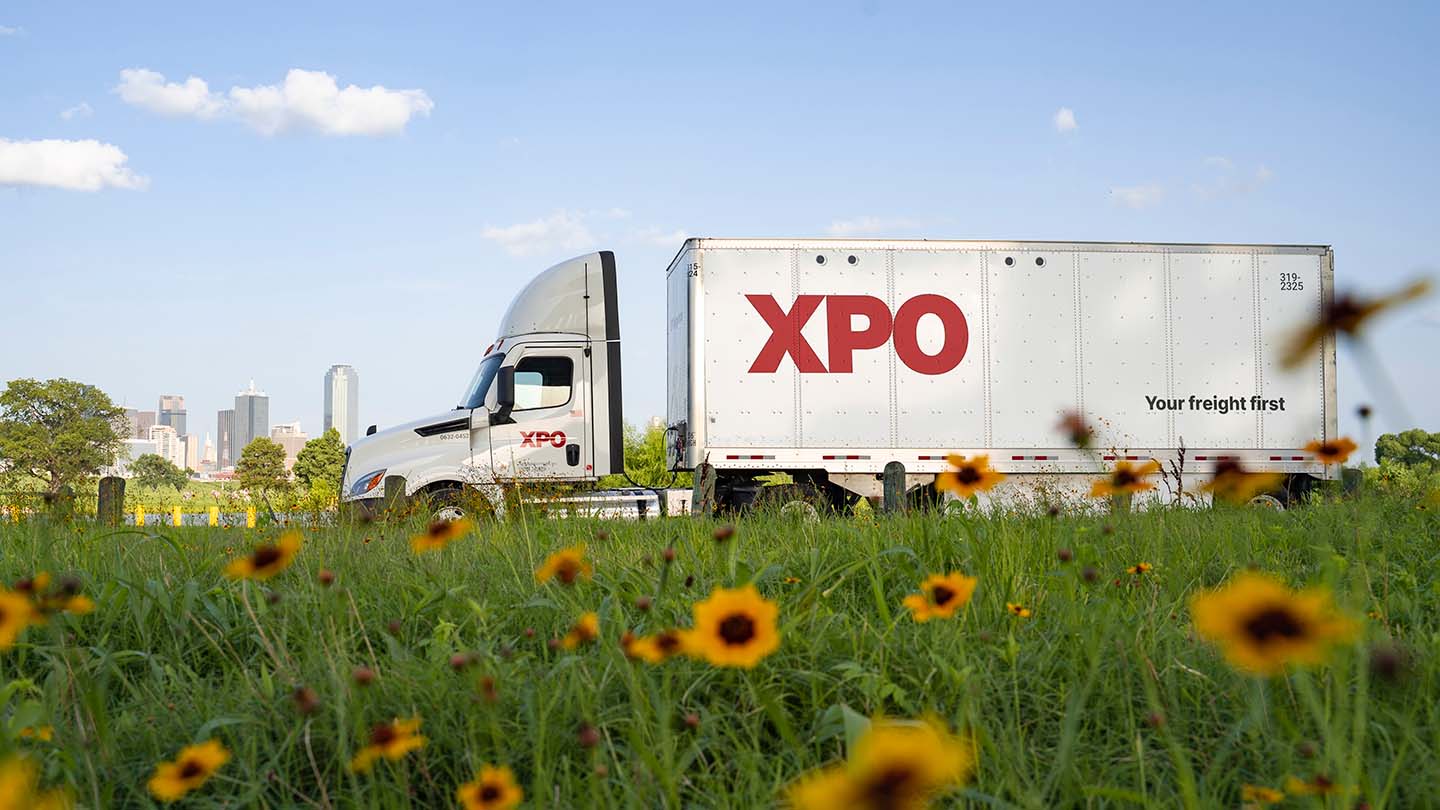
On October 1, 2026, XPO announced terminals in Mesa, Arizona, and Cameron, Missouri, bringing its North American network to 300 service centers. Their dock doors give freight places to enter, leave and change trailers. Capacity is useful when the location improves routes or removes a bottleneck; an empty building is less persuasive.
The July results show progress, with qualifications. Second-quarter revenue reached $2.36 billion. North American LTL’s adjusted operating ratio fell to 79.9%, from 82.9% a year earlier. Lower is better: less revenue is consumed by adjusted operating costs. It is a non-GAAP measure. European transportation, meanwhile, recorded a $6 million operating loss, primarily because of restructuring.
05What to borrow, and what to book
For a shipper, the practical choice starts with the consignment. XPO suits palletised freight that benefits from shared transport. Its premium options include day-definite delivery, selected noon deliveries, retail arrival windows and trade-show shipping. Customers can quote, track and manage shipments through web tools or connect their systems through EDI and APIs. Prices depend on the shipment and contract; guarantees have tariff conditions.
A full trailer, a small parcel or an unusually sensitive load may call for another arrangement. Compare the actual route, transit commitment, handling requirements and total charges. Network size alone cannot answer those questions.
For an operator in another industry, the transferable idea is narrower and cheaper than an acquisition: find the recurring failure customers pay for, give employees a repeatable way to prevent it, then measure the result before asking for a premium. XPO’s bet requires enough demand to use its assets and enough service improvement to justify its prices. The space between two pallets is small. The discipline required to manage it is considerable.