On November 1, 1989, a trucking founder took a train ride. Johnnie Bryan Hunt had been invited aboard by Mike Haverty, president of Santa Fe Railway. In the company’s account, they travelled west from Chicago and agreed to put Hunt’s trailers on trains. Consider the social awkwardness: two men whose industries competed for freight were discussing how to divide the same delivery.
- Trucks handle the ends; trains carry the long middle.
- Intermodal generated about half of J.B. Hunt’s 2025 revenue.
- The useful lesson: fix the customer’s handoffs, even when a partner does the carrying.
The first J.B. Hunt intermodal load left Chicago in February 1990. The arrangement acquired a suitably ambitious name, Quantum. Thirty-five years later, intermodal was a roughly $6 billion business inside a company reporting $12 billion in annual revenue. A ticket for the train had become a substantial part of the trucking company.
The competitor with the missing piece
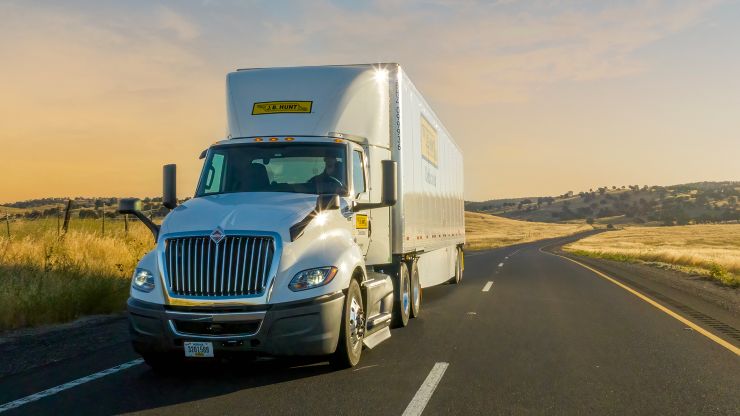
There is a small trap in calling J.B. Hunt a trucking company. It encourages you to count trucks. Its more interesting skill is arranging the journey. In intermodal shipping, a truck collects the container, a railroad carries it between terminals, and another truck finishes the delivery. The cargo stays in its container while the means of moving it changes.
That makes the railroad a supplier and a partner, even though rail also competes with highway freight. J.B. Hunt sells the coordinated service. The customer gets a route to a destination, with someone responsible for making the pieces meet. A warehouse manager has enough appointments to worry about without hosting a debate between transport modes.
“Intermodal started as an idea to bring two services together”
Shelley Simpson, president and CEO · February 2025
The willingness to change means predates the train ride. Johnnie Bryan and Johnelle Hunt founded the business in 1961 as a rice hull operation in Stuttgart, Arkansas. Five trucks and seven trailers helped turn it toward transportation. The Hunts relocated to Northwest Arkansas in 1969; the business went public in 1983. Its origins were agricultural, its opportunities increasingly logistical.

Five ways to finish the journey
Today, the customers are businesses moving goods across the United States, Canada and Mexico, from smaller shippers to manufacturers and retailers. Public customer recognitions in 2025 included General Mills and Home Depot. Their problems differ: moving food between facilities, keeping a retail fleet available, or delivering something too bulky for an ordinary parcel network.
J.B. Hunt answers through five reporting segments. Intermodal combines rail and road. Dedicated Contract Services assigns equipment and people to a customer’s operations, taking on fleet management. Integrated Capacity Solutions arranges freight through outside carriers. Final Mile Services moves heavy and bulky goods to homes and job sites, including installation. Truckload supplies highway transportation, including its trailer-pool offering.
Approximate segment revenue · US dollars
Rounded figures; intermodal accounts for roughly half of consolidated revenue.
The business earns transportation and logistics fees. Some work runs through contracts; some is priced transaction by transaction. When another carrier or railroad performs part of the service, J.B. Hunt pays for that portion. Revenue must cover purchased transportation, people, equipment and the expense of coordination. Software helps arrange these costs; it does not make them disappear.
Alternatives include Schneider and Hub Group for intermodal and logistics, alongside brokers, truckload carriers and a customer’s own fleet. J.B. Hunt’s distinction lies in combining company equipment, established rail relationships and third-party capacity. Which combination wins depends on the shipment. A fine company presentation is little consolation for a missing pallet.
A $500 million answer to empty space
The modern version of the partnership problem is information. A shipper needs capacity; a carrier needs a load. If neither can see the other’s plans, trucks can travel empty while freight waits. J.B. Hunt launched its 360 digital marketplace in 2017. In April 2022, it reported investing $500 million in technology over the preceding five years.
Shipper 360 lets customers quote, book and track freight across transport options. Carrier 360 lets qualified carriers search for loads and manage their work. The value is practical: compare a shipment’s options, find a suitable load, see its progress. The 2021 Google Cloud alliance supported the company’s cloud and data ambitions, rather than replacing the physical network beneath them.
Then there is 360box, announced in 2019: a pool of trailers for drop-and-hook work. A warehouse can load a trailer while a driver does something else, then a carrier collects the ready load. It separates two clocks that need not tick together. The product is pleasingly unromantic. Sometimes progress consists of giving the waiting to the object without wages.
The work is in making the handoffs behave.
The margin is where the trouble shows
The numbers keep this story honest. Integrated Capacity Solutions recorded an operating loss of $56 million in 2024 and $10 million in 2025. Acquisition-related integration and asset charges contributed to the earlier year’s difficulties. Better results still left a loss. A busy marketplace can arrange plenty of movement without retaining enough money from it.
Nor is intermodal a universal answer. Terminal access, rail schedules, handling and the delivery deadline determine whether a lane suits it. A short journey or unforgiving appointment can make direct trucking more sensible. In 2023, J.B. Hunt and BNSF revived Quantum for service-sensitive freight, advertising anticipated delivery about a day faster than traditional intermodal. That promise belongs to a specific service, not every container.
Copy the handoff, not the fleet
This is an expensive operation: net capital expenditure in 2025 was approximately $575 million, separate from the earlier technology investment. The accessible lesson is to draw the customer’s journey and find the costly wait or awkward transfer. Ask whether a partner already has the missing capability. Then measure the economics of completing the job, rather than celebrating how many transactions pass through.
The company is still applying that logic. Second-quarter 2026 revenue reached $3.50 billion, up 19% year over year. Its collaboration with UP.Labs produced Overroute, publicly launched in July; a September company account described automating load-status communication across business units. The tools have changed since the train ride. The recurring problem remains wonderfully ordinary: somebody needs to know what happens next.