Consider the pay phone. A truck driver stops, finds a telephone, calls dispatch and asks what comes next. The vehicle is perfectly capable of moving. The information is not. Schneider’s account of its early satellite communications makes this wonderfully unglamorous point: getting instructions into the cab meant drivers no longer had to stop for assignments. A transportation company could improve movement by repairing a conversation.
- Truckload, rail and brokerage give shippers several ways to move the same freight.
- Dedicated fleets turn recurring customer work into planned capacity.
- A failed delivery expansion carried substantial closure charges.
- Electric trucks work inside a carefully arranged depot-and-route system.
The missing minutes
The origin has the pleasing economy of a family anecdote. In 1935, Al Schneider sold the family car to buy a truck. By 1944, the fleet was adopting Omaha Orange. In 1958, its first interstate shipment carried goods for Procter & Gamble between Wisconsin and Michigan. The color supplied recognition; the expanding road network supplied opportunity.
But more vehicles create more opportunities to wait in the wrong place. Schneider installed a computerized control system in 1975 and subsequently adopted in-cab satellite communication. The useful observation is that dispatch belongs to the product. A shipper buys a completed journey, including the decisions that prevent the truck from spending its afternoon waiting for someone to answer.
Today that conversation also happens through FreightPower, launched in 2020. Shippers can quote, book and track loads, retrieve documents and reuse shipment details. Registration is free; moving freight costs money. For carriers, the marketplace offers loads and booking tools. Software is the front door to a transportation business with people, equipment and outside capacity behind it.
A train in the middle
Schneider’s customers include manufacturers, retailers and consumer-goods companies. Public examples range from P&G to Goodyear and Frito-Lay; FreightPower testimonials include Orbit Irrigation Products and Lotioncrafter. They share an awkward problem: goods must arrive even when their preferred capacity, route or schedule does not cooperate.
A truckload service handles the road journey. Dedicated service assigns fleet resources to a customer’s operation. Brokerage arranges transport with other carriers. Bulk adds specialized hauling. Intermodal, introduced in 1991, puts rail between the truck movements at either end. Warehousing and supply-chain management address the work surrounding those journeys.
The coordination stays part of the service, even when the vehicle changes.
Schneider works with CSX, Union Pacific and CPKC. The latter’s 2023 agreement added single-line service on a U.S.-Mexico corridor. That matters because a handoff between railroads adds another coordination problem. Schneider’s expertise lies partly in making the journey legible across companies whose assets it does not own.
This places it alongside other large freight operators, including J.B. Hunt and Knight-Swift, and against brokers such as C.H. Robinson where outside capacity is the answer. Its appeal is the combination of services. The right choice still depends on the load: predictable container freight near useful rail terminals offers a different proposition from an urgent delivery with an unforgiving appointment.
The price of predictable work
Dedicated transportation deserves special attention. A customer with recurring routes can outsource trucks, drivers and operating responsibility while retaining capacity arranged around its needs. Schneider earns transportation revenue under those relationships, alongside transactional freight charges, brokerage revenue and logistics management fees elsewhere in the business.
In November 2024, Schneider announced the Cowan Systems acquisition at approximately $390 million in cash, subject to adjustments, with separate real estate agreements of roughly $31 million. Cowan brought about 1,800 trucks and an established dedicated operation. Earlier purchases of Midwest Logistics Systems and M&M Transport pointed in the same direction. Predictable work was worth buying.
Business purchase price, subject to adjustments
The sofa that would not pay its way
Expansion has also supplied an expensive lesson. First to Final Mile served furniture, carpet and appliance movements through 26 terminals. In 2019, Schneider reported that results were considerably below projections despite sustained investment and operating changes. A $34.6 million goodwill impairment arrived in the second quarter.
Management reassessed the business’s prospects and alternatives, then chose closure. Operations were substantially shut by August 31; third-quarter pretax shutdown charges were $50.4 million. These were separate from the earlier impairment. A network can be busy, geographically impressive and economically disappointing all at once. Schneider’s decision gives managers something concrete to copy: review an adjacent business on its own results, then make the exit decision real.
Electricity needs an itinerary
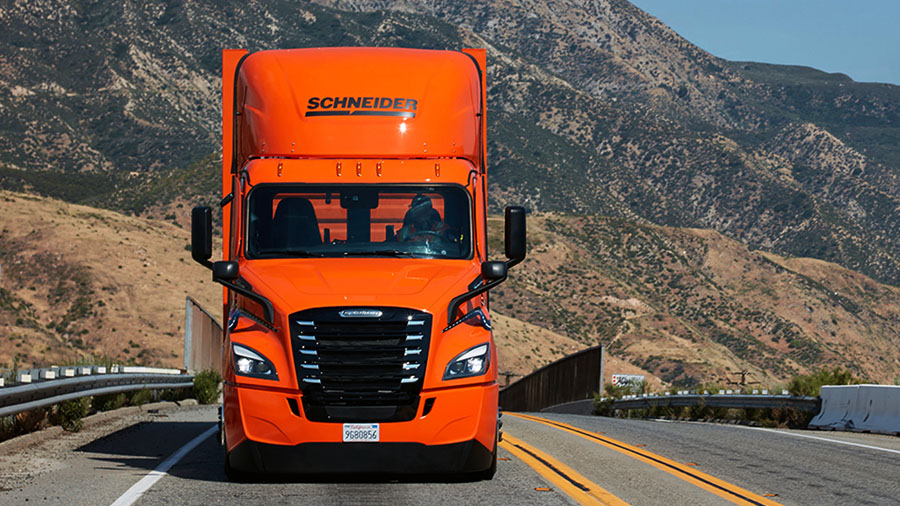
The electric fleet offers a more promising experiment. Schneider tested an eCascadia during 2020-2021 before putting 92 into Southern California operations in 2023. Its South El Monte depot could charge 32 trucks simultaneously. The company described approximately 220 miles of typical range and an 80% charge within 90 minutes. Public incentive programs helped fund the deployment.
By February 2026, Schneider announced more than 10 million zero-emission miles. Here, “zero-emission” describes the trucks’ operation, not a complete lifecycle accounting. The useful lesson is the fit between local freight, charging and scheduling. An operator without dependable power, charging time or suitable routes cannot simply purchase the same result along with the truck.
Three cents leaves little room for theatre
Schneider’s 2025 operating ratio was 97%: operating expenses consumed roughly 97 cents of each revenue dollar. That explains the attention to details. A needless wait can consume money a customer will never pay to replace. In the second quarter of 2026, operating income reached $71.4 million, up from $55 million a year earlier, as market conditions and operating performance improved.
“Nothing we do is worth harming ourselves or others.”Schneider’s published safety value
Jim Filter became CEO in July 2026 after a career that began at Schneider in 1998. On October 1, the company announced 26% more driver instructor positions; nearly 90% of existing instructors had come from driving roles. Even with a digital marketplace, experienced people remain part of capacity. The copyable habit is to examine the handoffs, idle minutes and repeatable demand before buying more equipment. A well-painted truck makes a handsome photograph. Knowing what it should do next pays the bills.