Imagine buying a truck journey by the slice. Your two pallets occupy a little space; somebody else’s machinery takes the rest. The bill becomes more bearable. The arrangement also introduces strangers, transfers, and opportunities for something delicate to meet something heavy. This is the everyday bargain of less-than-truckload shipping, or LTL. R+L Carriers has spent six decades building a business around that bargain. Its most interesting work begins where the tidy idea of sharing becomes untidy.
- Businesses buy shared freight capacity instead of an entire truck.
- Protected loads and timed delivery add control to the journey.
- Terminals, documents, and destination details do much of the work.
The empty space business
The company’s beginnings were agreeably literal. In 1965, Larry Roberts bought one truck and hauled furniture. Purchased operating authority and, later, trucking deregulation created room to expand. Acquisitions brought Gator Freightways into the business in 1989 and Greenwood Motor Lines in 1992. A furniture-hauling enterprise acquired the geography and infrastructure of a freight network.
Today its core customers are businesses moving goods that need more attention than a parcel but do not necessarily justify a whole trailer. Manufacturers, distributors, and retailers need collection, sorting, transport, and delivery. R+L earns transportation fees and offers additional services for particular requirements. A customer buys access to an organized journey, with optional help for its awkward parts.
The scale is substantial without needing a mystery valuation. Transport Topics placed R+L fifth in its 2026 LTL rankings, with estimated 2025 revenue of $3.725 billion. That is an industry estimate, rather than an audited public disclosure. It puts the company among established national carriers serving repeat commercial demand. For a smaller shipper, the practical attraction is access to that network without having enough cargo to fill it.
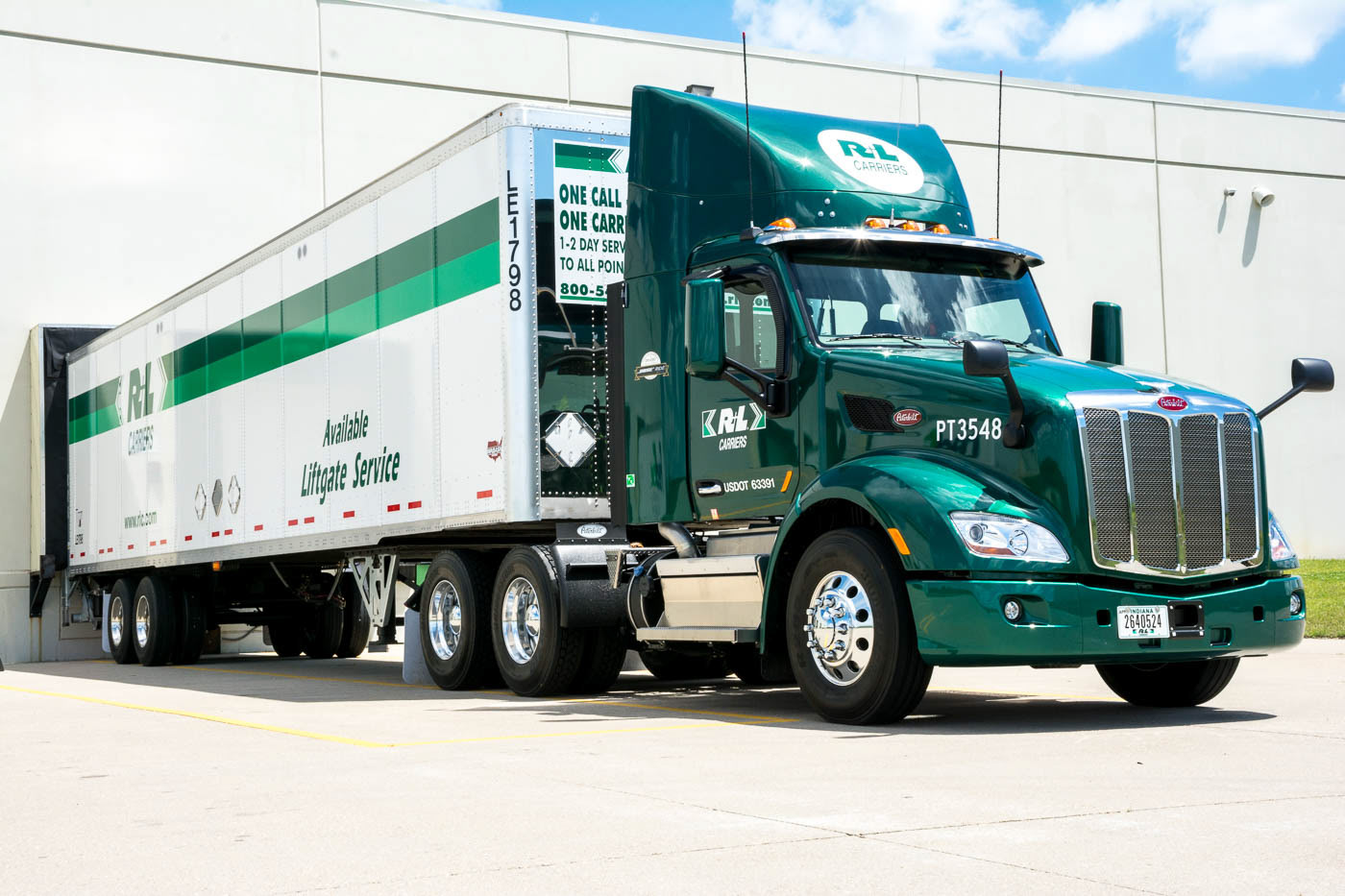
Concrete is part of the product
Consider the terminal. It is easy to admire a truck and forget the building that gives it useful work. LTL networks need places to consolidate cargo, change its direction, and prepare local deliveries. A service center turns individual shipments into routes. That physical network is expensive to assemble, even when the operating idea sounds wonderfully simple.
In December 2023, auction results reported by FreightWaves listed RAMAR Land Corp., identified with R+L Carriers, as the winning bidder for eight former Yellow terminals at $211.5 million. The figure is an acquisition price, not the company’s total expansion budget. It nevertheless supplies a useful correction to airy talk about networks: sometimes the network is a very substantial property bill.
The construction continues. In August 2026, R+L moved its Grand Rapids operation from Kentwood to a new service center in Wayland, Michigan. Such changes matter to a shipper for a practical reason: the route and local facility serving a particular address matter more than a handsome national coverage map.
A private room for your pallet
Sharing capacity introduces handling risk. R+L’s Load & Protect addresses that problem with a physical divider: a tamper-resistant bulkhead separates the shipment, while a trackable identification tag connects it to the customer. The freight stays in the same trailer from pickup through delivery. Customers pay for the space they need. It is an appealingly concrete response to a concrete worry.
Tagged + secured
Deadlines present another complication. Business Critical offers guaranteed delivery by 5 p.m., by noon, or within an hourly window, alongside expedited options. For the advertised qualifying guarantees, missing the commitment means a zero-balance freight invoice. That is useful accountability. It is also a specific remedy: the rules tariff excludes consequential damages from delay. A waived bill cannot put a lost production day back on the calendar.
These details explain R+L’s position against national LTL alternatives such as Old Dominion, Estes, XPO, and Saia. Shared capacity is familiar territory. The choice turns on lanes, handling, appointment requirements, price, and execution. Load & Protect gives customers a particular way to reduce transfers; it does not establish that every R+L shipment beats every competitor’s.
The paperwork gets there first
Freight has a second journey: its information. R+L’s in-cab scanning lets drivers capture delivery receipts and bills of lading at the transaction, making documents and updates available through tracing applications and EDI systems. A person waiting for confirmation can act before the truck returns to its terminal.
MyRLC supplies customer tools for quotes, records, documents, and shipment management. APIs connect shipping functions to another application or website. International air, ocean, warehousing, and customs services sit within the wider affiliated logistics offering. Those distinctions matter: a worldwide service portfolio need not mean an R+L-owned truck completes every mile.
“Customer satisfaction is mandatory to ensure future success.”R+L Carriers mission statement
A trucking benefit with a beach
Corporate talk about family can be excessively well upholstered. R+L gives it an unusual physical expression. Its benefits website lists four employee resorts for workers and their families: Pigeon Forge, Daytona Beach, Big Bear Lake, and Ocean Isle Beach. Alongside healthcare, retirement savings, and paid leave, these are benefits one can locate on a map.

Customer relationships offer another tangible measure. Parker Hannifin, an industrial manufacturer, began its R+L account in 2017 and named the carrier its 2025 North American Carrier of the Year for a second consecutive year. Geodis selected R+L as its 2026 Carrier of the Year. In September 2026, Univar Solutions recognized its service and partnership. These are named endorsements, with identifiable customers behind them.
Start with the awkward questions
The useful lesson is available to anyone booking freight. Begin with what could complicate delivery. Is there a dock? Will a liftgate be needed? Can the receiver accept an ordinary delivery window? Does the cargo need protection from freezing, special packaging, or fewer handoffs? Request the quote after supplying those facts, then compare the complete service and applicable charges.
For a shipment needing a dedicated vehicle or unusually fast transit, ordinary shared LTL may be a poor fit; truckload or expedited service deserves consideration. R+L’s history suggests a copyable habit: build around the troublesome handoff. A divider, a scanned receipt, or an unloading arrangement can be worth more to the customer than another grand promise painted on a trailer.