A network can be perfectly reliable and still be taking everyone the long way home. At Sony Pictures, according to Graphiant’s account, much of the traffic was headed for the internet. Yet it travelled through centralized MPLS hubs first. The system was doing what it had been designed to do. The destination had changed. Somewhere between that obedient network and the cloud application waiting at the other end sat a rather expensive detour.
- The offer: private enterprise connectivity sold as a capacity-based service.
- The trick: a stateless core, with encryption and intelligence at the edges.
- The evidence: Graphiant reports 70% lower WAN costs at Sony Pictures across 45 sites.
- The useful question: where does your traffic actually need to go?
Graphiant lives in that gap between the network a company bought and the network its work now requires. It connects branches, data centers, clouds and business partners through a managed fabric. The proposition sounds technical. The commercial ambition is pleasantly blunt: remove enough equipment, configuration and separate licenses that buying connectivity starts to resemble buying a service.
The inventor returns to the scene
Khalid Raza has been here before. He co-founded Viptela, an early SD-WAN company that Cisco acquired for $610 million in 2017. Software-defined wide area networking helped enterprises use internet connections more flexibly, reducing dependence on costly private circuits. It was a substantial answer to a substantial problem.
Then the problem moved. Applications spread into public clouds and SaaS platforms. Business partners needed access. More destinations meant more relationships to configure and protect. In his May 2026 essay revisiting SD-WAN, Raza argues that an architecture conceived around branches and data centers needs reconsideration for distributed AI and data sovereignty. Read it as an inventor’s competitive argument, rather than a verdict on every rival product.
He founded Graphiant in 2020. The company emerged publicly in September 2022 with $33.5 million in initial funding. The launch account describes the new wager: use a stateless core to give enterprises private-network performance with easier provisioning. Raza’s change of mind concerned the architecture’s assumptions. A network built around a central destination becomes awkward when work keeps acquiring new addresses.


Leave the memory at the edge
“Stateless” is an unfortunate word for a company selling control. It sounds like a network that has misplaced its passport. The actual idea is narrower: the core forwards traffic without retaining the per-session customer state that would otherwise help track individual conversations.
Graphiant’s technical documentation places encryption and customer-specific functions at the edges. Metadata helps direct packets through the backbone. The core can interpret Graphiant addressing, but it does not hold the keys needed to decrypt the customer payload. That payload stays encrypted between the sending and receiving edges.
Encrypt
metadata
Decrypt
The distinction matters because enterprise connectivity involves two different jobs: deciding what should communicate, and carrying the resulting traffic. Graphiant separates those concerns. Edges attach to the fabric; the organization expresses its connectivity and policy through the service. The company’s software can run on virtual machines or commercial off-the-shelf equipment, avoiding a requirement to buy its own proprietary appliance stack.
There is still machinery. There are still edges, access connections and a backbone. The useful reduction is in what customers have to assemble and maintain for every new relationship. A cloud workload, a branch and a supplier become participants in a common service rather than occasions for another bespoke arrangement.
Sony’s expensive detour
The Sony Pictures case gives that argument a named setting. Graphiant says Sony wanted a 50% cost reduction and achieved 70%, migrating 45 global sites in approximately four months. The published account reports break-even within three months and continued self-management without added headcount.
What failed first was the fit between traffic patterns and routing. Sony’s network remained reliable, the case says, but its centralized backhaul added delay for cloud and SaaS use. Graphiant enabled direct internet breakout at each location, replacing the tunnel-heavy design with label-based connectivity while preserving segmentation.
That is a more instructive story than a percentage floating above a sales brochure. The claimed savings accompanied an architectural change: less backhaul, fewer licensing complications and the removal of the previous MPLS arrangement. A reader can copy the diagnostic exercise immediately. Map the destinations of everyday application traffic, then compare that map with the route the network actually takes.
The results belong to this deployment and this account. They are useful evidence for a trial, not an automatic discount to apply to someone else’s bill.
The bill between the clouds
A second case, published in June 2026, follows an unnamed SaaS provider using Azure, Google Cloud, Confluent Kafka and StarTree Pinot. Here the cost problem included data continually moving between environments. Growth increased the travel bill.
Graphiant says moving those paths to private connectivity reduced cloud egress costs by more than 75%. It also opened access to lower-cost managed-service tiers that required private networking. The reported pilot took one month; full deployment took four. The mechanism is the interesting part: changing the connection can change which version of another service you are able to purchase.
Graphiant itself charges through a capacity-based subscription. Its published billing explanation says capabilities are included without separate hardware, software or feature licenses. That positions it against carrier MPLS, SD-WAN deployments and combinations of cloud networking and security products. Buyers are comparing a service bill with the cost of an entire operating arrangement.
Graphiant’s homepage advertises this average monthly pilot cost. It is a planning reference, not a quote for your network.
The homepage also advertises an average three months to production. Those averages give a buyer something to discuss. A sensible comparison still includes access circuits, migration work, existing contract commitments, support and the capacity actually required. A neat subscription cannot, by itself, make an untidy transition disappear.
A packet with an itinerary
Encryption answers who can read data. Enterprises may also need to specify where it is allowed to travel. Graphiant’s Data Assurance service, launched in 2024, adds granular path controls, monitoring and auditing for data in motion. An application’s permitted geography can become a network policy rather than a hope filed in a compliance folder.
This is a useful distinction for financial institutions, healthcare organizations, multinational businesses and public-sector buyers. It is also relevant to AI systems drawing information from multiple locations. The route is part of the design. The control has value when the available infrastructure can satisfy it; buyers should test permitted paths, fallback behavior and the evidence available afterward.
Gina AI, introduced in November 2025, works with the fabric’s telemetry to support observability, policy verification and compliance reporting. Graphiant describes an operational assistant that can flag path deviations with context and timestamps. The appeal is straightforward: give a network operator a faster explanation of what happened.
In April 2026, Graphiant announced native SASE capabilities, including zero-trust access, threat detection, malware protection and data loss prevention without additional feature licensing.
“SASE shouldn’t require buying and integrating multiple products.”
ALI SHAIKH / APRIL 2026
The commercial claim is as consequential as the technical one. Security becomes an included part of the fabric. A buyer still needs to verify what each control covers, especially when evaluating encrypted traffic, existing security workflows and application-specific requirements.
The machinery behind the promise
A network service must earn trust in places where a diagram cannot help. Graphiant’s July 2026 engineering account describes automated quality gates, nightly regression tests, staging and small, monitored canary releases. AI agents generate failure scenarios and draft initial analyses; engineers approve executions and verify the hypotheses. The company also operates its own corporate network on Graphiant.
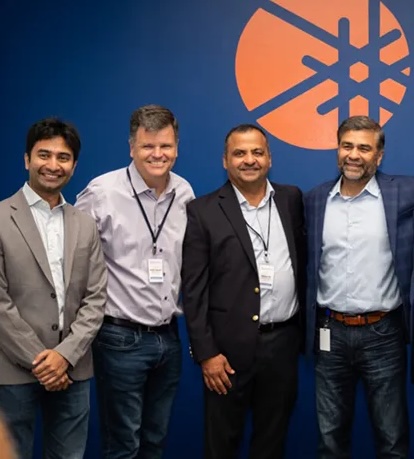
Expansion has required capital. A $62 million Series B in March 2023 followed the launch. A further $19 million strategic investment in May 2025, with Wa’ed Ventures and TALI Ventures joining, supported Saudi expansion. Ali Shaikh became CEO that October, as Raza moved toward strategy and international growth.
The market is widening, too. A joint Gcore solution pairs GPU infrastructure with Graphiant connectivity. An August 2026 Peraton partnership combines the fabric with government mission integration. Supporting compliance requirements is part of that proposition; it should not be confused with a blanket certification of every deployment.
Graphiant is most interesting where connections multiply, data travels between clouds, and the network team inherits the resulting complications. A small, stable environment may have little to consolidate. A deployment without suitable access, acceptable regional paths or a workable migration plan will not be rescued by the word “stateless.”
For everyone else, the starting point is wonderfully unglamorous. Pick a troublesome flow. Measure its route, cost and performance. Put it through a bounded pilot, including failover and policy checks. Then inspect the new bill. Graphiant’s argument becomes persuasive precisely where those measurements show that the old network was faithfully taking the wrong journey.
Follow the packets
Explore the company website, technical documentation and news and product blog. Follow Graphiant on LinkedIn, X and YouTube.
↗ Watch: AI networking, Data Assurance and Gina demo↗ Watch: Graphiant’s Network-as-a-Service presentation