A network earns much of its reputation by escaping notice. The connection holds, the office gets on with its day, and the people responsible for the equipment receive the modest reward of being left alone. Udy Kashkash works in this peculiar economy of attention. As President and CEO of RAD, he leads a company whose products sit between a promise of progress and the awkward business of keeping an existing system alive.
His career gives that position a particular texture. He has worked in research and development, sold telecommunications technology, led customer-facing operations and eventually taken responsibility for the whole company. Each job puts a different person on the other side of the same question. An engineer asks how the system should work. A customer asks what happens to everything already installed.
From the lab to the customer
Before joining RAD, Kashkash held senior R&D positions at Seabridge and Nokia Siemens Networks. He also worked on sales and business development for mobile-backhaul solutions in North America at Nokia Siemens Networks, then served as a vice president of sales at Ceragon Networks. At Ceragon, his responsibilities included strategic customers and the pre-sales team.
That is an instructive collection of jobs. Pre-sales occupies the stretch of ground where an attractive proposal must withstand technical questions. The people there have to translate between what a product can do and what a buyer needs it to do. A feature can look impressive in isolation and become considerably less charming when somebody asks about installation.
Kashkash’s computer science education supplies another part of the picture. He earned a degree at the Open University of Israel, with a public executive biography dating its completion to 2000. His later commercial roles placed that technical background in direct contact with customers. The result is a career spanning both the construction of telecommunications systems and the business of persuading organizations to adopt them.
North American operations
leadership
President & CEO
A promotion with forty years behind it
Kashkash arrived at RAD in 2016 as head of North American operations. He subsequently led the Customer Facing Group. In April 2021, the company named him President and CEO, succeeding Dror Bin, who moved to lead the Israel Innovation Authority.
The appointment put him in charge during RAD’s fortieth anniversary year. Founded in 1981 by Yehuda and Zohar Zisapel, the company already had a long history of supplying telecommunications equipment. Kashkash was taking over an established business with established relationships. There was a great deal to carry forward, and plenty of machinery already carrying it.
Yehuda Zisapel, then chairman, endorsed the promotion by pointing to Kashkash’s work leading sales and services globally. Kashkash, in turn, emphasized the employees he had worked alongside for five years. The exchange described a succession built on familiarity: the board knew his work, and he knew the organization he would lead.
“Most critical in my view is to maintain stability.”
Udy Kashkash, May 2021
That sentence came soon after his appointment. For a new chief executive, stability can sound like an unusually restrained ambition. In a business selling communications infrastructure, it is a demanding one. Customers need confidence in the equipment, the delivery schedule and the people who will support it after the order has been signed.
New services, existing networks
Two years before becoming CEO, Kashkash was already discussing the commercial difficulty behind network modernization. In August 2019, RAD announced a multi-year deployment for an unnamed major operator in Southeast Asia. The project involved virtual customer-premises equipment, allowing network functions to run as software.
The operator would continue delivering existing private-network services while adding capabilities such as security functions. Business customers would be able to activate service functions through a self-service portal. Kashkash described the competitive pressure on service providers to offer more useful services to their customers.
The interesting detail is the coexistence. Old obligations did not vanish because new possibilities appeared. That makes the project a useful early expression of the practical subject that recurs in his public work: how to introduce change without requiring a customer to begin again.
There is a human dimension to that apparently technical problem. An installed network represents decisions, budgets and skills accumulated over time. Treating it as a blank sheet would be convenient for a presentation. The person responsible for operating it is entitled to prefer a less artistic approach.
A camera at the end of the fibre
One early project of his CEO tenure made the question easy to visualize. In August 2021, RAD announced its selection for an Israeli pilot connecting traffic cameras over 5G. The Ministry of Communications and the Israel Innovation Authority selected the project, with the National Transport Infrastructure Company participating.
The obstacle was physical. Fibre-connected cameras could only be added where suitable fibre existed. The planned pilot would use RAD’s SecFlow gateway to carry live video over a mobile network, opening a route to locations beyond that fibre footprint. It was a proposed deployment with a specific constraint, rather than a general declaration that a city should become smarter.
The attraction of this example is its scale. A grand technology story can shrink to a perfectly intelligible question: how do you connect the next camera? A useful answer has to reach the site. The word “smart” does remarkably little digging.
In a separate industrial-automation interview, Kashkash likened SecFlow to a Swiss Army knife. The gateway brought several functions into one device. He also explained how processing sensor data near its point of origin could support faster local decisions. The analogy is revealing as a piece of communication: a collection of technical capabilities becomes something a customer can picture, carry and count.
London supplies the working example
By November 2024, another partnership supplied a commercial example. RAD and The Kenton Group announced an extension of their work with Vorboss, a fibre provider serving London businesses. The companies described eighteen months of collaboration delivering Ethernet services, using RAD equipment through Kenton.
The announcement concerned 10G and 100G products and an extended agreement for network termination equipment. Kashkash credited the engineering team’s ability to customize product features, as well as Kenton’s expertise. Vorboss chief operating officer Rhod Morgan pointed to reliable service and the company’s continuing effort to connect businesses across London.
Each participant had a different responsibility. RAD supplied equipment. Kenton brought its part of the delivery relationship. Vorboss faced the business customer. The partnership is a useful corrective to the habit of imagining a CEO’s strategy as something that leaves the office fully formed and proceeds directly to success.
In practice, a network service has to pass through several organizations before it reaches a desk. The details of that passage matter. Kashkash’s emphasis on customization gives the customer-facing portion of his career a concrete place in the story: the product must fit the deployment, and other people must be able to deliver it.
Back to school, then into the photograph
Alongside his executive work, Kashkash’s LinkedIn profile lists executive MBA studies at Tel Aviv University’s Coller School of Management for 2023-2025. The dates follow his appointment as CEO. It is a small biographical detail with a pleasing implication: reaching the top job did not close the classroom door.
His public work also includes participation in the Israel-UAE Business Forum in Abu Dhabi. Such appearances place him in the relationship-building part of international business, where a networking company needs another kind of network. A useful contact still has to be made by people.
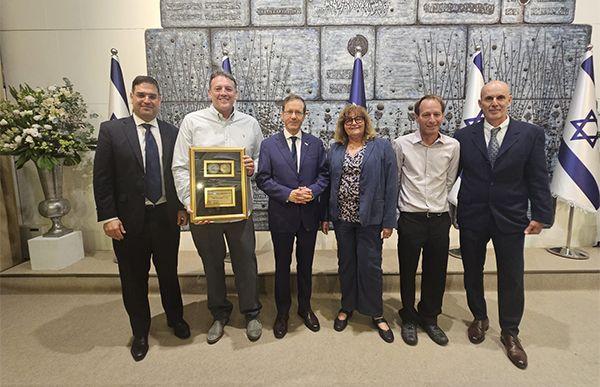
RAD’s Outstanding Exporter Award for 2025, in the high-tech category, provided a more ceremonial moment. Kashkash accepted it alongside board member Nava Zisapel at the Israeli president’s official residence. In his response, he directed credit toward the employees.
“This award is first and foremost a tribute to RAD’s employees.”
Udy Kashkash, on RAD’s export recognition
The distinction belongs to the company. The photograph places its CEO among colleagues and public officials, with a plaque providing the unusually visible evidence of work generally performed out of sight. For a business of connections, the group portrait seems an appropriate format.
The work beyond the equipment rack
Some of Kashkash’s responsibilities appear in less photogenic documents. RAD’s October 2024 quality policy, bearing his name as CEO, connects customer satisfaction with product and service quality. It emphasizes planning, preventing failures and employee accountability.
The company’s business-continuity policy similarly commits resources to reducing disruption and maintaining delivery and support. Its information-security policy addresses the protection of customer and employee information. These documents do not describe a private personality. They do show what the organization formally commits to under his leadership.
In the 2025 ESG report, Kashkash’s opening message broadens the agenda to sustainable products, more efficient resource use and measurable reductions in consumption. He also discusses community involvement and mentorship. The report describes activities including environmental clean-ups, farm support and school-supply donations.
For a company selling continuity, those commitments extend the view of what must keep working. Products depend on production; production depends on people and resources. The administrative prose is unlikely to compete with a launch announcement for attention, but it belongs in an account of the chief executive’s job.
A faster network, the same practical question
RAD’s 2026 announcements show the company addressing new demands. In February, it introduced the ETX-2i-400G platform for data-center interconnect and high-capacity enterprise connectivity. In March, it announced a collaboration with Arqit to bring quantum-safe encryption to telecommunications services.
ANNOUNCED FEBRUARY 2026
DATA-CENTER INTERCONNECT
September brought recognition for the ETX-2i product line from Mplify, alongside a Distinguished Fellow award for RAD chief technology officer Ron Insler. Those achievements belong to the product team and to Insler respectively. They also illustrate the technical organization Kashkash leads, with specialists doing work that a CEO should have no need to claim as his own.
The demands change: more data to move, different security requirements, more services to deliver. The practical question remains familiar. How does a customer introduce the next capability into a network that already has a job to do?
Kashkash’s route from engineering through sales to the CEO office makes that question a fitting way to understand his career. There is room for ambition here, and for restraint. The next system has to arrive. The present one still has to carry the call.