A water meter in a remote location makes an awkward customer for the modern internet. It cannot move closer to the router. It has no appetite for a daily charge. Its reading may be small, but someone still needs to receive it. Ben Cade’s latest business chapter concerns precisely this sort of customer: an object with something useful to report and no convenient way to report it.
It is a considerable change of scenery from the smartphone industry, where Cade helped establish Trustonic in 2012. There, the challenge was to make a connected device safe enough for sensitive work. At Myriota, the Australian satellite communications company he now leads, the challenge includes getting a connection to a device in the first place. His career has followed the parts of technology that usually disappear beneath somebody else’s product.
The pattern begins before either company. Cade is an engineer with a master’s degree from Southampton and an MBA from London Business School. His work has included Sony and Arm. The combination of engineering and commercial experience is useful territory for a person whose job repeatedly involves explaining why an obscure technical capability deserves a place in a customer’s budget.
First, make it easier to build
In 2010, Cade was part of Linaro’s founding leadership. The venture brought together companies including Arm, IBM, Samsung, Freescale, ST-Ericsson and Texas Instruments to work on open source software for systems built around Arm processors. Hardware companies could compete over their products while cooperating on some of the software underneath them.
That arrangement addressed a practical obstacle. A developer faced with different chips and different software requirements has work to do before the interesting application can begin. Shared engineering can reduce that burden. For Cade, the early Linaro chapter put cooperation between substantial companies at the centre of a new organisation’s purpose.
By October, Linaro had appointed George Grey as CEO. Cade remained an executive director through the end of the year. The young organisation had grown from ten engineers to seventy in less than five months. Those were Linaro’s collective results, and they illustrate the type of undertaking involved: assemble the contributors, establish the organisation and help other people build on its work.
A small room inside the phone
Trustonic arrived in December 2012 as a joint venture between Arm, Gemalto and Giesecke & Devrient. Cade became its founding chief executive. Smartphones were taking on more financial and personal responsibilities, and their security needed to support those responsibilities. A device used for shopping or banking had become a rather consequential thing to leave on a café table.
The company’s foundation was the trusted execution environment, or TEE. It provides an isolated area within a device’s processor for sensitive operations and information. The everyday operating system can run the phone while particular security tasks take place behind a separate boundary. Trustonic combined Arm’s TrustZone technology with security software contributed by its partners.
For a chief executive, the work extended beyond explaining that boundary. Device manufacturers needed to incorporate the technology. Developers needed ways to use it. Service providers needed applications that justified the effort. The security mechanism sat inside a much larger chain of commercial decisions.
By 2019, one application involved Volkswagen’s virtual car-key sharing. Trustonic Application Protection helped protect the app, while a trusted user interface isolated the confirmation of a key transfer from the main operating system. An abstract phrase such as “trusted execution” became rather more concrete when the thing being handed over was access to a car.
The job of that infrastructure was to let an ordinary action remain ordinary. Sharing a key should feel manageable. The machinery needed to make it safe could be complicated; the person using it had other plans for the afternoon. Across Cade’s career, that gap between technical complexity and practical convenience keeps reappearing.
Eight years, then a handover
On 24 February 2020, EMK Capital announced its acquisition of Trustonic from Arm and Gemalto. Its announcement put the company’s hardware-backed security platform in more than two billion devices. That figure described the platform’s embedded reach at that point in its history, a measure of how widely the underlying technology had travelled.
Devices containing its hardware-backed security platform at the time of EMK Capital’s acquisition announcement.
Cade’s farewell followed on 10 March. He called it “Trustonic. The End of the Beginning.” The title allowed the business a future beyond his tenure. With a new owner, he wrote, the time had come to hand over to a new leader.
His attention went to the people who had made the venture possible. He thanked the investors for their patience and the team, partners and customers for their belief in the work. One short conclusion carried the weight of the eight-year experience: “nothing is more important than people”.
“nothing is more important than people”
Ben Cade · Trustonic farewell, March 2020
A founder’s departure can become a story about the founder alone. Cade’s public account distributed the credit. The accompanying photograph showed the Trustonic team at an all-hands gathering in Croatia. An enterprise described through processors and security platforms was, at its point of transition, pictured as a group of colleagues.
The next customer is beyond the signal
Myriota announced Cade’s appointment as chief commercial officer in December 2021. The company already existed: Alex Grant and David Haley had developed its origins in university research and founded the business in 2015. Cade joined an established technical effort with a commercial task ahead of it. In April 2022, he became CEO.
The applications gave his new brief a distinctly physical character. Myriota connects sensors and other devices through satellites so that users can gather information from assets beyond conventional network coverage. Water, agriculture, logistics and environmental monitoring supply plenty of reasons to want those connections. They also supply the awkward conditions in which a product must work.
A partnership with pump maker Grundfos offers a useful example. The companies developed remote monitoring for solar water pumps. Distribution would run through Grundfos’s authorised dealers, with trained specialists installing the systems. The path from a satellite network to a working pump therefore included a manufacturer, a dealer and an installer. Space still required someone on the ground who knew the equipment.
A simplified view of remote monitoring. The application determines what happens next.
In Saudi Arabia, Myriota worked with the Communications, Space and Technology Commission, Saudi Telecom Company and Giza Systems on connected water meters in remote locations. The deployment served the Ministry of Environment, Water and Agriculture. In February 2025, the company reported that the devices remained in the field, monitoring meters where cellular connectivity was limited or absent.
These projects make the commercial challenge easier to understand. A network must fit into a customer’s actual operation. Getting data out of a remote place is one part; delivering it in a form that helps someone manage water or equipment is another. Cade’s remit sits across that journey.
There was evidence of growing adoption during his early leadership. In July 2023, Myriota reported 300% growth in the volume of devices connected to its satellite network over the preceding financial year. The announcement described expansion into Latin America and partnerships spanning pumps, tracking and animal management. It was a company-reported deployment measure, grounded in the devices using the network.
A route other people can use
The partnership work continued. A 2024 distribution agreement with Globalsat Group gave a multi-country consortium access to Myriota’s technology and pre-release hardware kits for testing. That kind of arrangement rarely makes a dramatic photograph. It does help explain how a technology reaches organisations that already buy through someone else.
In May 2025, Myriota joined ETSI, the telecommunications standards organisation. The company described a role in contributing satellite experience to the development of 3GPP products. Standards can make it easier for manufacturers to build with available components and for customers to use products across a broader ecosystem. The familiar Linaro question appeared again: how can other people build on this work?
HyperPulse added another route. Announced for general availability in December 2025, the service combined Myriota’s 5G non-terrestrial network architecture with L-band satellite capacity leased from Viasat. It complemented UltraLite, the company’s service focused on low energy consumption, security and spectrum efficiency. HyperPulse offered lower latency and larger daily data allowances for applications requiring more frequent or detailed reporting.
In July 2026, Myriota announced four additional satellites for its UltraLite constellation and reported connectivity available to customers in more than 57 countries. Cade remained CEO. The current chapter continues the work of extending capacity, supporting deployments and giving customers a reason to connect the next asset.
There are people behind the payload
For a less technical view of that work, consider the company’s tenth-birthday photograph. Haley and Cade stand together over a cake, surrounded by colleagues. The decorations are enthusiastically blue. The chief executive who arrived in 2021 is sharing the knife with a founder whose work predates the company.
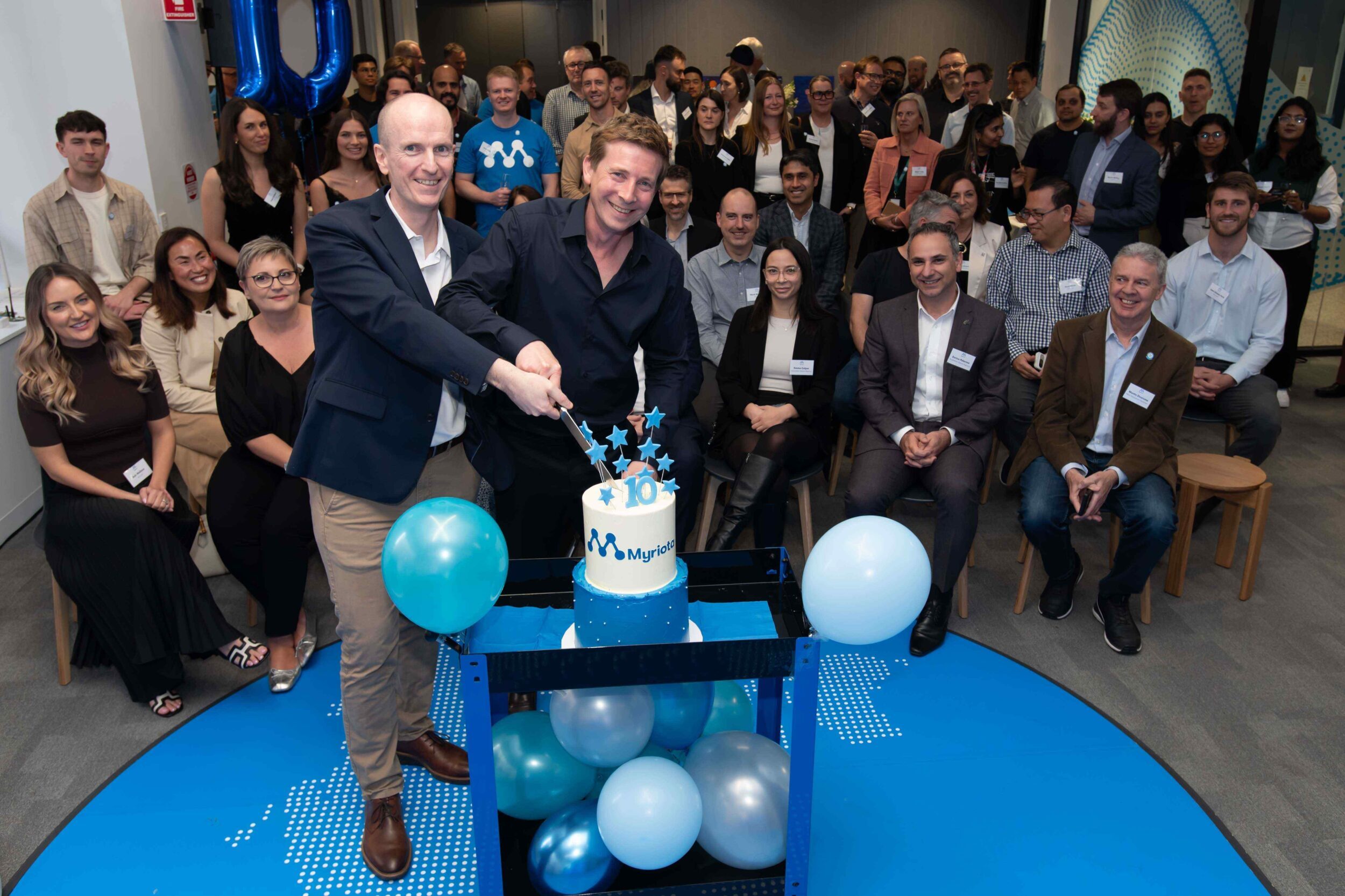
The image gives proper scale to the job. There are people responsible for the radio technology, the products, the finances, the customers and the regulatory permissions that let the network operate. In April 2026, when Myriota announced another employer award, Cade credited people and talent leader Sharon Elding for helping translate the company’s direction into the team’s experience of working there.
His earlier farewell at Trustonic and this later acknowledgement have something in common. Both recognise work spread across an organisation. The public record offers a career full of partnerships, technical platforms and handovers. Its continuity lies in making those arrangements useful enough for other people to depend on.
Somewhere at the end of the network is a meter, a pump or a piece of equipment with a reading to send. The grand journey through orbit becomes a small piece of information on somebody’s screen. For Cade’s current business, that is where the work earns its keep.
Follow the connections
- Ben Cade on LinkedIn
- Myriota
- Trustonic company profile
- Watch: Achieving Wide-Scale IoT Adoption
- Read Cade’s Trustonic farewell
- Trustonic’s 2020 acquisition
- Myriota’s latest constellation expansion
- Ten years of Myriota
- Myriota’s HyperPulse launch
- Myriota and Grundfos
- Water monitoring in Saudi Arabia
- Myriota joins ETSI
- Linaro’s founding-year leadership
- Volkswagen’s key-sharing application