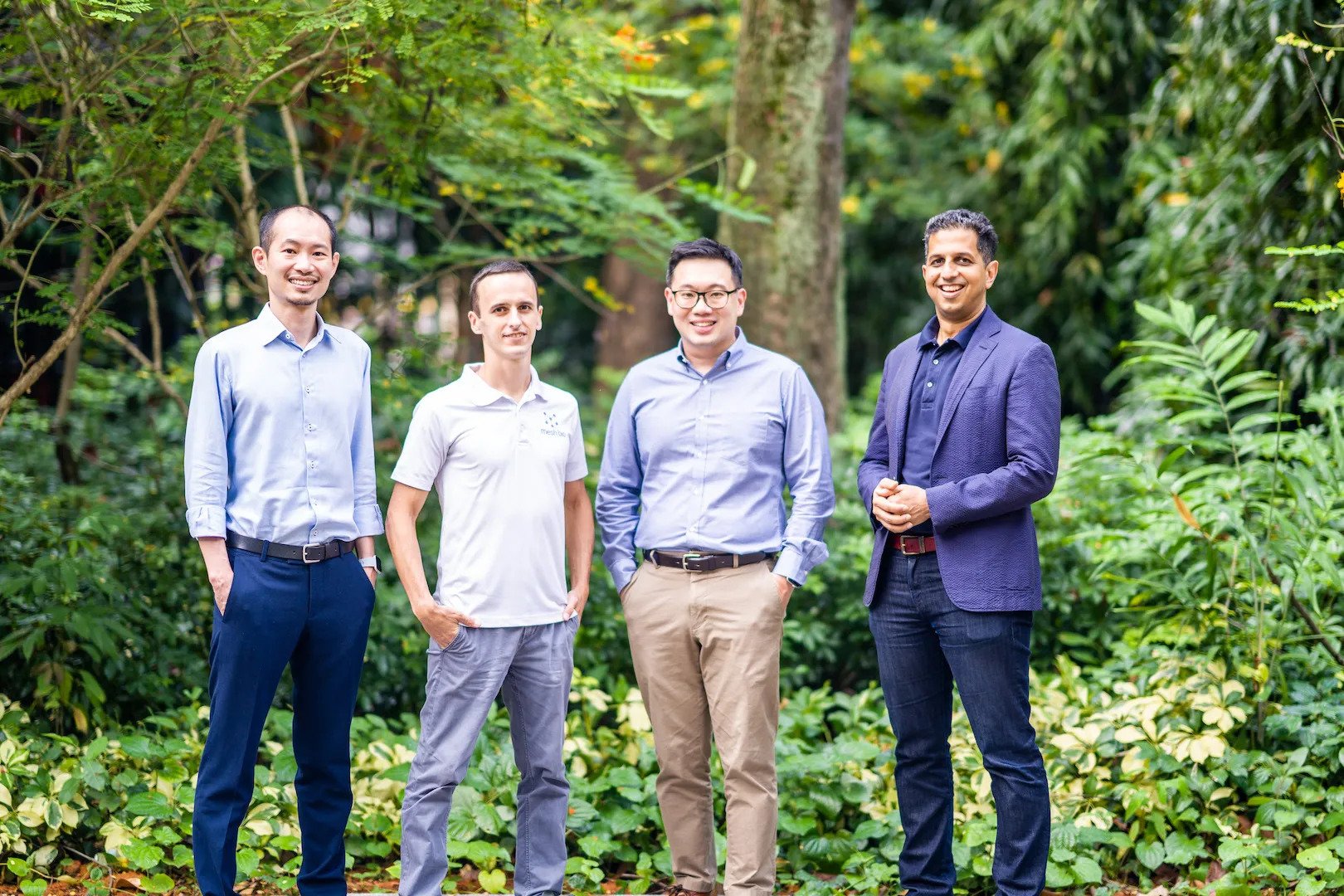
Andrew Wu is standing on the left of a photograph, smiling beside three other people. There is greenery behind them and no particular effort to make the picture look like the future. It accompanied Mesh Bio’s March 2021 announcement of US$1.8 million in seed funding. The company had a chief executive, a technical co-founder, a third founding collaborator and an investor in the frame. A fairly sensible way to photograph a business, really: include some of the people required to make it exist.
Wu’s title was co-founder and CEO. The longer explanation involved a biochemical engineering education in London, regional operations in Southeast Asia and years spent helping technical work reach commercial use. By the time he helped start Mesh Bio in 2018, he had already done several of the jobs a young company eventually discovers it needs. His story begins with that accumulation of responsibilities, well before anyone had a funding announcement to circulate.
Five markets before a founding date
At University College London, Wu earned a bachelor’s degree and a PhD in biochemical engineering. His doctoral studies ran from 2003 to 2007. His doctoral research concerned process scale-up, a suitably practical subject for someone whose later career would keep returning to the question of how technical work travels beyond its original setting. He also served as a vice warden in UCL residences. Even the university years contained a little administration.
Wu began his career as a bioprocess engineer. From 2007 to 2011, he was technical director at Cordlife Limited, responsible for laboratory operations across five regional markets. The number matters because it changes the nature of the assignment. Five locations bring more people, more coordination and more opportunities for an apparently straightforward instruction to become complicated. His responsibilities also included quality accreditation work.
The titles that followed kept moving him across the boundary between technical expertise and business responsibility. He held senior management positions at Clearbridge Biomedics from 2011 to 2016, then served as chief operating officer in 2016 and 2017. In June 2017, he became chief product officer at Clearbridge Health. Engineering, operations, product: these are different ways into a company’s daily decisions. Wu had occupied each before taking on the founder’s job.
at Cordlife
at Clearbridge
at Mesh Bio
The colleague who went looking for colleagues
Chee Wah Chong, a former colleague, recalled Wu arriving as a project director in 2011. What stayed with Chong was the effort Wu put into finding people for a new team. He described someone who spent time searching for suitable candidates and shaping the organisation around what the business needed to accomplish. Chong praised his execution as well as his strategy.
That recollection supplies some texture to a career otherwise easy to reduce to a sequence of executive abbreviations. A COO can sound like a person who inherits a working machine and keeps it oiled. Here was an account of someone helping assemble the machine, including the people who would decide whether it ran at all. Recruitment appeared as part of the work itself.
Another former colleague, Cherie Daly, described Wu as organised, efficient and focused. Those are workplace observations, rather than a licence to invent a private personality. They nevertheless fit the responsibilities visible in his career. His professional record repeatedly involves taking technical expertise into an organisation, then dealing with the people and practical arrangements needed to put it to use.
Wu later gave his own account of what he wanted in recruits. In a 2020 interview, he explained his interest in people who could work beyond a single specialism and take on hybrid roles. He added: “As with all startups, being agile and adaptable are key qualities that we value.” It is an unglamorous hiring requirement with considerable consequences. A young company’s organisation chart can be more of a pencil sketch than its employees would prefer.
Singapore, 2018. Munich, next.
Mesh Bio was founded in Singapore in 2018. The early founding group included Wu, Arsen Batagov and Melvin Heng. Wu brought his experience of operations and commercialisation; Batagov brought a research and bioinformatics background. The company’s current leadership identifies Wu as CEO and Batagov as CTO. The combination gave the enterprise different kinds of experience from the beginning.
In 2019, Mesh Bio was selected for the third batch of Startup Creasphere in Munich. The programme connected startups with corporate partners, including Roche and Plug and Play. For a recently formed Singapore company, it offered a way to meet people and test ideas beyond its home market. An accelerator’s grandest claims can fill a brochure. Access to experienced people is a more concrete benefit.
Wu’s own reflection was straightforward: “I've learned so much from these peers and mentors.” He posted it while sharing the company’s account of its Munich experience. That small sentence is useful because it leaves room for a founder to be a learner. A doctorate and a succession of senior roles had given him experience. They had also brought him to another room full of people worth listening to.
The programme gave Mesh Bio opportunities to develop relationships and refine its work with established organisations. Wu discussed those possibilities alongside plans to extend partnerships beyond Singapore. International ambition was already part of the company’s early conversation. So was the less theatrical business of learning enough about another market to be useful there.
Four people in the funding photograph
By March 2021, Mesh Bio had a seed round to announce. Elev8.vc and Seeds Capital led the US$1.8 million investment, with Citrine Capital and Tael Partners participating. The photograph placed Wu beside Batagov, Heng and Elev8.vc’s Aditya Mathur. It is tempting to let the number take over the story. The company had also reached a point at which a group of investors was prepared to back its next stage.
East Ventures announced an investment in October 2023. A further announcement followed on 30 January 2024: Mesh Bio had raised US$3.5 million in Series A financing led by East Ventures, with existing investors also participating. The two disclosed round amounts mark separate moments in the business. They are useful dates in Wu’s career, without being a measure of his personal finances or a substitute for understanding his work.
Individual round amounts. Company financing, not personal wealth.
In his public response to the East Ventures investment, Wu thanked both the investors and his colleagues. The team’s hours and commitment featured in the acknowledgement. Public thank-yous can become a corporate reflex, of course. Across Wu’s posts, however, the list of other people keeps returning. His accounts of the company leave colleagues, partners and mentors visibly attached to its progress.
The company gets more company
The partnerships expanded alongside the financing. In 2023, Wu signed a memorandum of understanding with Indonesia’s Pramita, represented by Nabil Fachliansyah. By July 2024, Mesh Bio was describing agreements with three additional Indonesian organisations and operations in the Philippines in collaboration with Fullerton. The geography in those announcements gives substance to the earlier talk of moving beyond Singapore.
A founder can describe Southeast Asia as a market in a single breath. Operating across it takes more conversations. Wu’s earlier regional responsibilities make this part of the company’s development especially relevant to his story. He had already worked in a role spanning five markets. At Mesh Bio, regional expansion again meant relationships with organisations that brought their own experience and requirements.
His work also extended to younger teams. In 2021, he was a technology mentor to Team Screenable in a National University of Singapore competition. The team placed third in the open category and received a social responsibility award. It is a modest entry beside a funding round, but it adds another relationship to the picture: an experienced operator helping students develop their work.
In 2025, Wu welcomed Adrian Chua as Mesh Bio’s chief operating officer. Chua had already been advising the team and contributing to its operations and growth strategy. Moving him into an executive role made that relationship more formal. For Wu, a former COO himself, the appointment also meant adding another person with operating responsibility to the company’s leadership.
What happens off-mic
Recognition supplied several public occasions along the way. Mesh Bio was selected for Forbes Asia’s 100 to Watch list for 2024. When Wu attended the award event, he acknowledged the team and the wider network around it, and congratulated fellow East Ventures portfolio companies. In November 2025, Mesh Bio was among the Emerging Enterprise Award winners. These were company milestones, shared with the people who had helped produce them.
The international connections continued. Mesh Bio appeared in the directory for Endless Frontier Labs’ Frontiers 2026 showcase, held in New York on 7 May. Wu was listed as CEO and co-founder alongside Batagov and Chua. London, Singapore, Munich, New York: the places trace an education, a company’s home and successive opportunities to meet collaborators and audiences.
“Doing this interview made me appreciate (again) how much work happens off-mic to make ‘innovation’ real.”Andrew Wu, commenting after a radio appearance
That observation, shared after a radio interview, brings the story back to the people outside the spotlight. Wu had spoken on air; colleagues had contributed the work behind what he could say. It was a useful acknowledgement from a chief executive whose career had included so much responsibility for getting organisations to function.
Return to the funding photograph and the arrangement makes sense. Wu is clearly present, and so are his collaborators. The professional story attached to him is full of degrees, titles, investments and international programmes. It also contains recruitment, mentoring and the decision to bring an adviser into an executive role. Those details give the milestones their human scale. Someone has to find the colleagues, make the introductions and keep the work moving after the photograph has been taken.