In 2012, a New Jersey hospital rehearsed a catastrophe. Three hundred volunteers played casualties in a Department of Defense-supported exercise at Robert Wood Johnson University Hospital. The hospital tested its response with and without real-time location technology. According to a later customer account, the exercise exposed a surprisingly ordinary obstacle: knowing where people and equipment actually were.
- STANLEY Healthcare is now Securitas Healthcare.
- It connects location tags, safety devices and software across hospitals and senior living.
- The useful trick: make the information change the daily routine.
The drill gave administrators a reason to see location data as everyday infrastructure. RWJBarnabas Health subsequently reported roughly 16,400 tagged assets across seven hospitals and nearly $9 million saved in devices, medication and food. Those are historical customer-reported results in a vendor case study. They make an arresting proposition: some of a hospital’s next equipment budget may already be sitting somewhere inside the building.
A pump can be present and absent
Consider the infusion pump. It moves between patients, cleaning areas, storage rooms and maintenance. An inventory can say the hospital owns it without telling a nurse whether it is nearby, clean or available. Buying another pump addresses ownership. The immediate problem is access.
Securitas Healthcare sells the machinery for answering those smaller questions. Its AeroScout real-time location system, or RTLS, combines wireless tags and location infrastructure with software. MobileView turns those signals into maps, alerts and reports. Applications cover equipment, patient flow, staff workflow, environmental conditions and protection. The company occupies the space between a hospital’s physical operations and its information systems.
AdventHealth Orlando offers a useful example. Its work on infusion pumps joined PAR-level management - keeping enough equipment in the right places - with on-unit cleaning. The change linked a location system to a dependable routine. Staff could collect a clean pump where they expected to find one, rather than begin another round of telephone calls.
Identified savings in capital, labor and repairs across four units.
Customer results described in the company’s PAR-level management account; not a forecast for other hospitals.That distinction matters. A screen cannot disinfect a pump or carry it down a corridor. The plausible advantage comes from combining visibility with an agreed handoff. Hospitals evaluating the system can copy that method: choose one equipment category, measure the delays, and change the replenishment routine alongside the technology.
The same signal, a different emergency
The portfolio’s breadth becomes clearer when the thing being located is a person. Hugs, introduced in 1998, puts a small security tag on an infant’s ankle. It activates when attached and supports tamper and exit detection. An optional component called Kisses checks mother-and-infant matching. The names sound like nursery decorations; the software serves a demanding security job.
The company says Hugs serves more than 1,780 hospitals and protects two million infants annually. Elsewhere in the portfolio, staff duress badges let caregivers request help with location information. These applications share a practical concern: an alarm becomes more useful when the responder knows where to go.
- 01SenseA tag or sensor reports a change.
- 02InterpretSoftware applies the configured rule.
- 03RespondThe responsible team takes action.
Senior living brings another version of the same problem. At Nebraska’s Riverside Lodge, Arial emergency call and WanderGuard BLUE wander management feed alerts into one system. Maintenance staff can manage door controllers at an Arial station. Nurses receive resident calls and wandering alarms together. The gain is fewer administrative detours between a notification and a person who needs attention.
“One of the most important things to us is time.”Melissa Miller, Executive Director, Riverside Lodge
The refrigerator gets a voice
A refrigerator cannot press a call button. Sensors can do the equivalent. Environmental monitoring tracks conditions affecting medication, vaccines and other sensitive stock, then alerts staff when something needs attention. AeroScout Links packages this work in a cloud-based service with mobile notifications, reports and a tiered monthly subscription.
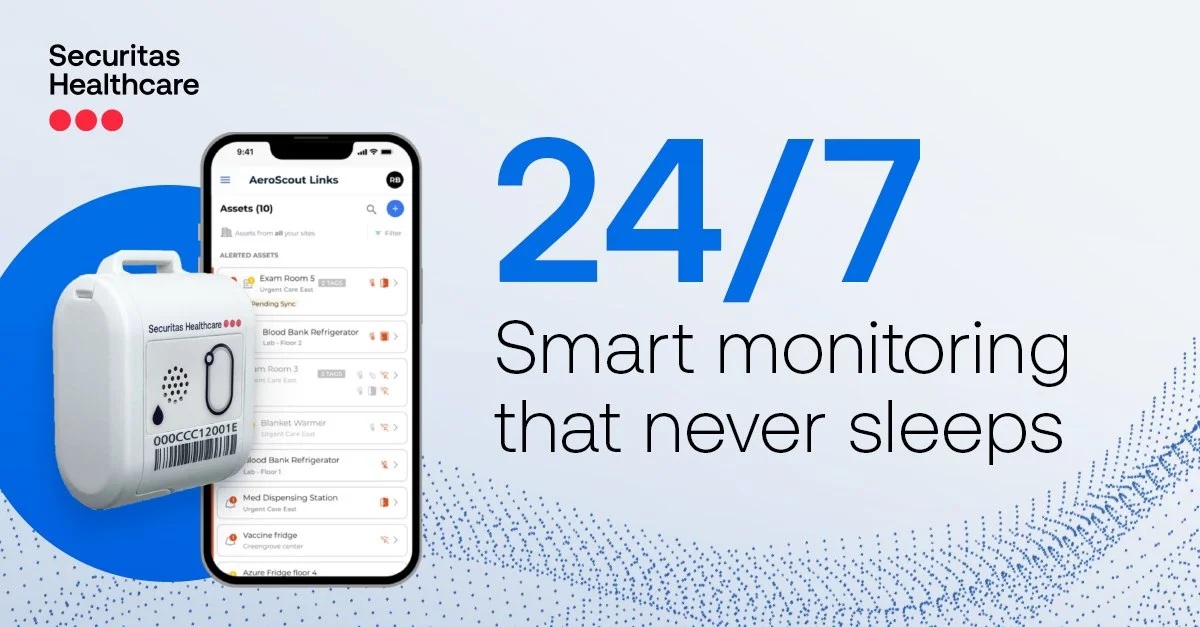
This is also where the business model becomes tangible. Securitas Healthcare supplies hardware, software and services; it offers training and clinical education as well as technology. A buyer needs a deployment plan, integration work and people who understand the alerts. Subscription software is one part of that relationship. Tags and training remain physical, practical work.
A familiar name, a cloudward turn
Securitas completed its acquisition of Stanley Security, including Healthcare, in July 2022. The announced $3.2 billion price covered the broader security transaction. Securitas Healthcare formally launched its new name in March 2023, carrying established product brands into a different corporate home.
Its competitive argument rests on the range of healthcare problems it can address together. Cisco infrastructure integration, Sonitor ultrasound positioning and BD Alaris device connections help explain that reach. AiRISTA also offers healthcare tracking and workflow software using existing wireless infrastructure. Buyers therefore have alternatives; the useful comparison is how each system fits the building, devices and work already there.
In February 2025, Securitas Healthcare announced its tenth Best in KLAS RTLS category win. In May 2026, it acquired ZulaFly, adding a modern cloud-based RTLS and staff safety platform. That purchase extends its cloud offering alongside established deployments. It also signals the continuing importance of making systems easier to manage across facilities.
The conditions for success are quite concrete: suitable wireless coverage, maintained tags, accurate configuration and someone responsible for responding. More signals can create more work when nobody owns the next step. The company’s training services acknowledge that implementation reaches beyond installation.
For the reader, the transferable idea is almost embarrassingly modest. Before adding equipment, establish what is available. Before adding another alarm, decide who will answer it. Before expanding a platform, test whether one daily task gets easier. The nurse looking for a clean pump is a rather good judge of whether the technology works.