At Bryan Health, the nurses had heard the alarms before. An earlier AI-only monitoring system had produced too many false positives. Attention drifted. Trust followed. When the Nebraska health system introduced Artisight, it changed the sequence: human observers first, artificial intelligence second. The machine would alert an observer, who decided whether the floor needed to hear about it.
- Artisight connects hospital rooms for remote care, observation and documentation.
- Its pitch spans the bedside and the operating room on shared infrastructure.
- The practical lesson: build a trusted response team before adding more alerts.
The first three months included calibration and confidence-building. The vendor-published case study reports a 40% reduction in falls with harm or injury, and ten full-time-equivalent roles redeployed from one-to-one observation. These are results from a local care program, rather than a promise about every installation.
“We had tried AI before and it created more noise than it solved.”
Jessica Hanes / Bryan Medical Center
There is a useful distinction here between recognizing a problem and arranging for someone to solve it. Hospital technology has to accomplish both. Artisight’s story becomes interesting at that junction.
A room that can share the work
The company calls its product a Smart Hospital Platform. In practical terms, it connects cameras, microphones, sensors, two-way communication and software to the work already happening around a patient. A remote nurse can help with admission questions or discharge education. An observer can watch patients at risk. Documentation can flow into the electronic health record.
These are different jobs. Observation is about attention; nursing requires clinical expertise. Artisight puts them on common infrastructure, alongside teleconsults and ambient documentation. A family member can join a conversation remotely. A specialist can appear without walking into the building. The room becomes a place several people can work through, even when only one is physically present.
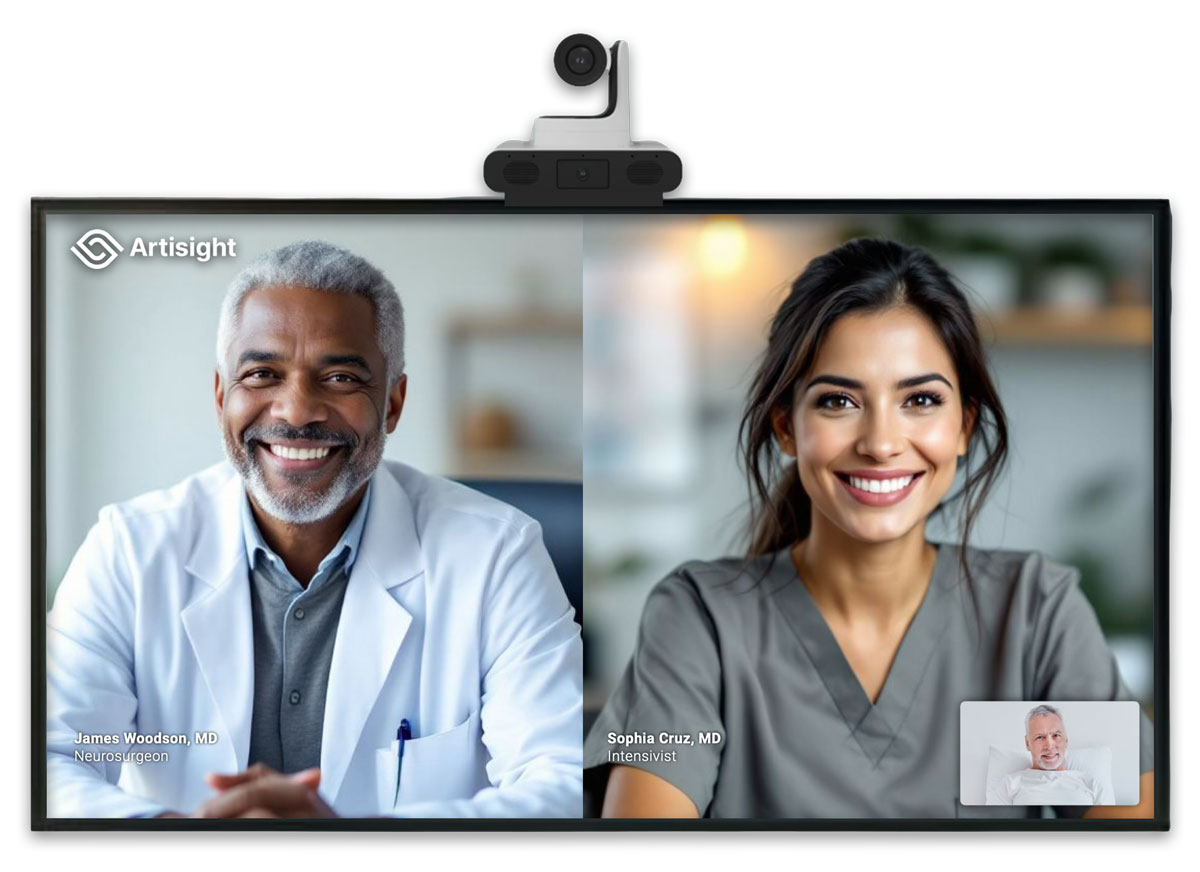
The All-in-One device handles sensing, communication and edge processing. Artisight says its NVIDIA Jetson Orin NX processor runs AI locally, reducing dependence on cloud processing and the bandwidth needed to send data away. Existing cameras can also connect through the Artisight Connect Module. That compatibility matters when the customer already owns a building full of equipment.
The operating room came first
Artisight began in 2015 with Andrew Gostine, Garrett Larance and Tim Koby. Its official history describes a resident physician joining forces with a lean manufacturing expert and a software-and-AI-focused physicist. The first application targeted operating-room efficiency. That origin helps explain why the company talks about coordination as readily as it talks about clinical care.
Inside an operating suite, the next useful action may be a notification that a room needs cleaning or that a procedure has finished. Artisight’s operating-room offering includes coordination, case-length prediction, tracking and documentation. Its expanded 2025 collaboration with KARL STORZ and NVIDIA supports Pathway.AI, bringing computer vision and ambient listening into perioperative workflows.
The underlying proposition is straightforward: stop making people repeatedly announce events the room can detect. The difficult part is fitting those detections to the institution. Artisight’s partnership announcement emphasizes local fine-tuning because procedures, teams and workflows differ. A hospital’s habits are part of the engineering problem.
Who gets the minutes back?
Guthrie offers a second view of the idea. Its Pulse Center connects care across a rural network, with Artisight cameras supporting visual monitoring and data collection. Remote expertise is particularly useful when experience is unevenly distributed across geography: the colleague who knows what to do may work at another hospital.
Artisight’s Guthrie case study describes virtual nurses handling documentation, medication verification, education and support for newer nurses. It reports that nurse turnover fell from 25% to 13% during the initial program. Those figures describe a broader operational change; they do not isolate the camera’s contribution from staffing, management or other tools.
The buyers are hospitals and health systems. The daily users include nurses, observers, physicians and operational teams. Their alternatives include AvaSure and Caregility, which also combine virtual nursing and observation capabilities. Artisight’s positioning brings operating-room workflow and bedside care into the same infrastructure discussion. Buyers still have to compare individual workflows, integration and support.
WellSpan’s expansion illustrates the buying process. An August 2023 pilot at its Surgery and Rehabilitation Hospital preceded a February 2024 announcement covering just over 1,000 beds. The health system worked with Artisight on algorithms for its setting. The sequence gives other buyers a practical starting point: establish a narrow use case, observe the results and then decide how far to extend it.
The price of a connected room
Artisight sells a subscription including hardware, software and updates. That makes continuing upgrades part of the commercial relationship. The financial question for a hospital extends beyond the subscription: remote work still needs staffing, escalation still needs a bedside response, and integration still needs people who understand the hospital.
For investors, the spending is more visible. Artisight announced a $42 million Series B in January 2024, with NVIDIA and health-system investors participating. Healthcare Brew subsequently reported an additional $40 million investment in July 2025. Funding pays for expansion; it does not establish what a customer earns back.
The installation is part of the invention
The 2026 announcements show the ambition. UChicago Medicine’s agreement includes more than 1,800 devices across several care settings. MetroHealth selected the platform for nearly 500 rooms across five facilities, with expansion planned over two years. These are deployment commitments, so their scale should be read separately from completed outcomes.
Then, in September, Artisight acquired TMG Global, bringing site readiness, installation, testing and clinical handoff expertise in-house. It is a revealing purchase. A clever model cannot repair a network closet or train a shift. Someone has to make the room usable.
The transferable lesson is to design the response alongside the detection. Choose a concrete task. Give it an owner. Check coverage and staff confidence before expanding. Without those conditions, a connected room can simply manufacture another interruption. With them, the screen has a chance to give the bedside team something scarce: an uninterrupted minute.