A hospital can buy a ventilator. It cannot buy, off the shelf, the specialist who knows when to change its settings at two in the morning. That mismatch is the little crack Cloudphysician widened into a company. The Indian-founded business connects hospital intensive-care units to remote intensivists and critical-care nurses, then gives both ends the same view of the patient through a platform called RADAR. The machine may be in a district hospital; the experienced eye can be somewhere else.
- Cloudphysician sells hospitals remote clinical coverage, workflow software and training.
- RADAR brings video, vitals, documentation and team communication into one place; AINA adds video-based safety alerts.
- The company says it has served more than 300 hospitals and treated more than 200,000 patients.
- The model depends on capable bedside staff, reliable connections and a clear division of clinical responsibility.
Dr. Dhruv Joshi and Dr. Dileep Raman founded Cloudphysician in 2017. Both are critical-care physicians. That matters because the first design problem was not how to put an ICU on a screen. It was how a distant clinician could become useful to the nurse standing beside the bed. A video call can show a face; it does not, by itself, show the medication history, a change in heart rate or who has authority to act.

The night shift, stretched across a map
Cloudphysician's service has the shape of a hub and spokes. Its care center supplies remote specialists; partner hospitals supply the beds, local clinicians and physical care. Cameras with pan, tilt and zoom, secure communications and the RADAR app let the two teams examine a case together. The remote team can review vitals, labs and imaging, join rounds, recommend treatment and respond to emergencies. The bedside team carries out the hands-on work and makes the final local decisions. This is a service contract as much as a software license.
This arrangement gave hospitals in smaller cities a way to handle harder cases without sending every patient elsewhere. Cloudphysician describes one remote hospital 2,200 kilometers from its care center where a team managed a child with severe respiratory failure using prone ventilation under remote guidance. The point is not that distance disappears. The point is that expertise can cross it while the patient stays near home.
The pandemic provided a harsher test. A published account of Cloudphysician's public-private partnerships reports work with 14 government hospitals across four Indian states between June 2020 and December 2021. It records 487 ICU beds added and 4,514 admissions. The paper also describes the conditions for admission to the network: adequate equipment, connectivity, communication and staff willing to train. Those details are less photogenic than an AI dashboard, and far more useful to anyone trying to copy the model.
The screen that had to earn its place
In one Cloudphysician case study, a Kolkata superspecialty hospital had already tried a prominent international technology provider. Adoption was limited. The hospital needed clinicians to find data quickly, use the system across units and expand it to a wider network; the earlier tool did not fit those demands. That is the revealing failure in this story. In clinical work, a product loses the room before it loses the sale: a doctor reaches for the old method because the new one slows the next decision.
RADAR was built around that daily choreography. It offers a web and mobile workspace with live video, secure chat, alerts, handovers and patient records. Its named assistants take on narrower jobs: AIRA drafts notes, HERA digitizes documents, NETRA uses computer vision and SWARA handles dictation. The company now presents AINA, a video AI agent that reads patient movement alongside clinical context to flag possible risks. An alert can help, but it still needs a recipient who trusts it and can act.
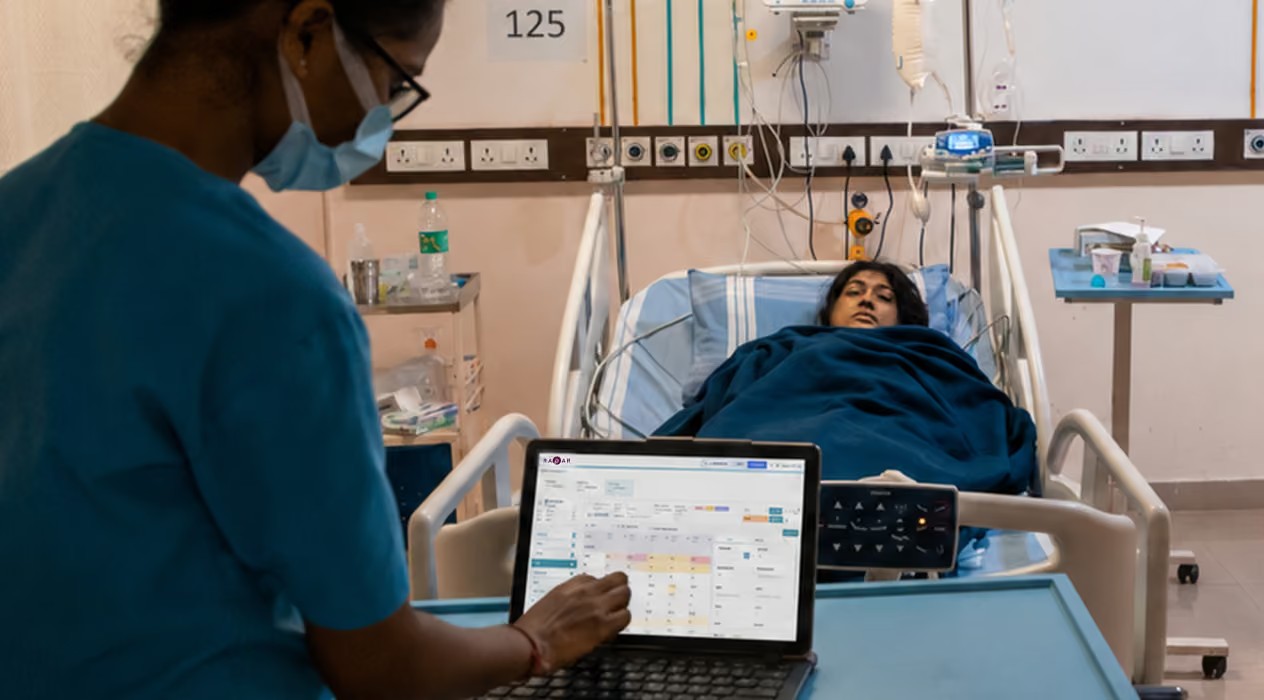
The product range has widened from Smart-ICU to neonatal, emergency and dialysis services. That expansion makes sense: these are all places where specialist judgment is unevenly distributed and delays matter. It also makes the business harder. Neonatal care is not an adult ICU with smaller beds. Each specialty needs its own protocols, training and escalation rules.
“We’re taking a much wider approach to operational AI.”Dr. Dileep Raman, in a Google Cloud case study
What the buyer actually buys
Cloudphysician sells to hospitals, not to patients browsing an app store. Its public Smart-ICU agreement describes contracted remote clinical services, RADAR, training and cameras installed by Cloudphysician. The hospital is responsible for specified local hardware, networking, power and bedside staffing. There is no public standard price. A buyer would need a quote and a clear count of beds, cameras, network work and coverage hours before claiming the system saves money. The company's own promise is operational: admit more complex cases, reduce transfers and use existing beds more effectively.
Start with the night shift, not the demo. Map who notices deterioration, who can authorize a change and how the remote specialist reaches that person. Then test the camera view, connection, handover and false-alert burden with the actual bedside team.
Cloudphysician reports more than 300 hospitals served and more than 200,000 patients treated. Forbes Asia reported more than 2,000 monitored beds across India, Bangladesh and Kenya in 2025, when it named the company to its 100 to Watch list. Cloudphysician and Google Cloud also report an up-to-40% reduction in ICU mortality within partner hospitals. That figure describes the reported network experience; it is not a forecast for every new ward. Patient mix, staffing, baseline care and how outcomes are measured all shape what a hospital can expect.
A different reason to change clouds
The company's infrastructure choice offers a small window into its priorities. It moved its primary infrastructure to Google Cloud in late 2023. Technology director Dhruv Sud said cost mattered, but so did access to Med-PaLM, Vertex AI and Gemini. Google Cloud describes Cloud Vision API helping read inconsistent monitor displays and lab documents. That is the practical indignity of hospital technology: two machines can measure the same thing and present it in incompatible ways. Before software can predict anything, it must first know what it is looking at.
Cloudphysician's competitive position sits between three alternatives: hire more local intensivists, build an in-house tele-ICU, or buy a standalone monitoring platform. It bundles clinicians, workflows, training and software. That bundle can make adoption easier for a hospital short of specialists. It also means the company must perform as a clinical operator every day, not merely ship a release. The best technology in this account is the part that makes another person's work possible at 2 a.m.