The least glamorous piece of hospital technology may be a voice saying, “Please wait.” A patient starts to get up. Someone watching from another room notices, speaks through a bedside device, and calls for help. A few seconds later, a colleague arrives. AvaSure has made that sequence into a business. The camera gets the attention; the sequence deserves it.
- AvaSure connects remote observers and nurses with hospital patients and bedside teams.
- Virtual sitting reduces dependence on a separate sitter beside every monitored bed.
- Its next ambition is the connected room: nursing, consultations, AI, and clinical systems together.
- The useful lesson is operational: design the response before admiring the camera.
01The expensive business of paying attention
Watching over a vulnerable patient is deceptively demanding work. An observer needs to notice movement, interpret it, and act before a small decision becomes an injury. Assigning one person to one bed gives the task a reassuring simplicity. It also gives it an awkward arithmetic. Every additional patient requires another person, shift after shift.
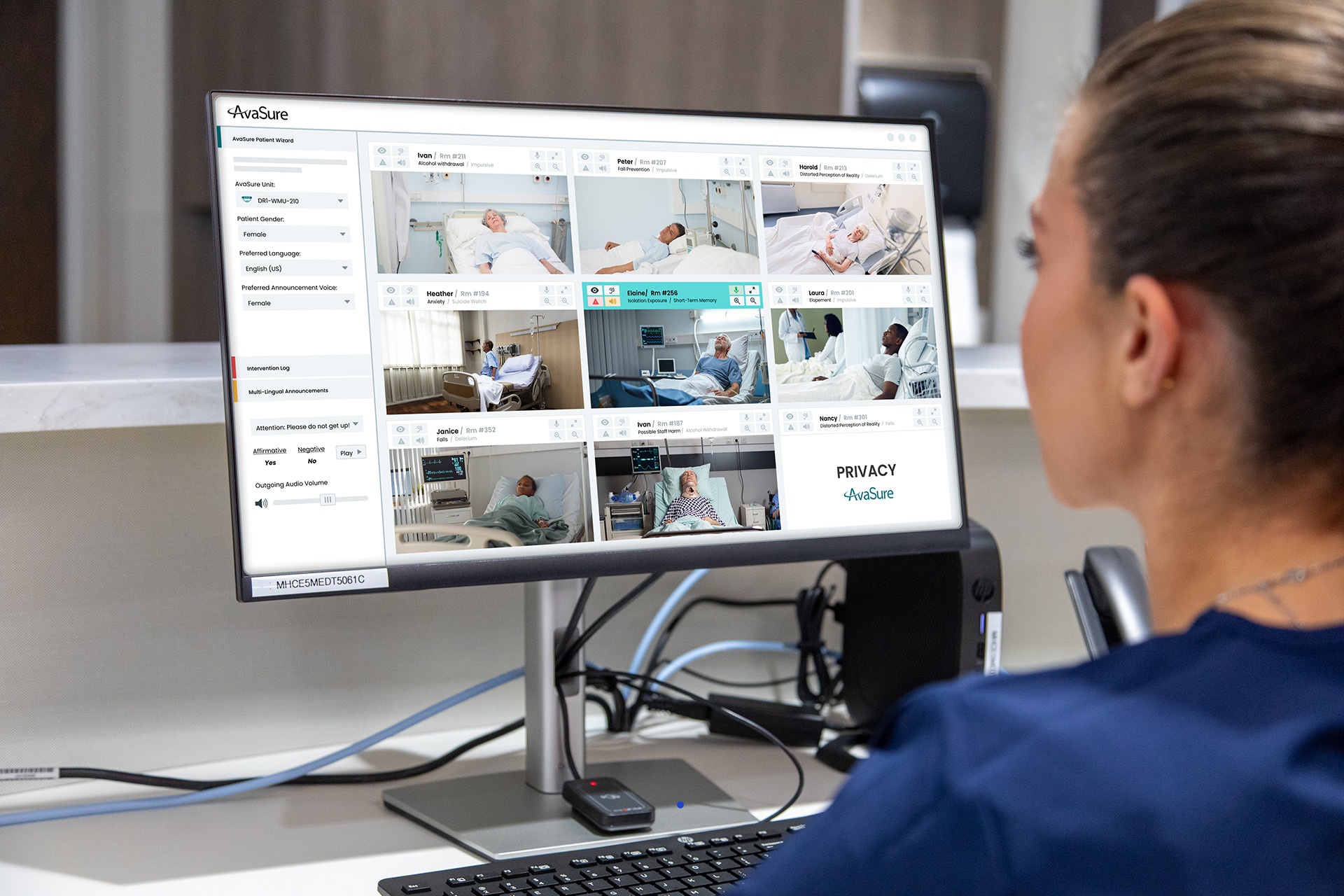
AvaSure’s TeleSitter solution changes that arithmetic. Live video and audio let a trained attendant observe several patients from a monitoring station, speak with them, and summon bedside help. In a 2019 study covering 71 hospitals and 15,021 patients, the reported average alarm response time was 15.8 seconds. The measured fall rate was 1.50 per 1,000 surveillance days. Those figures describe a particular monitored population, rather than a promise for every ward.
The company began in 2008, founded by Brad Playford. Its early proposition was fall prevention. Today it sells a broader inpatient virtual care platform to hospitals and health systems. The market is institutional: the buyer has nursing rosters, IT systems, clinical policies, and a budget committee. A pleasing video call is merely the entrance examination.
02A screen is a staffing decision
At St. Luke’s in Duluth, the program that began in November 2021 used 16 devices and a two-person routine. One specialist watched the monitors; another delivered equipment, checked rooms, and exchanged updates with nurses. They swapped roles at least every four hours, depending on patient acuity, to manage fatigue. The hospital reported more than $1.5 million in annual savings for 2023 and, on some units, a 73% reduction in one-to-one sitters between 2022 and 2023.
“Promoting a team approach to safety has helped build trust and goodwill among departments.”Kristin Townley, RN, St. Luke’s
The detail worth stealing is the division of work. Monitoring did not make equipment arrive at the bed. Somebody had that job. An order did not explain the system to a patient. Somebody had that job, too. The hospital put movement, communication, and observation into a routine. Its savings belong to that whole arrangement.
AvaSure’s educators had described another turning point back in 2018: the first successful intervention. Stacey Overholt, then its clinical services leader, wrote about the moment an observer persuaded a patient to stay in bed or brought a nurse to the room in time. Staff confidence followed a visible result. For a purchasing committee, evidence may arrive in a slide deck. For a ward, it can arrive wearing a colleague’s shoes.
03The bill beneath the savings
A 2025 study at Gaylord Specialty Healthcare gives the economics a useful scale. Its program leased 12 Guardian devices and software, with equipment costs averaging $89,000 annually. Estimated savings excluding fall costs were $160,234 across the study period. IT support and Wi-Fi improvements were omitted. Total falls declined 25.1%, but the proportion involving injury did not significantly change. This was an observational comparison with an earlier period.
Equipment and software leasing. Observer staffing and hospital infrastructure require their own budget.
The study also recorded hardware and software errors that interrupted monitoring. Those mundane failures matter: a disconnected patient is still a patient. A hospital needs downtime procedures, reliable coverage, and an in-person response. The honest calculation counts the full operating system around the screen.
There is an editorial temptation to turn every successful intervention into a fall prevented and every avoided fall into money saved. Resist it. Interventions, observed injuries, labor hours, and modeled costs answer different questions. A finance team should keep them in separate columns. The most convincing business case is the one that survives that small act of tidiness.
04The room grows a second job
Once a room can connect a patient to a remote observer, it can connect that patient to a registered nurse. AvaSure supports admissions, discharge teaching, medication reconciliation, documentation, and mentoring from a distance. Virtual sitting and virtual nursing use related infrastructure, but require different people and clinical responsibilities. The distinction matters as much as the equipment.
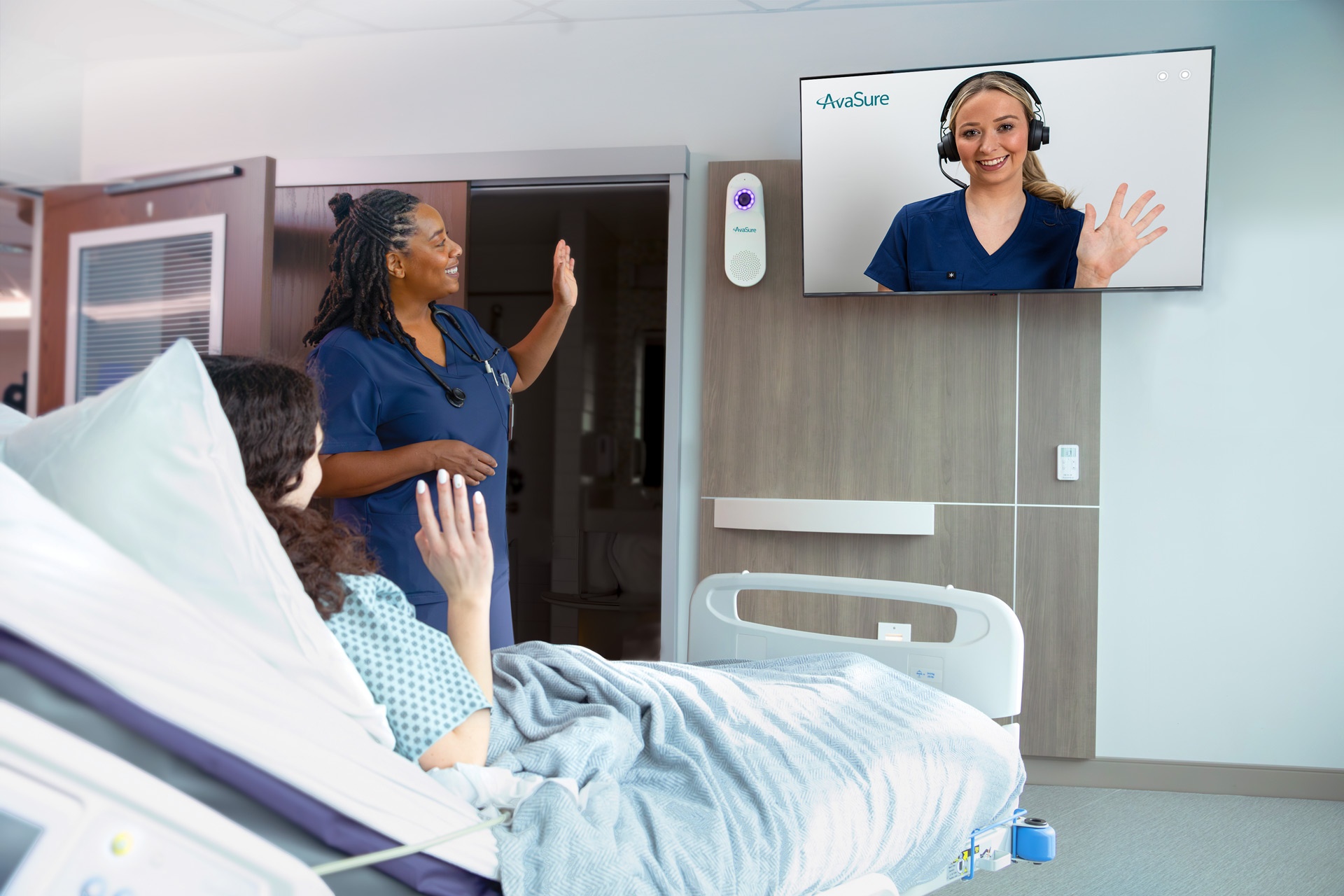
AvaSure’s adoption model proposes a sequence: start with virtual sitting, optimize it, then use the savings to launch and expand virtual nursing. Its 2024 account of UCHealth described 693 devices and experienced remote nurses supporting the recognition of patient deterioration. Its example of Holzer Health System was smaller: 16 devices serving virtual sitting and specialty care, including wound consultations between facilities.
That sequence is commercially astute. It gives hospitals a reason to buy a limited deployment and a reason to reuse it. It also makes adoption less dependent on a grand promise about the future. The first investment has a job; the next investment must earn one.
05A platform with hospital manners
AvaSure combines enterprise software, room hardware, implementation, and support. The devices include mobile Guardian carts, ceiling equipment, and DualFlex fixed units. DualFlex pairs a wide-angle sensing camera with a separate camera for consultations. Placement becomes a clinical and practical choice: portable equipment can follow demand; fixed installations give a room a permanent connection.
Caregility and Artisight inhabit the same broad virtual care market. AvaSure’s pitch rests on its long experience with observation, its clinical implementation team, and its integrations. The company says 15% of its team are nurses. That is a pertinent number for software whose users work through alarms, patient anxiety, and shift changes. Clinical experience should show up in the workflow, where customers can judge it.
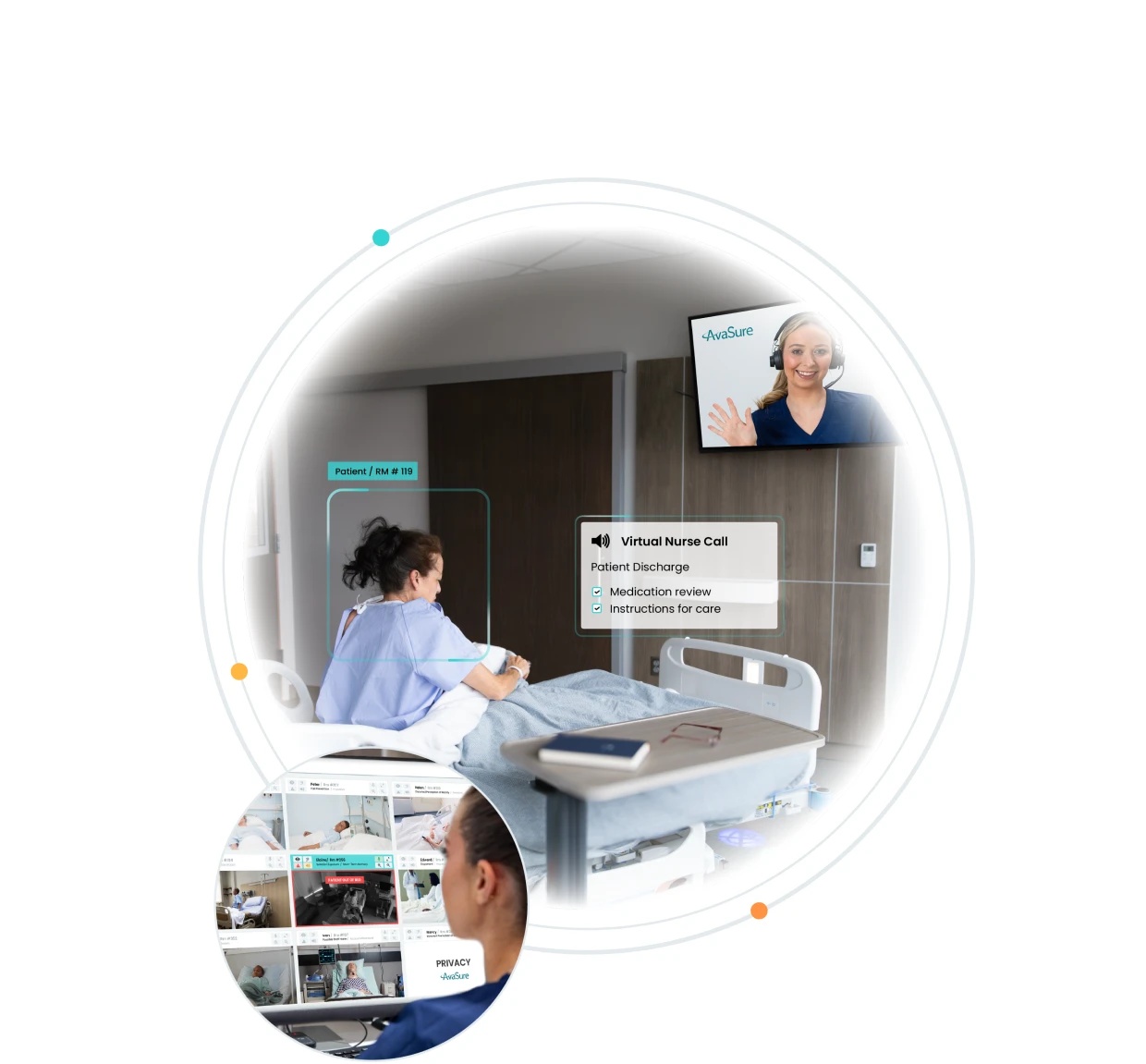
Its acquisitions explain the direction. In July 2024, it bought Ouva’s smart room solutions after a prior partnership, adding ambient AI capabilities and engineering resources. In March 2025, it acquired Nurse Disrupted, bringing founder Bre Loughlin into AvaSure and naming Tufts Medical Center an innovation partner. Algorithms and nursing practice arrived through different doors.
The integrations are equally revealing. A 2025 Ascom agreement routes monitoring alerts into clinical communications. In July 2026, AvaSure announced an Epic Toolbox designation for inpatient virtual care, covering workflows such as launching visits inside Epic and supporting observation with Epic Monitor. Less switching between systems is a practical ambition in a profession already rich in interruptions.
06Copy the sequence, then measure it
The AI ambitions are growing. AvaSure previewed a Virtual Care Assistant called Vicky in March 2025, using Oracle Cloud Infrastructure and NVIDIA technology. The intended role is to sort patient requests and direct them to appropriate teams. A request for assistance can be a clinical emergency or an operational task; routing it well is the point. A preview is an ambition to evaluate, rather than an outcome to bank.
Expansion also means different care settings. In June 2026, AvaSure, VirtuAlly, and Anuvia announced a virtual nursing program for residential substance use and behavioral health treatment. Their account emphasized designing workflows around that setting’s staffing and regulatory requirements. The room may look familiar. The work inside it changes.
For hospitals considering the approach, the transferable idea is modest and demanding: choose a task, specify who acts, train the people, and measure the result. Check whether patients suit remote observation and whether staff can respond promptly. Watching cannot supply hands-on care. A more capable room still needs a capable team.
AvaSure’s appeal is that it began with a task small enough to understand and costly enough to matter. Its next challenge is preserving that clarity as it adds applications. The hospital of the future has no shortage of things that can see. It will benefit from knowing exactly who is expected to do something next.