The modern hospital has a peculiar kind of traffic. Nurses walk toward medication rooms. Pharmacy technicians push carts toward nursing floors. Vials travel from wholesalers to shelves, from shelves to drawers, and from drawers to patients. Every movement carries a question: Is this the right medication, in the right dose, for the right person, at the right time? Omnicell built a business by putting a computer, a lock and an audit trail in the middle of that journey.
The company is best recognized for automated dispensing cabinets - tall banks of secure drawers that sit close to patients and release medications to authorized clinicians. But describing Omnicell as a cabinet maker is now like describing a smartphone as a telephone. Its portfolio reaches into the central pharmacy, the sterile IV room, controlled-substance monitoring, inventory analytics, retail patient communication, specialty pharmacy and 340B services. Hardware is the visible edge. Software and human expertise increasingly surround it.
A cabinet born from a scavenger hunt
Randall Lipps found the problem before he found the product. In 1992, while his newborn daughter was in intensive care at the University of California, San Francisco, he watched nurses struggle to locate supplies. Lipps had worked in sales and operations at American Airlines, an industry trained to move people, parts and luggage through a time-sensitive network. He wondered why a hospital could not manage supplies with the same operational discipline.
Omnicell sold its first hospital system in 1994 and went public in 2001. Over time, the problem shifted from locating gauze and syringes to governing medication itself: who may access it, where it should be stored, when it will expire, whether a controlled substance has gone missing and how much attention a nurse spends at the cabinet instead of the bedside. The drawer became a point in a network.
What the system actually does
At the point of care, an authorized nurse signs into a dispensing cabinet, selects a patient and retrieves an ordered medication from a controlled pocket. The system records the transaction and updates inventory. That sounds modest, but it replaces loose keys, handwritten counts and open shelves with identity, permissions and traceability. The cabinet can also warn about look-alike or sound-alike drugs, manage overrides and help pharmacy teams plan restocking work.
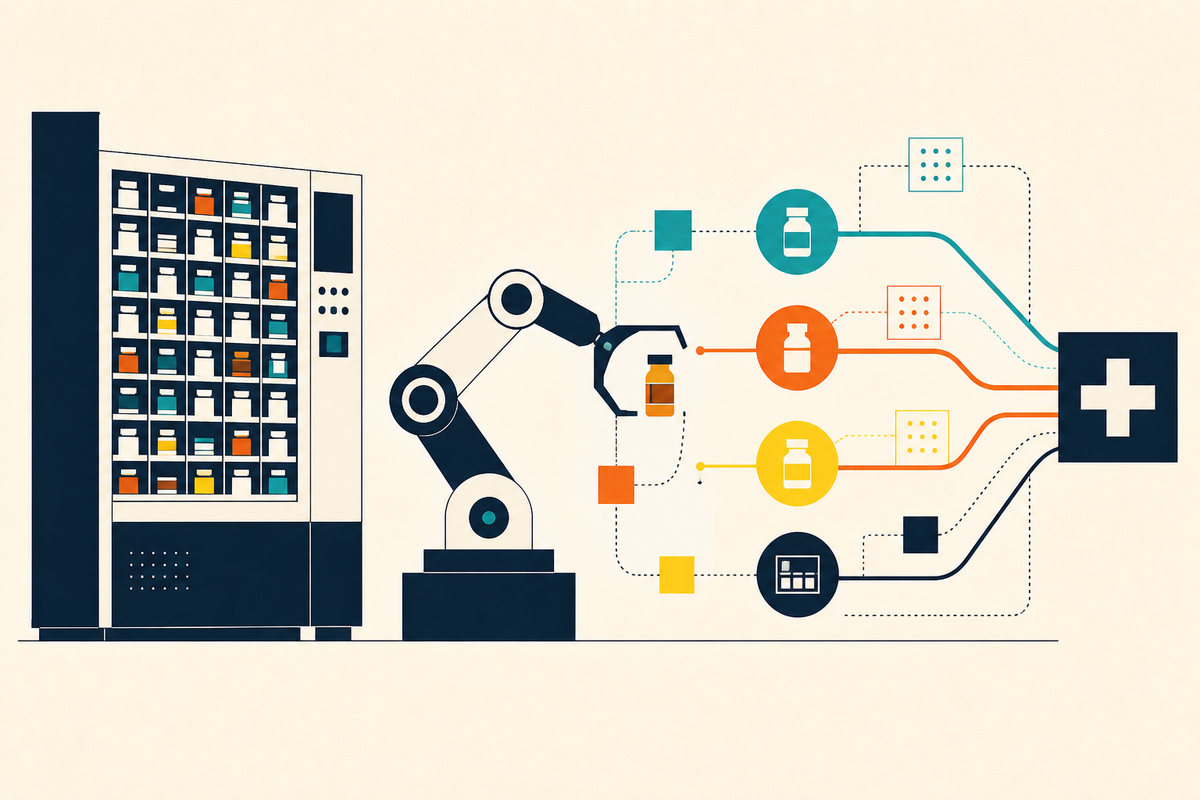
One dose, four operational handoffs
Deeper in the hospital, Omnicell sells larger machines for different kinds of repetition. The XR2 robot automates central-pharmacy picking and dispensing. Vertical carousels compress storage and bring products to technicians rather than sending technicians up and down aisles. IVX Station compounds sterile intravenous doses using barcode scans, imaging and weight-based checks. Omnicell says its compounding robots have prepared more than 13 million patient doses. Pharmacists still define protocols and verify work; the machine handles the controlled, repeatable motions.
Outside the inpatient pharmacy, the company operates specialty-pharmacy and 340B services for health systems and EnlivenHealth software for retail pharmacies and health plans. Those businesses tackle a different end of the medication journey: access, patient outreach, refills, adherence and program economics. The common thread is not a cabinet. It is the attempt to make medication work visible enough to manage.
The business behind the beeps
Omnicell makes money twice: when a health system buys and installs technology, and over the years that follow. Connected devices, perpetual software licenses and related items are product revenue. Consumables, maintenance, technical support, cloud software and expert services create the recurring layer. In 2025, products represented 56 percent of the company's $1.185 billion in revenue; services represented 44 percent. Annual recurring revenue reached $636 million at year-end, up from $580 million a year earlier.
2025 revenue mix: machine up front, service over time
That model rewards long relationships. A dispensing cabinet is tied into an electronic health record, user permissions, pharmacy configuration, medication formularies, support procedures and staff training. Replacing one is not like swapping an office printer. The integration burden creates staying power for Omnicell, but it also raises the standard: customers expect equipment to remain available, secure and supported through long capital cycles.
The customers are health systems, hospitals, long-term-care sites, retail and community pharmacies, specialty-pharmacy programs and health plans. The everyday users are nurses, pharmacists, technicians and anesthesia teams. One revealing scale example comes from Massachusetts General Hospital: it had 260 Omnicell cabinets dispensing 80 percent of its medication doses before upgrading its older fleet. In a hospital that large, a cabinet is not a convenience. It is part of the delivery system.
The cloud moves onto the nursing floor
Omnicell's next product cycle is built around OmniSphere, announced in 2024 as a cloud-native workflow and data platform. The goal is to connect devices that historically performed their jobs in separate care areas and give pharmacy teams an enterprise view of users, formularies, tasks and inventory. OmniSphere received HITRUST i1 certification in 2025, a meaningful checkpoint for software expected to operate around sensitive healthcare workflows.
Titan XT, launched in the United States in December 2025, brings that platform to a new generation of dispensing hardware. Guided restocking tells technicians where a newly assigned drug belongs. Central controls can standardize configurations and recalls across a health system. Safety prompts target common error sources without making every action another alarm. At Holzer Regional Medical Center, a clinical informatics pharmacist said an OmniSphere drug-assignment workflow cut about 70 percent of the time from that task. It is one customer report, not a universal result, but it illustrates the practical target: remove minutes from routine work, repeatedly.
The familiar product
A secure cabinet dispenses medication near the patient and records access. Buyers judge reliability, capacity, ergonomics, safety and electronic-record integration.
The larger bet
A shared cloud layer coordinates inventory and tasks across nursing floors, central pharmacy, IV rooms and other care areas, then adds analytics and expert operation.
Where Omnicell fits - and where it gets challenged
The closest broad rival is BD's Pyxis, a name clinicians often use almost generically for automated dispensing. Swisslog Healthcare and ARxIUM compete in central-pharmacy automation; Capsa Healthcare appears in carts and point-of-care storage; ScriptPro and Yuyama overlap in retail dispensing and packaging. Specialty-pharmacy services bring a different peer set, including Shields Health Solutions. No single comparison covers every corner of Omnicell's portfolio.
Omnicell's distinction is the breadth it can put around a health system's medication chain: nursing-floor cabinets, central-pharmacy robotics, IV automation, inventory software, diversion monitoring, technical service and pharmacy operators. Its 2025 acquisition of ANiGENT added software designed to detect patterns that may indicate controlled-substance diversion. A collaboration with German manufacturer Gollmann added another source of robotic storage and dispensing technology. The strategy is to make the whole workflow more valuable than any single device.
Breadth also creates risk. Health systems face tight capital budgets and staffing constraints. Hardware installations are complex and can slip. Cloud platforms must prove security and interoperability. Artificial intelligence can help prioritize inventory risks, but a false signal in a clinical environment is not a harmless recommendation error. Omnicell must persuade customers that one connected ecosystem reduces burden instead of creating another layer to administer.
Autonomy without the empty pharmacy
The phrase “autonomous pharmacy” invites the wrong mental picture: a gleaming room with no people. In practice, Omnicell describes a direction, not a lights-out destination. Routine counting, picking, tracking and alerts move toward machines and software. Pharmacists retain judgment, establish rules and handle exceptions. Nurses still administer medications and watch the patient. The technology is useful when it returns attention to those human tasks.
The company has kept a founder's interest in operational details. Its Austin Innovation Lab, opened in May 2025, uses short sprints to test customer-identified problems with mechanical design, robotics, sensors, machine vision and AI. Ideas can advance, change or fail quickly. That is an unusually grounded frame for innovation in healthcare: not every improvement needs to resemble science fiction. Sometimes the answer is a better latch, a clearer prompt or a drawer that already knows it needs restocking.
Omnicell carried that combination of old and new into the middle of 2026. Second-quarter revenue rose 7 percent year over year to $312.2 million, helped by connected devices, technical services, SaaS and expert services. The company increased its full-year non-GAAP profitability guidance, but trimmed the lower ends of its bookings and annual-recurring-revenue outlooks - a useful reminder that big hospital purchases still move unevenly. Customer engagement for Titan XT and OmniSphere was expanding, while fuller software releases were expected to start in early 2027. The locked drawer remains. The bet is that, once connected to everything around it, it can finally stop behaving like one.