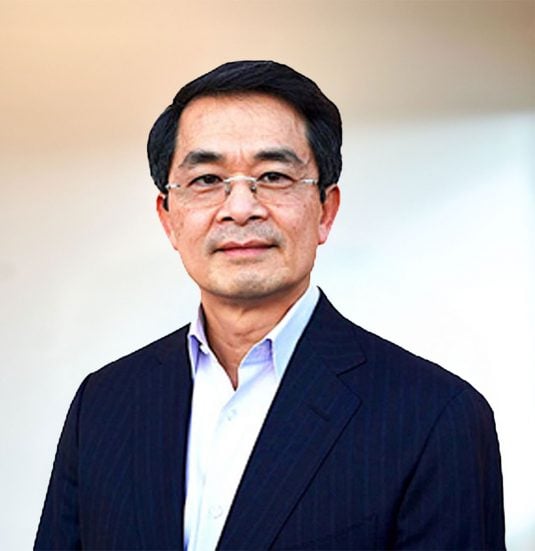
The Engineer Who Bet Early - and Right
Julien Nguyen doesn't talk about Zoom the way most VCs do - as a trophy on the shelf. He talks about it the way a builder talks about a problem that needed solving. In 2013, when IT-Farm wrote a Series A check into a small video-conferencing company that most people had never heard of, the thesis was straightforward: distance is a bottleneck for human connection, and technology can remove it. Nobody needed a pandemic to see that. Julien and his colleagues just saw it a few years earlier than everyone else.
That kind of early conviction comes from somewhere specific. In Julien's case, it comes from two decades spent on the other side of the table - not watching founders pitch, but being the one doing the pitching. He founded or co-founded four companies before transitioning to venture capital. One went public. Three were acquired. Along the way, he filed 21 US patents. The combination of a builder's instinct and a rigorous scientific education from two of France's most demanding institutions - Ecole Polytechnique and Telecom Paris - produced something unusual: a venture capitalist who actually understands what he's funding.
"We like to see a young company that can serve a huge problem. After that, we want to see that there is a credible path to get there."
- Julien Nguyen, 1Mby1M Virtual Accelerator Investor Forum
His four startups read like a highlight reel of the late 1990s technology moment. Ezlogin was acquired by 724 Solutions. Novita Communications was picked up by Planetweb. E-Motions found a home at Sigma Designs. And Radius - the one that went all the way - went public, putting Julien in the rare category of founders who have experienced the full spectrum: acquisition, acquisition, acquisition, IPO. Not many venture capitalists can say that. Not many investors have held a term sheet from both directions.
After building, he moved to Applied Materials Ventures as Managing Partner - a fund born from one of Silicon Valley's oldest and most formidable companies. There, he led investments in Infinera (now on Nasdaq), helped guide Grandis toward acquisition by Samsung, and backed a range of companies across semiconductors, optics, and materials science. The co-investors on those deals - August Capital, Benchmark, Kleiner Perkins, Matrix Partners - are not firms that sit across from mediocre due diligence. Julien's presence in those syndicates says something about the caliber of work he was doing.
Digital health is an incredible virgin territory - and healthcare in the US is one of the most inefficient markets across all dimensions.
Then came IT-Farm. Founded in Tokyo in 1999, the firm is something the venture world has very few of: a genuine bridge between Silicon Valley and Japan. Not a consultant that helps you translate your deck, but an operator that has spent 25 years building the relationships, institutional knowledge, and deal flow to move startups meaningfully across the Pacific. IT-Farm's record - seed investments in Zoom, Treasure Data, and Wish, plus 100+ international companies helped into Japan - is a quiet brag that most firms would shout from rooftops.
As General Partner running the Silicon Valley office from Menlo Park, Julien is the US face of a fund whose real differentiator is geographic arbitrage. The firm manages multiple vehicles - Hikari Fund, Kibou Fund, and Fund 7 among them - all under approximately $100M in total assets. The check sizes are deliberately seed-stage: $300,000 initial investments, with reserves north of $1 million for follow-on rounds. This is not a fund trying to lead $50M Series Bs. It is a fund that writes the first check and then stays close.
In IT-Farm's sixth fund, the firm narrowed its focus to digital health - a decision that looked obvious in hindsight and contrarian in 2017, when most of the world was still pouring capital into enterprise SaaS and consumer apps. Julien's thesis was blunt: US healthcare is a market defined by inefficiency, fragmentation, and incumbent resistance to change. Every one of those problems is a technology opportunity. The global pandemic that followed a few years later made digital health's moment impossible to miss, but IT-Farm was already positioned.
The seventh fund expanded the aperture again. IT-Farm's current portfolio includes companies in AI, clean energy, robotics, healthcare technology, and industrial automation - sectors that share a common thread: they are transforming physical industries with digital intelligence. Julien's own advisory work at MemComputing, a company developing hardware for memory-computing AI, gives a sense of where his intellectual curiosity sits: at the intersection of the physical and the computational, the same place he's been since he was an engineering student in Paris.
"We place a very high premium on the quality of the team. Strong founders navigate the inevitable pivots and changes that every startup faces."
- Julien Nguyen, 1Mby1M Investor Forum
There is something unusual about a venture capitalist who holds 21 patents. Patents are not trophies - they are proof of work, evidence that you did not just observe an innovation but contributed to one. Julien's patent portfolio is a window into the technical depth that sits beneath his investment instincts. When he evaluates a founding team's technology claims, he is not reading a pitch deck with a polite smile. He is reading it the way an engineer reads a spec sheet - looking for what's not there as much as what is.
The Japan angle is worth pausing on. Most US venture capitalists who claim a Japan strategy have a Tokyo office they visit twice a year and a local partner they defer to entirely. IT-Farm is different. The firm's Tokyo headquarters is the originating point, not the satellite. The Silicon Valley office - Julien's territory - is the one that was added later, as the firm recognized that the most interesting startups it wanted to back were increasingly being built in California. Over 25 years, IT-Farm has helped more than 100 international companies establish themselves in Japan's market, a feat that requires more than capital. Japan's enterprise culture, regulatory environment, and preference for trusted intermediaries make it a market where relationships built over decades are worth more than any term sheet.
Hikari means "light" in Japanese. Kibou means "hope." These are not accidental choices for fund names. They reflect a philosophy about early-stage investing that Julien has articulated in interviews: the goal is not to time markets or find the category winner after it's obvious. The goal is to find the light at the edge of a problem - the signal that a team has found a credible path through a genuinely difficult challenge - and then commit before the crowd arrives.