A pacemaker can be extraordinarily attentive. It can check on a patient while that patient is asleep, at dinner, or quietly pretending not to be worried. The trouble begins when its message reaches a clinic. It arrives in the manufacturer's portal, in the manufacturer's format, accompanied by other messages from other devices that are just as conscientious. Someone must decide what each one means. The devices have done their part. The queue has not.
At the University of Chicago Medicine, that queue had grown into a system of separate device portals, manual summaries and physician sign-offs. Heart-failure diagnostics lived elsewhere. Weekend coverage and technician turnover made the arrangement harder to maintain. The clinicians described those conditions in a 2026 company-sponsored white paper about their adoption of Rhythm360, the platform made by San Francisco-based RhythmScience. Their account is the best lens on what this company actually sells: a way to make the messages arrive together, and an operating model for deciding what happens next.
- Rhythm360 brings implanted-device, wearable and home-sensor data into one cardiology workflow.
- Clinics can add trained reviewers and patient outreach to the software, with physicians retaining oversight.
- Chicago's teams reviewed more than 73,000 reports through the system in 2025; most device-generated alerts were nonactionable.
- Pricing is set by contract and is not publicly listed.
The expensive art of saying “nothing to see here”
Remote monitoring is often described as a triumph of detection. A device notices a change before an appointment does. But detection has a shadow cost: every alert asks for attention, even when it turns out to be routine. Chicago's review counted more than 73,000 reports in 2025, averaging over 18,000 per quarter. According to the white paper, most alerts generated by original equipment manufacturers did not require action. The workload came from reading the entire pile, not merely from treating the true emergencies.
Reports reviewed through Rhythm360 at University of Chicago Medicine. Volume is a measure of the queue, not proof of a clinical outcome.
That distinction matters. A product may make a report easier to find, yet still leave a cardiologist with hundreds of decisions. RhythmScience's answer has two parts. Its software gathers data from different makers and modalities into a shared view; its optional service team can perform first-level review, help with reporting and patient compliance, and pass along the work requiring clinical judgment. Chicago chose the service-supported version, with Epic integration and mobile sign-off. One physician told the white paper he was more likely to sign a report during a meeting because it was available on his phone. That is a modest observation. It is also a credible description of a bottleneck removed.
One desk, many devices
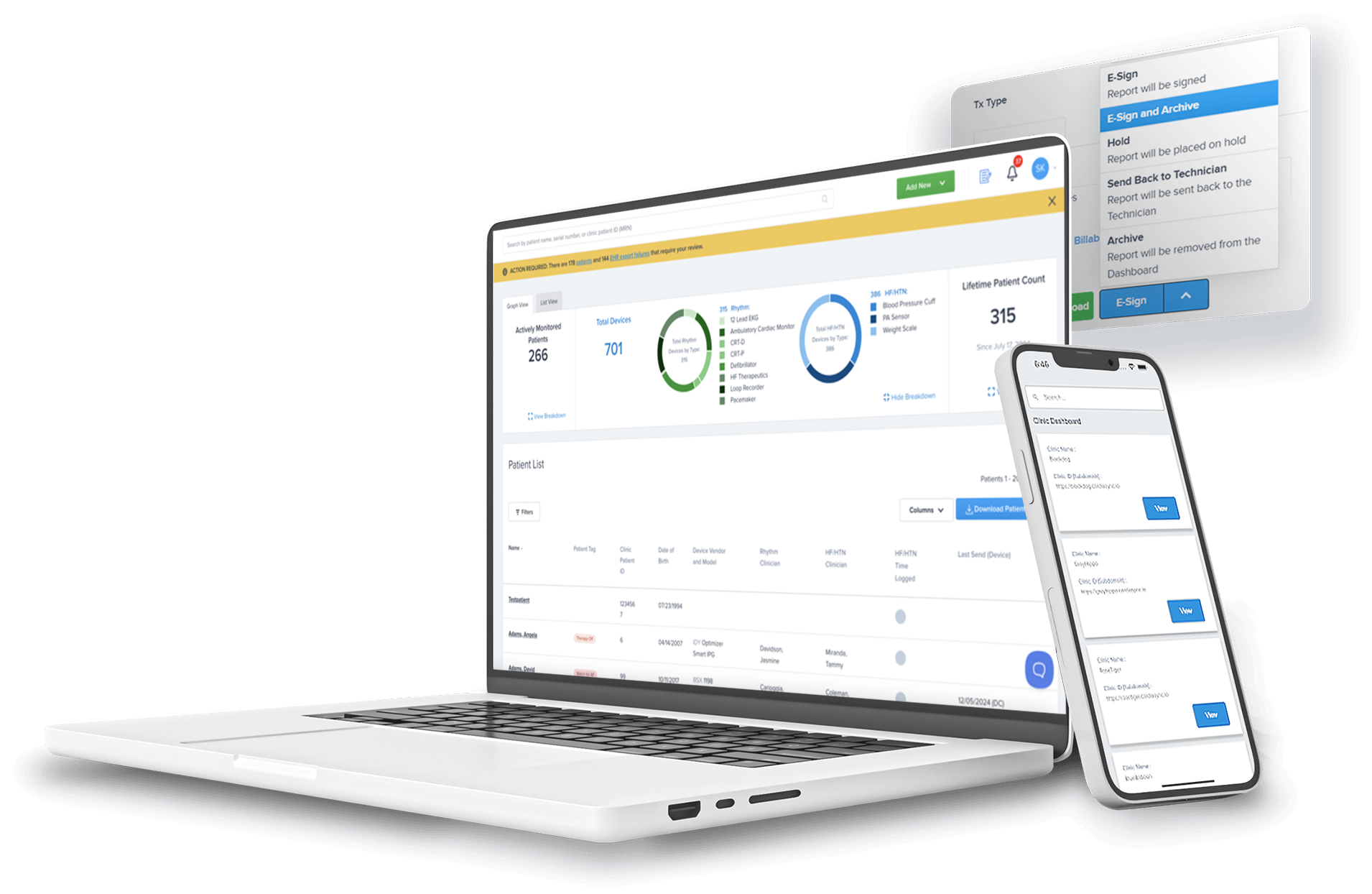
The platform began with a practical annoyance in electrophysiology. A clinic with devices from several manufacturers can have several logins, several alert conventions and several ways to build a report. Rhythm360 presents itself as vendor-neutral: it collects cardiac implantable electronic device transmissions, loop recorder data and ambulatory monitor readings, then pairs them with information from blood-pressure cuffs, weight scales and other connected sensors. Its public materials describe standardized reports, customizable alert triage, bidirectional EHR connections and tools to document billable monitoring. A clinician sees a patient rather than a collection of vendor accounts.
The breadth is deliberate. RhythmScience lists hypertension, heart failure, rhythm management and ambulatory cardiac monitors as its domains. It integrated QT Medical's home 12-lead ECG device and later added support for CVRx Barostim and Impulse Dynamics Optimizer Smart Mini, two heart-failure therapies. In 2025 it licensed exclusive rights to a Cedars-Sinai algorithm intended to help clinicians optimize guideline-directed heart-failure medication. The company's announcement cited results from the algorithm's research; those results should not be mistaken for evidence that Rhythm360 has already reproduced them in ordinary clinics.
The software is only one side of the order form. RhythmScience's public terms describe paid access to the platform, EHR integration and optional monitoring services. Clinics can choose packages to match their operation. There is no public price list, so “what did it cost?” has an honest answer: the $6 million Series A in 2023 is public; an individual clinic's contract price is not. In practice, a buyer would need to price the software together with staffing, integration, training and any services its own team would otherwise provide.
What changed at Chicago
The first thing to fail was not a sensor. It was a workflow built around separate portals and scarce human time. The white paper says Chicago's leaders reconsidered the model as device volumes, physiological data and staffing pressure rose together. They chose centralized multi-vendor aggregation, trained first-level review, Epic integration and mobile tools. Afterward, clinicians reported seeing more transmissions each day and identifying more abnormalities. One said earlier recognition let the team call some patients in rather than waiting for a three-month visit. Another reported better billing accountability. These are participant observations in sponsored material, useful as a description of operations but not a controlled comparison of patient outcomes.
“That was a big piece for us, to have an integrated review of data from trained personnel.”Gaurav A. Upadhyay, MD / University of Chicago Medicine
The sentence explains RhythmScience's place in the market better than a list of features. Manufacturer portals remain an alternative for clinics with simpler device mixes or enough staff to manage them. Other vendor-neutral monitoring companies compete for the same problem. RhythmScience tries to occupy the gap between data plumbing and clinical labor: it wants to deliver a tidy queue and, when purchased, people who help tend it. That can be valuable where volume is high, device makers are numerous and weekend coverage is brittle. It is less compelling where a practice already has a coherent single-vendor setup or cannot connect the new workflow to its EHR and staff routines.

The business behind the inbox
Shawn Kumar founded RhythmScience in 2019. Investor TenOneTen Ventures says he had worked in technical medical-device sales and built the first version of the product himself. That history helps explain the company: it does not sell a new implant, but an answer to what happens after implants are sold. Cedars-Sinai Health Ventures led its $6 million Series A in March 2023, joined by OCA Ventures and TenOneTen. The company named University of Chicago Medicine and Houston Methodist among its users then, and said its software analyzed data from tens of thousands of U.S. patients. It also lists Torrance Memorial in its customer materials and announced a MedAxiom industry partnership in 2023.
There is a more personal note in the company's own account. RhythmScience memorializes its former chief architect, Alan Solitar, who helped take the system from pilot to production before his death in 2020. He lived with chronic health conditions, and the company says his experience informed the work. It is easy for “patient-centered” to become wallpaper in health technology. The detail is sharper here: the software's architect had reason to think about what a missing follow-up might mean from the other side of the screen.
The lesson another clinic can copy is remarkably prosaic. Count the reports. Sort them by device and by how often they actually require action. Write down who reviews each class, what reaches a physician, how quickly, and where the signed decision lands. Then test whether a shared platform and a service team reduce the time between a consequential signal and a useful response. Buying a dashboard without redesigning that sequence would leave the most important part of the queue exactly where it was.