The most revealing thing about Rhyme is not that it automates prior authorization. Plenty of software companies have volunteered for that punishment. It is that Rhyme wants to automate the process so thoroughly that some authorizations can stop existing. First make the request touchless. Then observe every pause and failure. Finally, use the evidence to let trusted providers skip the ritual. In a healthcare system that often confuses another portal with progress, this is an unusually coherent three-act plot.
Prior authorization is the insurer's checkpoint before it will cover certain drugs, scans, procedures or services. The theory is cost and clinical control. The lived experience is a scavenger hunt: a provider leaves the electronic health record, hunts through payer rules, enters familiar data into an unfamiliar portal, faxes a document, calls for status and waits. A delayed approval can become a delayed appointment, an abandoned treatment or a denied claim.
Rhyme sits in the seam. Its software works inside provider EHR workflows, connects with insurer systems and tracks the request from preparation to decision. The customer is not the patient tapping an app. It is the hospital system, patient-access team, revenue-cycle operation, outsourcing firm or health plan trying to get thousands of cases through a process assembled from incompatible parts.
The first product missed. The workaround did not.
Joe Anstine and his co-founders did not begin with a grand prior-authorization manifesto. In an early interview, Anstine described an origin that had nothing to do with prior auth and an initial product they expected to build the company around. Customer discovery dragged them toward the uglier, more persistent problem. By his account, the team was an “iteration company,” not an innovation company. The distinction sounds modest, almost anti-Silicon Valley. It also explains why Rhyme survived its first idea.
What failed first, then, was the original thesis. What changed their minds was the work users were doing around the product - the repetitive, fragmented authorization chores that were expensive precisely because nobody owned the whole route. The founders followed that friction. PriorAuthNow was born with a name as literal as a hardware-store aisle sign.
“We consider ourselves ‘Switzerland’; we sit neutrally between providers and payers.”Joe Anstine, co-founder and CEO
The metaphor earns its keep. Providers want care approved quickly and resent administrative labor. Payers want utilization controls and complete clinical information. Selling only to one side can optimize one inbox while making the other side's work worse. Rhyme's pitch is neutrality: connect both systems, structure the exchange and give both parties a shared view of what happened. That neutrality is not soft culture. It is the architecture and the sales strategy.
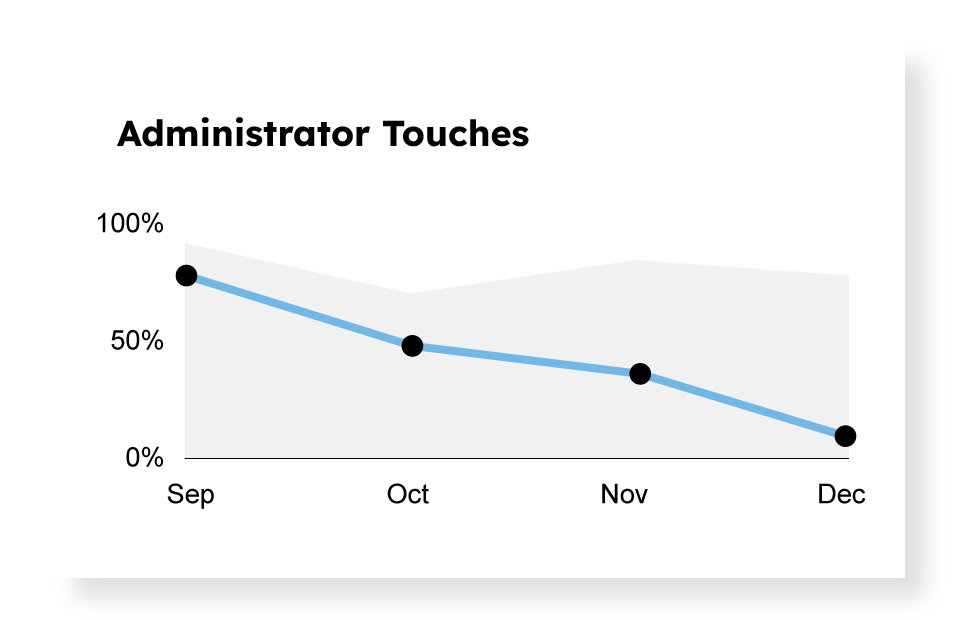
Automate it. Watch it. Earn the right to delete it.
Pull the required data, route the request and return the result inside the existing workflow.
Measure touches, failures, delays and approval behavior in a dashboard shared across the divide.
Use a credible record to waive qualifying requests for trusted providers and procedures.
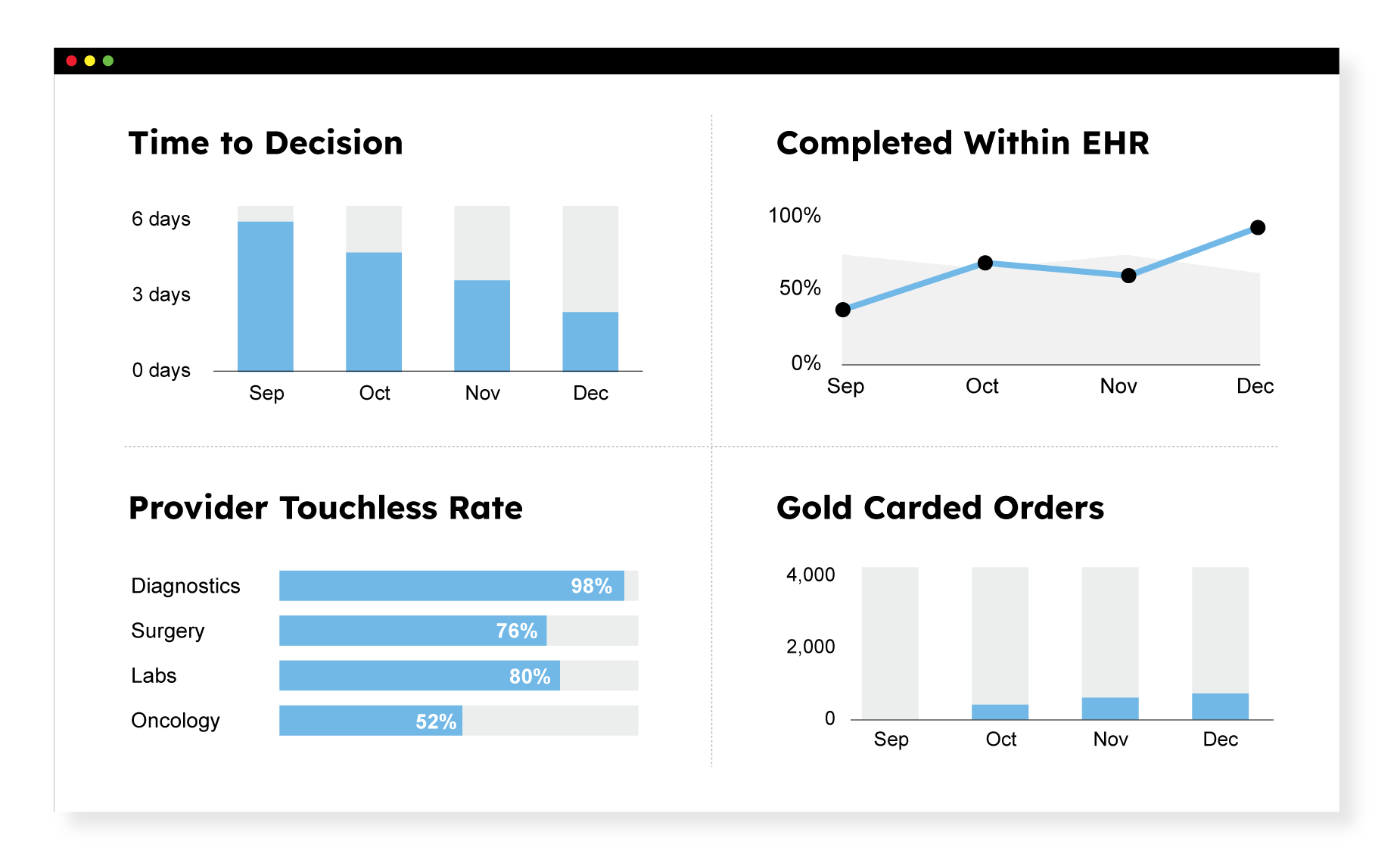
The first layer is practical automation. Rhyme prepares, submits and monitors cases, then returns status or a decision without forcing staff to tour payer websites. The second layer may be more strategically valuable: observation. Its dashboards show where manual effort, friction and waste accumulate. Once the network can see the same failure, payer and provider can argue from a common ledger instead of dueling anecdotes.
The third layer is gold carding. If a provider's requests for a certain procedure are consistently approved, a payer can exempt those cases from prior authorization. This changes the question from “How fast can we process this form?” to “Why are we demanding the form?” The product's most interesting output becomes the absence of a transaction.
A three-company relay in Ohio
The 2024 partnership among Medical Mutual of Ohio, Cohere Health and Rhyme is the clearest map of where the company fits. Medical Mutual is the payer. Cohere supplies clinical intelligence and digitizes authorization requests. Rhyme provides the EHR-integrated network that carries the request from the provider workflow. Cleveland Clinic, Ohio State University Wexner Medical Center and OhioHealth were named among the systems using the combined approach.
This is also an honest picture of competition. Rhyme overlaps with prior-auth vendors, clearinghouses, payer portals and revenue-cycle automation firms, but it can partner with a company such as Cohere because the jobs differ. Cohere emphasizes clinical review intelligence; Rhyme emphasizes connective tissue, workflow integration and observability. CoverMyMeds, Humata Health, Myndshft, Infinx, AKASA and incumbent utilization-management vendors all approach some part of the same budget and burden.
The business is enterprise SaaS plus network infrastructure. A hospital is not downloading it on Tuesday and expensing $19 on Wednesday. Integrations, security review, payer connectivity, implementation and workflow redesign are part of the sale. Rhyme says it limits protected health information to the fields required for authorization requests and transmits data through encrypted connections. In this market, security is table stakes, but the table is bolted to the floor.
This also explains who feels the return. Patient-access staff lose fewer hours to status checks. Revenue-cycle leaders get fewer avoidable denials and a clearer record of where cases stall. Payers receive more structured requests instead of chasing missing documentation. Patients are the intended beneficiary, but they are not the buyer and may never see the brand. Rhyme's website says provider organizations save millions of dollars; it does not sell the outcome as a prettier form. It sells fewer touches, faster decisions and less rework across a very large case volume.
Roughly $57 million bought the unglamorous middle
The funding history tracks the cost of building those rails. A $3.6 million round arrived in 2017. A $10.5 million Series A followed in 2018, when the software served 39 hospitals and health systems and 1,600 users. A later financing targeted $10 million. In February 2022, Insight Partners led a $25 million round with Panoramic Ventures and Health2047 Capital Partners participating, bringing reported total funding to roughly $57 million.
Three months later, PriorAuthNow became Rhyme. The old name had helped early buyers understand the product, then became a cage. “Rhyme” made room for a broader promise: coordination between parties that rarely move in meter. The marketing team reportedly converted nearly 100 company assets for the launch. Charming name aside, the costly work remained integration, trust and distribution.
The company has collected some institutional validation along the way. KLAS named it the Points of Light overall award winner in both 2023 and 2024, recognition aimed specifically at successful collaboration among payers, providers and technology partners. That matters here because a flawless interface on one side of the transaction can still produce a miserable system. Rhyme's achievement is less a clever screen than getting organizations with different incentives to use the same pipe and inspect the same timestamps.
The fax machine is the comic villain. Fragmentation is the durable one.
The approval moves into the conversation
In October 2025, Rhyme announced a collaboration with Microsoft to explore integration with Dragon Copilot, Microsoft's ambient clinical assistant. The ambition is to initiate and return an authorization result while the physician is still with the patient. A qualifying case could receive an immediate decision or a Rhyme-enabled gold card inside the clinician's native workflow. The authorization would move upstream from a post-visit chore to background plumbing in the visit itself.

It is a plausible direction, not a universal solvent. Touchless processing works when the clinical data is available, the payer is connected, rules can be evaluated, identifiers match and the case is routine enough for automation. Gold carding needs sufficient history and payer participation. Novel therapies, incomplete records, conflicting criteria and genuine medical ambiguity still summon humans. A fragmented local payer mix or a small provider without modern EHR interfaces will weaken the network effect.
What another company can copy
- Watch what users do after your product. The workaround may contain the larger business.
- Automate before promising elimination. You need process data before you can safely remove the process.
- Build one shared measure for opposing parties. Visibility can be a product, not merely an admin screen.
- Choose a neutral position only when the architecture and incentives support it.
The conditions that make Rhyme work are demanding: high case volume, recurring procedures, willing payers, usable interfaces and enough trust to share operational truth. Without them, automation can simply accelerate a bad rule or create another screen. Rhyme's better idea is sequential. Do the existing work with fewer touches. Make the friction visible. Let the data identify which work never deserved to exist.
That is where Rhyme fits in the market. It is neither a consumer advocate nor an insurer's decision engine alone. It is a connective layer trying to make authorization behave like a network transaction. The company has grown from 39 health systems in 2018 to a claimed 91 large systems and more than 300 payers by late 2025, processing over 5 million cases annually. The numbers matter because networks improve with coverage. The irony matters more: Rhyme succeeds when fewer people notice it is there.