There is a particular sort of software failure that arrives disguised as success. The pilot works. A few coaches can see their patients. The spreadsheet has the right columns. Everyone knows which phone call comes next. Then the program grows, the file takes longer to open, and the reassuring little system begins to behave like a folding chair at a wedding: adequate until everyone sits down.
Welkin Health built its company in that moment. Chase Hensel and Gideon Wald, former Google colleagues, founded the business in San Francisco in 2013. Their first idea was a coaching app for people with diabetes. It was respectable, timely and, in one important sense, wrong. The pair could see patient outcomes improving, but they also saw digital-health companies repeatedly polishing the patient experience while the people doing the coaching still wrestled with the same backstage mess.
The valuable thing was not another disease program. It was the machinery that made a program operable: who needs a call, which assessment is overdue, what the last message said, when a therapist should be reminded, and how an unusual care pathway can change without summoning a developer. Welkin stopped behaving like the owner of a single care model and became the canvas on which other organizations could draw their own.
The spreadsheet was the canary
The cleanest illustration comes from Community Health Center Network, a Bay Area nonprofit serving high-risk and underserved patients. Its Care Neighborhood program had a prototype called CareNote, built in Excel. The workbook proved that community health workers needed a system to guide their work. It also became slow, crashed often, lacked email and text messaging, and could not comfortably follow the program into more clinics.
That sequence matters. The spreadsheet did not fail because it was foolish. It failed because it was useful enough to attract more work than it could bear. Welkin configured data integrations, workflows and six outreach channels around the program, bringing EHR, demographic and claims information into one dashboard. In a survey of 13 users, 93 percent agreed the replacement was easy to use. Among those who had used CareNote, all agreed.
Coach people with diabetes through a dedicated digital experience.
Care teams across conditions shared the same coordination and workflow problems.
Sell the configurable operating layer, then let customers define the care model.
What sits behind the appointment
Welkin now calls the product a healthcare CRM/EHR. The ungainly label is informative. Traditional EHRs are good at preserving the official chart; generic CRMs are good at tracking relationships; point solutions are good at one task or condition. Welkin tries to occupy the busy territory between them. It stores encounters and patient data, but it also runs tasks, care plans, forms, assessments, reminders, permissions and communications.
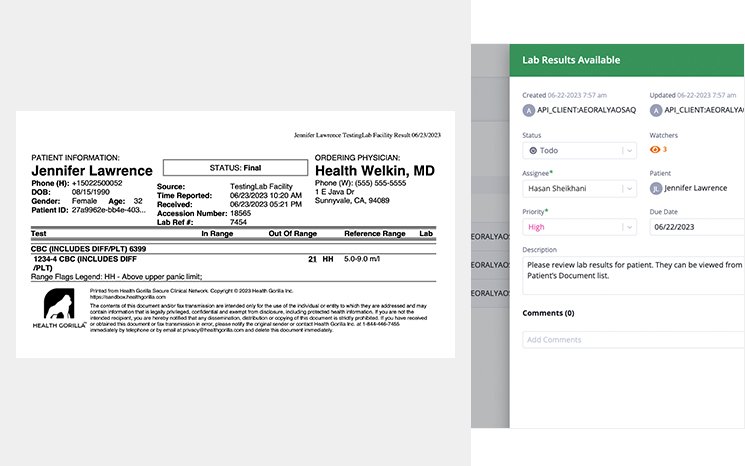
An administrator can design multiple programs without code, assigning phases and rule sets to each. Developers can use APIs and webhooks. Patients can answer assessments or communicate through an app. The platform connects to scheduling, billing, e-signature, e-prescribing, labs, analytics, payments and video tools. It is less a finished clinic in a box than plumbing with a friendly control panel.
Handspring Health shows the appeal. The pediatric mental-health provider wanted therapists to see only the forms, notes and views relevant to their work. It used automations for monthly assessments, charting, reminders and intake. As Handspring expanded from New Jersey to six states, it increased access to therapists sixfold and grew from six care programs to nine. Those are Handspring's results, not a controlled trial of Welkin, but they clarify the job: make a changing care model less expensive to operate mentally.
The price of flexibility
Welkin sells to organizations, not casual subscribers. The base platform carries a custom monthly license rather than a public sticker price. Implementation, migration, enterprise support, training and a dedicated account manager can be part of the arrangement. A 14-day sandbox gives startups and product managers a way to test the design tools.
There is unusually concrete evidence of the add-on economics. A 2023 Welkin fee sheet listed DrFirst e-prescribing at a $5,000 one-time setup, $500 annual maintenance and $1,000 per prescriber license. Health Gorilla labs and imaging carried $6,000 annual maintenance. Advanced Sisense analytics listed separate setup, maintenance, designer and viewer charges.
Those dated figures are a window into the model, not a current quote. The durable point is that a configurable platform moves cost away from one neat per-seat number and into the particular stack each care program assembles.
Capital paid for the other kind of flexibility. Rock Health and others joined a $2 million seed round in 2015. Thrive Capital led an $8 million Series A in 2017. Altos Ventures led a $17.5 million Series B in 2019, with Thrive, Red Swan Ventures and Asset Management Ventures participating. Contemporary reporting put the total then at about $30 million and said the customer base had more than doubled after the Series A.
A platform must bend without going soft
Customization is the advantage and the trap. Every customer wants its own fields, rules and pathways; healthcare also requires disciplined access, auditability and security. Welkin's answer is role-based permissions, audit logs, a public trust center, SOC 2 Type II audit notices and support for HIPAA, GDPR and PIPEDA obligations. The same Designer that lets an operator rearrange a workflow also controls who can see what.
The newest products sharpen that theme. A unified Inbox brings text, email, chat, WhatsApp, video and call context beside the patient record, then routes work into personal and team queues. Data Views let administrators decide what a nurse, behavioral-health specialist or program manager sees. An AI Data View can summarize selected patient data; Welkin labels the result, timestamps it and lets admins choose the source context and refresh threshold. The restraint is more interesting than the magic trick. In clinical work, knowing when a summary was generated is part of knowing whether to trust it.
What another builder can steal
Welkin's most portable lesson is not about healthcare. Start with the workaround. If users surround your product with spreadsheets, reminders and hand-built handoffs, those are not merely annoyances to integrate later. Together they may describe a larger product than the one you intended to sell.
The second lesson is to separate primitives from opinions. Welkin supplies communications, tasks, assessments, permissions and APIs; the customer supplies the care pathway. That bargain works when organizations possess genuine operating knowledge but lack the software to express it. It also explains the limits.
- A small clinic with a standard workflow may be better served by a simpler, cheaper EHR.
- An organization without a clear care model can automate confusion faster than it can improve care.
- Teams that need certified-EHR reporting or tightly bundled billing should verify those requirements before treating a CRM/EHR hybrid as a replacement.
- Heavy customization creates governance work. Someone must own the rules, permissions and changes.
In 2013, Hensel and Wald thought they were building a better conversation with a person who had diabetes. They were, eventually. They simply had to travel backward through the system first - from patient to coach, from coach to workflow, and from workflow to the configurable layer underneath it. The oddity of Welkin Health is that the company became more patient-centered by turning its attention away from the patient screen. It noticed the folding chair.