The most revealing thing about Caregility is that its best customer stories begin with a complaint about work. A nurse is spending too long on discharge instructions. A hospital is paying people to sit one-to-one with patients who might fall. A specialist is somewhere else. A patient needs an interpreter. The camera is rarely the plot. It is the aperture through which the hospital reorganizes who can help, from where, and at what moment.
Caregility, founded in 2019 after emerging from enterprise videoconferencing company Yorktel, packages that idea into a connected-care platform. Its software handles one-to-one consults, one-to-many observation, virtual-nursing tasks, requests, alerts, and fleet administration. Its carts, wall systems, cameras, microphones, and sensors live in patient rooms. Its integrations connect the lot to electronic records, nurse-call systems, interpreters, televisions, and other clinical tools. The customer is a health system, not a patient hunting for a doctor on an app.
By September 2025, the company said it had more than 30,000 connected devices, six million virtual sessions a year, and deployments across 1,500 hospitals and more than 75 health systems. Those numbers place it in a specific corner of telehealth: deep inside the inpatient workflow, where dropped connections are not merely annoying and a clever feature still has to survive a night shift.
The second set of hands has no hands
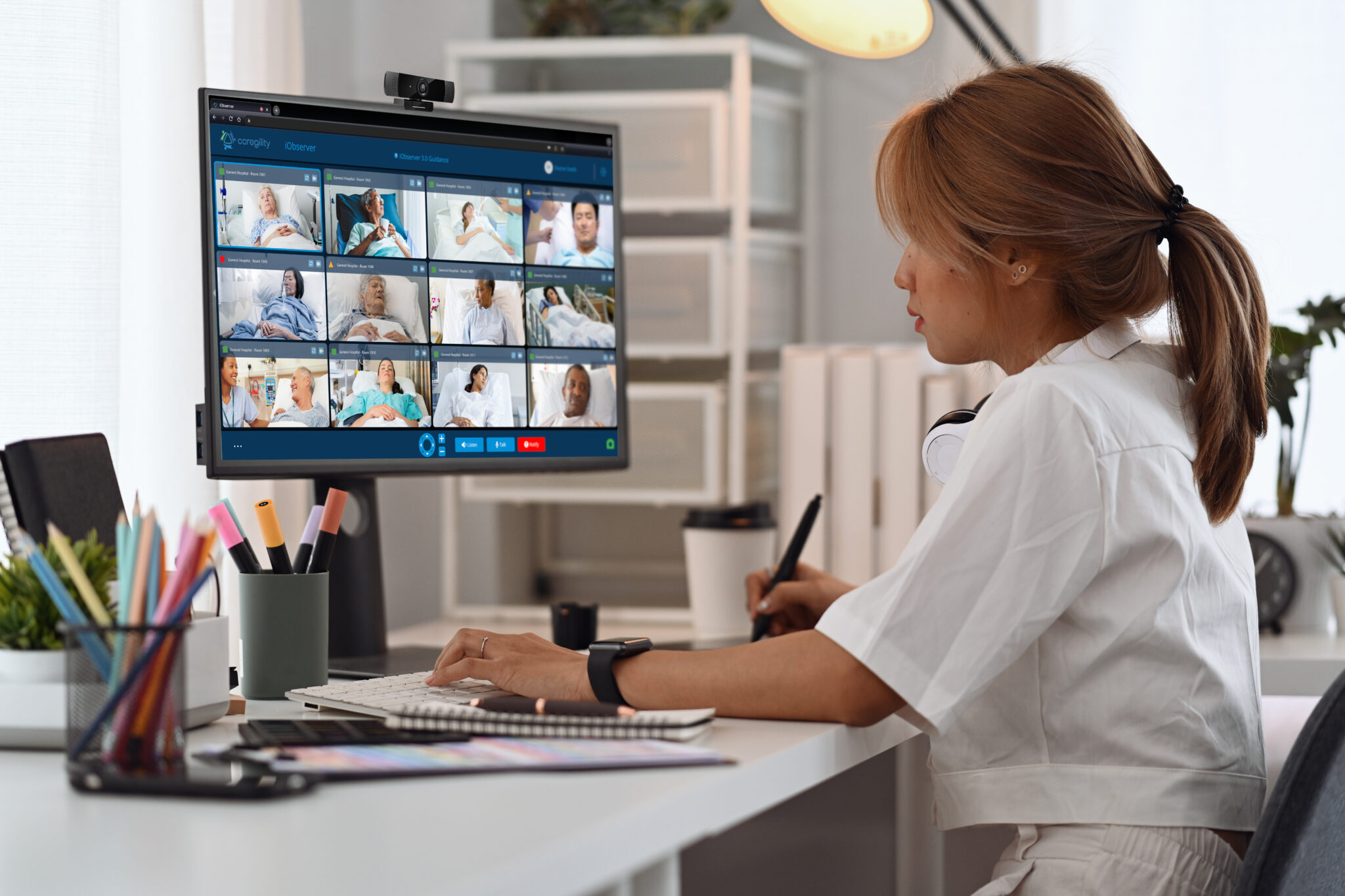
Virtual nursing is an odd phrase because the remote nurse cannot adjust an IV or catch a falling body. What that nurse can do is absorb work that travels well: admissions, discharge education, chart review, medication verification, checklists, rounding, mentoring, coordination, and conversations with families. Caregility's pitch is that bedside nurses should spend more time on the physical and relational work that refuses to travel.
The suite divides the job cleanly. iConsult opens a secure one-to-one session with a patient, specialist, interpreter, family member, or care team. iObserver lets a remote sitter watch up to 16 patients while keeping every room visible during an intervention. iNotify gathers requests. iCare Coordinator assembles tasks, bedside calls, engagement, and AI alerts in one view. Control Hub gives IT staff a way to manage the users and endpoints that make a large rollout either dependable or feral.
The useful loop
That breadth differentiates Caregility from a simple video vendor and from consumer telehealth. It is also where the company meets AvaSure, Artisight, care.ai, Vitalchat, Amwell, Teladoc, and hospital-built stacks. KLAS research has credited Caregility with broad inpatient use cases, particularly virtual ICU, while also recording customer concerns about cost, development delays, issue resolution, and reporting as the company grew. Hospital-grade hardware and integrations deepen the product. They also deepen the bill and the implementation.
What failed first: the humans did not buy the premise
Lee Health supplies the useful bruise. During an early virtual patient-observation pilot, nursing staff pushed back and ancillary departments were not communicated with well enough. The problem was not a camera that refused to turn on. It was a workforce hearing that a new system might rearrange responsibilities without seeing how or why.
The response was more training, more communication, and more involvement before the next facilities went live. When Lee Health later designed a virtual-nursing pilot, its clinical and IT teams started with staff surveys and workflow mapping. They chose cardiac and selected high-acuity medical-surgical patients. They used nurses from existing floor rotations, which meant the people on screen and the people in the room already knew one another. Managers gathered comments during daily rounds and shift huddles. Both remote and bedside nurses received training.
The personal nature of two-way video breaks through the glass.Jonathan Witenko, Lee Health
The program used a virtual-nurse-to-patient ratio of one to ten and was designed to launch in six weeks. Lee Health later reported a 20 percent improvement in patient-experience scores, discharge times under two hours, more than 20 catches from virtual chart reviews, and the retention of experienced nurses. These are customer-reported outcomes, not proof that a camera causes satisfaction. They do show what changed minds: not a demo, but operating evidence from a familiar team.
The price is private. The proof is public.
Caregility does not publish a menu price. That makes sense for a system that can include subscriptions, carts or fixed endpoints, cameras, sensors, implementation, EHR work, support, and dozens or hundreds of rooms. It also means the honest answer to "what did it cost?" is: the contract is unknown, and the customer's internal program cost matters as much as the license.
The public numbers instead describe return. Salem Health's test covered admissions and discharges and reported that 93 percent of discharges and 52 percent of admissions were supported virtually. The system estimated 30 to 60 minutes saved per discharge, a 25 percent improvement in order-to-discharge time, 2.1 full-time equivalents preserved per two units, and about $250,000 saved in the first few months. That evidence helped secure approval to expand to 280 more beds, targeting all 340 inpatient beds across five adult units.
Salem Health's test of change
Share supported virtually / company case study
Another Caregility case study reported that UMass Memorial shifted from one-to-one sitters toward a hub-and-spoke observation model in which staff monitored patients in groups and backed one another up. The economic logic is plain: if one trained observer safely covers several rooms, labor can be redeployed. The clinical logic is fussier. The hospital still needs patient selection rules, privacy controls, escalation coverage, and enough bedside capacity to answer the alarm.
AI enters the room, quietly
Caregility raised $25.1 million in September 2025 across Series A-2 and Series C financing led by Star Mountain Capital. It said the money would accelerate computer vision, ambient listening, and sensor-based tools. The company has since described contactless vital-sign trending, audio-based duress detection, voice commands, augmented observation, and radar monitoring for spaces where cameras are inappropriate. A Microsoft collaboration aims to bring Dragon Copilot's hands-free clinical documentation into enabled rooms.
This is a logical extension of the installed endpoint. A camera that already carries a virtual visit can also run edge models. A microphone used for conversation can detect a call for help. Radar can sense movement without producing an identifying image. The strategic advantage is not that Caregility invented every model. It owns a place in the room and a route into the clinical workflow.
Signals become assignments
AI is useful when an alert has context, an accountable recipient, a fast route to the bedside, and a measured false-alarm rate.
More alarms, same bottleneck
Without staffing, governance, privacy rules, integration, and response capacity, sensing simply creates a brighter dashboard of unresolved work.
The guardrails matter because this is not a recommendation engine for movies. Computer vision in a patient room touches dignity, consent, bias, security, and clinical risk. Caregility points to HIPAA alignment, ISO 27001 and 27701 certifications, FIPS validation, and a newer ISO/IEC 42001 AI-management certification. Those controls are table stakes, not immunity. Hospitals still have to decide which rooms can be watched, what is retained, who sees it, and what happens when the model is wrong.
The playbook worth stealing
Caregility fits the market between telehealth platforms and smart-hospital infrastructure. Its value grows as a health system uses the same network for more jobs: a virtual sitter in the morning, an interpreter after lunch, a specialist consult at night, and a remote nurse handling tomorrow's discharge education. That reuse can improve the economics of an expensive endpoint. It can also tempt leaders to launch too many workflows before one has earned trust.
Copy the rollout, not the brochure
- Pick one painful workflow and one willing unit. Do not begin with an enterprise slogan.
- Measure the baseline: minutes, sitter hours, discharge lag, adverse events, patient experience, and staff burden.
- Map who owns every step, especially the moment remote work becomes bedside action.
- Use trusted clinicians in the first remote roles and train both sides of the screen.
- Collect feedback every shift, publish the result, then earn the next group of rooms.
The approach will not travel everywhere. A small hospital may lack enough rooms to justify dedicated hardware and software. Weak connectivity or thin IT support can turn devices into expensive wall ornaments. A unit without executive sponsorship, bedside response capacity, staff trust, clear consent, or integration resources should solve those gaps before adding sensors. And a hospital hoping virtual nurses will simply replace local nurses will discover that the tasks left behind are the ones requiring hands.
Caregility's mission is to connect care everywhere. Its more defensible accomplishment is narrower: it has made the hospital room addressable. A remote professional can enter without opening a door, see without standing in the corner, and help without taking the assignment away. In a labor-starved hospital, that is not science fiction. It is scheduling, wiring, training, and a very careful knock.