The most important moment in the Salvo Health story may have arrived when the company stopped acting like the doctor’s office was a piece of furniture to route around. When Salvo launched in 2022, its offer looked like a crisp specimen of pandemic-era digital health: pay $127 a month, open an app, meet a virtual physician, health coach and care navigator, and finally do something about the gut problem that had survived years of hurried appointments. It was logical. It was convenient. It was also asking patients to assemble yet another island of care.
The quick read
- Salvo adds dietitians, GI-trained nurses, behavioral support and software to existing gastroenterology practices.
- Patients message a care team, track symptoms and meet virtually between regular doctor visits.
- The practice keeps the patient relationship and can bill eligible monitoring and chronic-care services.
- Salvo says it had agreements with 801 GI physicians by early 2026, after shifting from a consumer subscription toward provider enablement.
The problem hiding in the calendar
A chronic illness with an occasional appointment
The oddity of chronic GI care is temporal. Symptoms happen at breakfast, on the commute, at two in the morning. The clinical system records them in a twenty-minute visit every few months. A patient can leave with sensible instructions about diet, sleep, stress, movement or medication, but those instructions must then compete with real life. The specialist rarely sees which part failed first.
Salvo’s answer is what it calls wraparound care. The patient’s local gastroenterologist stays in charge. Salvo supplies the part most practices were not built to staff: a registered dietitian, a GI-trained nurse, behavioral-health support, monthly video visits, frequent messaging, symptom tracking and a care plan that can change while the patient is actually living it. The app is less a second clinic than a long hallway connecting one office appointment to the next.
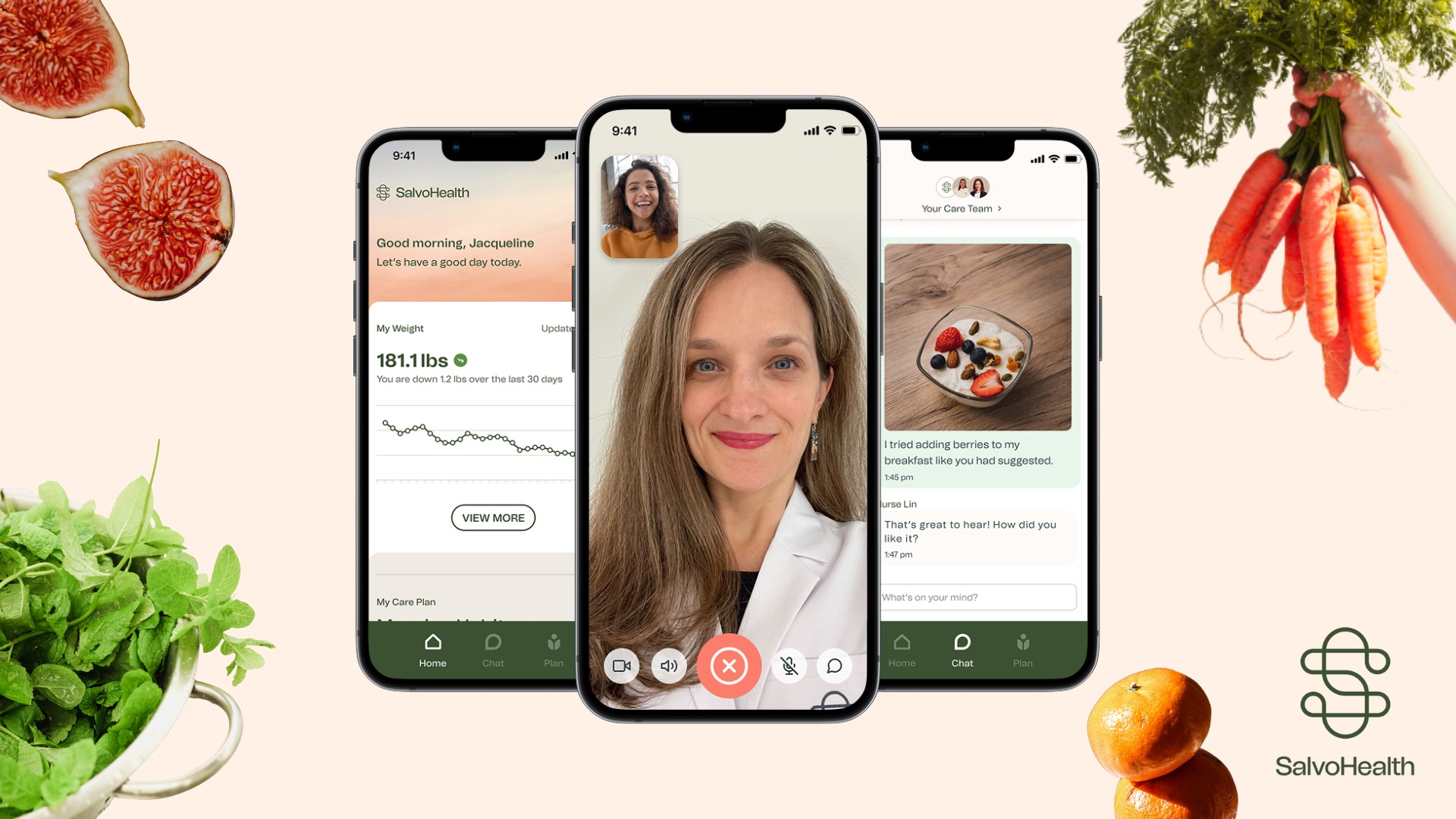
“They feel expert care not just at occasional appointments, but as if they have a dietitian in their pocket.”Jeff Glueck, co-founder and CEO
The move that mattered
From another clinic to the clinic’s missing middle
The first version of Salvo was sold mainly to the person with the stomachache. The current version is sold through the person with the medical license. That change is more than a distribution tweak. It alters trust, payment and workflow at the same time.
2022 / Go around
Consumers buy a $127 monthly virtual-clinic membership and assemble care outside their usual practice.
2024 onward / Go through
Practices retain supervision and billing while Salvo provides the care team, app and operating layer.
Why change? The public record offers the shape of the answer. Salvo raised $5 million in February 2024 specifically to expand provider enablement. It described local physicians as the hub, not an incumbent to displace. By June 2025 it said more than 700 board-certified GI physicians had signed contracts. In January 2026 the number was 801, including three of the four largest GI practices in the country. The company reported that patient count and revenue each grew 800 percent in 2025.
This is the lesson worth borrowing. In regulated markets, the old gatekeeper may also be the best channel, the source of trust and the owner of the reimbursable workflow. A startup can spend years explaining why a customer should defect. Or it can make the institution the customer and improve what happens after the referral.

The machine and the humans
Software does the repetition. People do the judgment.
Salvo calls its technology stack Sano. It coordinates individual care plans, app content, messages, tracking and documentation. In 2024 the company said software and app-based material accounted for roughly two-thirds of monthly care minutes, with licensed personnel providing one-third. That split is the business model in miniature. Automation stretches scarce clinicians; clinicians keep the automation from becoming a glorified checklist.
The company’s clinical scope is broader than a symptom diary. It supports patients with IBS, IBD, GERD, celiac disease and gastroparesis, as well as obesity, GLP-1 medication journeys and metabolic liver diseases such as MASLD and MASH. Its earlier partnership with Gemelli Biotech brought certain at-home breath and blood tests into the virtual clinic. A partnership with Lohman Technologies added cellular-connected home monitoring. In each case, more signals flow into the same care loop.
Company-reported figures from Salvo’s early patient population. They are useful signals, not a substitute for large, independent clinical trials.
There is a cheerful practicality to those engagement numbers. Five questions a week is not a vanity metric if the fifth question prevents a bad medication choice, catches a flare early or keeps a patient from abandoning a diet on Wednesday. It also explains why ordinary practices struggle to provide this service themselves. Someone must answer.
Who pays, and why
The care has to fit the billing system
Salvo’s customers are GI groups, health systems, accountable care organizations and payers. The local practice supervises the patient and can bill eligible remote patient monitoring and chronic-care codes. Salvo is the subcontracted team and technology. Its provider materials estimate that a typical ten-physician practice could add $2 million to $3 million a year in billable services without hiring the equivalent staff in-house. That is a sales projection, not a guaranteed return, but it makes the pitch unusually concrete.
Provider proposition
More follow-up capacity + reimbursable monitoring + fewer low-acuity interruptions to specialist time
Salvo’s estimate for potential annual billable services at a typical ten-physician practice. Actual reimbursement depends on patient eligibility, payer rules, documentation and execution.
Patients get another kind of arithmetic. Salvo reported that 84 percent described the experience as better than prior healthcare and 76 percent reported symptom improvement after at least four weeks. A separate two-arm study reported a 79 percent reduction in GI-related emergency and urgent-care use. The company also commissioned actuarial work suggesting potential savings of three dollars for every dollar spent for commercially insured IBS patients.
A founder’s advantage, and burden
Three outsiders discover the inside route
Salvo’s three founders arrived from industries that software had already rearranged. Jeff Glueck ran Foursquare and served as chief marketing officer of Travelocity. Avi Dorfman was on the founding team at Compass. Jason Finger co-founded Seamless. Their original instinct was familiar: give the consumer a cleaner digital door.
Their reasons for choosing healthcare were personal. Glueck has written about a late-pregnancy loss in his family and the slowness with which medical systems incorporate advanced diagnostics. Dorfman lived with persistent reflux. Finger watched people close to him bounce around conventional care before finding help at expensive concierge clinics. They named the company Salvo partly for “salve,” partly for sano y salvo, Spanish for safe and sound, and partly for a volley of simultaneous actions. It is an unusually accurate name for a care plan involving food, sleep, stress, medicine and behavior all at once.
Founded in New York
Glueck, Dorfman and Finger begin with chronic gut care as the first specialty.
The consumer clinic
A $10.5 million seed round backs a $127-a-month virtual membership.
The physician becomes the hub
A $5 million round funds provider partnerships, staffing and remote-monitoring enablement.
Seven hundred contracts
Salvo raises another $4 million and expands deployments into nine states.
The hybrid bet gets a Series A
An $8.5 million round funds clinical hiring and an AI-led engineering roadmap.
Where Salvo sits
Not a virtual waiting room. Not quite a clinic.
Salvo competes with virtual GI platforms including Oshi Health, Cylinder Health, Ayble Health and Digbi Health, and with the oldest alternative of all: the practice doing nothing between visits. Its distinction is structural. Salvo does not need the patient to leave the local doctor. It tries to make that doctor’s care feel continuous.
The idea travels well, but only under certain conditions. The condition should be chronic enough to reward repeated small interventions, measurable enough for remote signals to matter, and low-acuity enough that much of the work can happen outside a procedure room. The practice must cooperate, reimbursement must support the service, and patients must actually use the app. Emergency symptoms, poor connectivity, thin insurance coverage or a disengaged clinic can puncture the loop.
What changed Salvo’s trajectory was not a more dazzling screen. It was recognizing that healthcare distribution is inseparable from healthcare itself. The doctor was not the door blocking the startup. The doctor was the door the patient already knew how to open.