- Allara combines a medical provider and registered dietitian in one virtual care team.
- It treats chronic hormonal, metabolic, and reproductive conditions across all 50 states.
- Insurance coverage - not video calls - turned a cash-pay service into a national healthcare business.
- The portable lesson: if customers coordinate the system themselves, coordination may be the product.
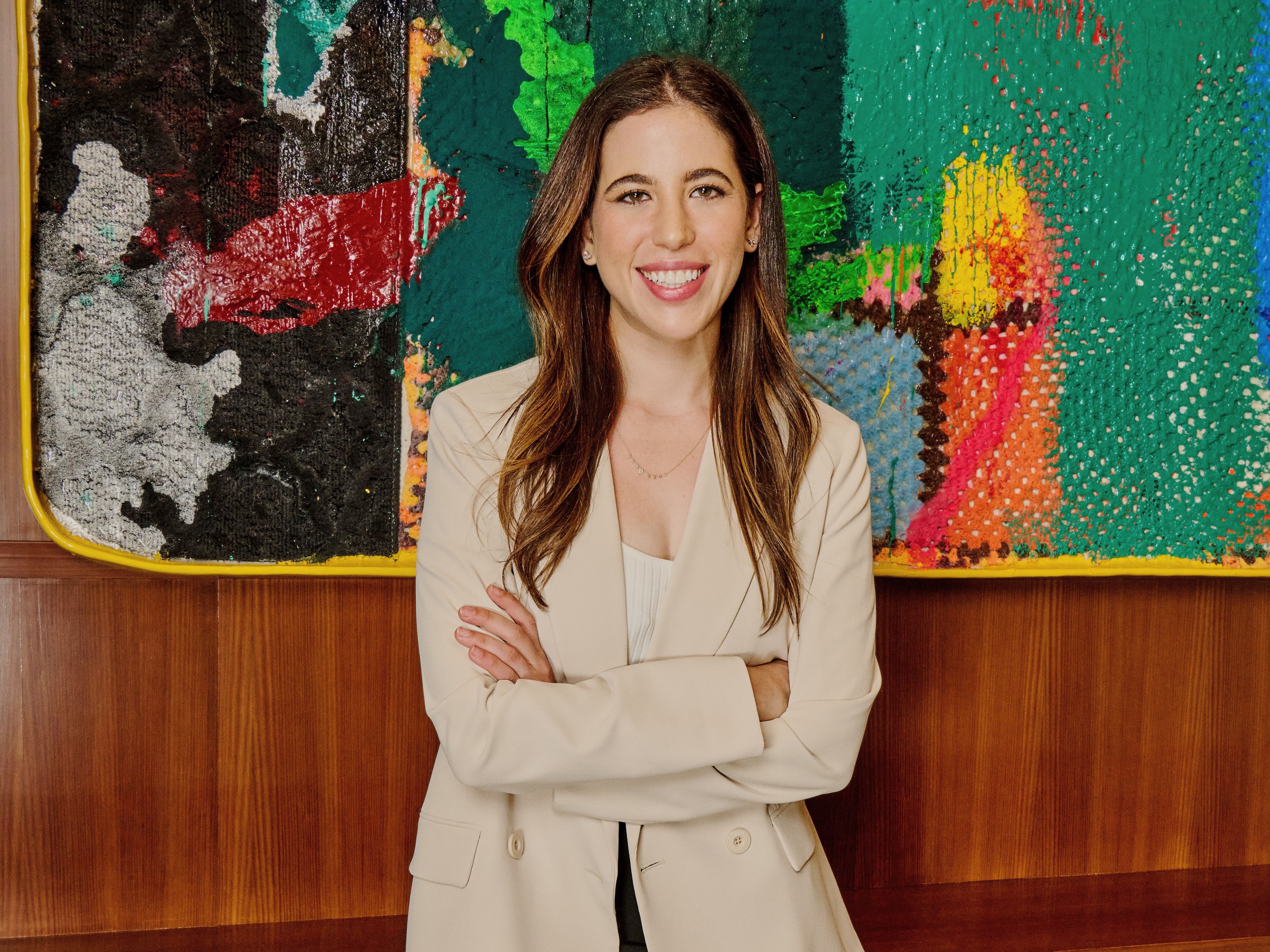
Rachel Blank's problem began with an abundance of experts. There was the gynecologist, the endocrinologist, the dietitian, and the great unofficial specialist of American medicine: the patient herself, sitting at home with a browser full of tabs, trying to make four opinions add up to one plan. Blank had been diagnosed with polycystic ovary syndrome at 21, after years of unexplained symptoms. She had access to good care. What she did not have was a person whose job was to connect it.
This distinction is the key to Allara, the company she founded in 2020. It is usually described as a telehealth platform for women's hormonal health, which is accurate in the way that calling a restaurant “a room with tables” is accurate. The screen is only the delivery mechanism. The actual product is agreement: a medical provider and a registered dietitian looking at the same patient, the same labs, and the same long-term plan.
01 / The origin
The most expensive person in the room was the patient
Blank has called her old routine “whack-a-mole”: research one symptom, find another specialist, try another lifestyle change. The first thing that failed was not a startup experiment. It was the ordinary care pathway. Hormonal conditions sit awkwardly between medical departments. PCOS can involve menstrual cycles, fertility, insulin resistance, weight, skin, hair, mood, and long-term cardiometabolic risk. A ten-minute appointment can address one of those. A life contains all of them at once.
Her change of mind was personal and then statistical. The more women she spoke with, the less her experience looked exceptional. The business insight followed: women did not necessarily need one magical PCOS doctor. They needed several capable people arranged around one shared record and an ongoing relationship.
“There weren't a lot of places for me to go, because the concept of a specialist for my condition didn't exist.”Rachel Blank, founder and CEO
Allara launched in June 2021 as a $100-per-month PCOS service. The bundle was unusually literal: intake visits with a medical provider and dietitian, blood testing when needed, a personalized treatment plan, regular check-ins, nutrition support, and community. It was the care Blank had assembled by hand, packaged so the next patient would not have to.
One loop, fewer loose ends
02 / The expansion
PCOS was the doorway, not the whole house
The original diagnosis gave Allara a sharp entrance into the market. But patients do not respect product categories. Someone with PCOS may also be planning a pregnancy, managing insulin resistance, investigating thyroid function, or entering perimenopause. So Allara widened the clinical frame to include endometriosis, hypothyroidism, uterine fibroids, hormonal weight concerns, fertility planning, and menopause. The customer is often younger than the stereotypical women's-health patient - the company's average was about 30 in early 2025 - and is looking for help before pregnancy or a medical crisis makes the system pay attention.
This is where Allara separates itself from adjacent virtual clinics. Midi and Gennev built around menopause. Fertility services organize around conception. Ro is known for convenient condition-specific prescribing. Tia offers broader women's primary care. Allara's claim is narrower and deeper: long-term hormonal and metabolic specialty care, with medical and nutrition work happening together.
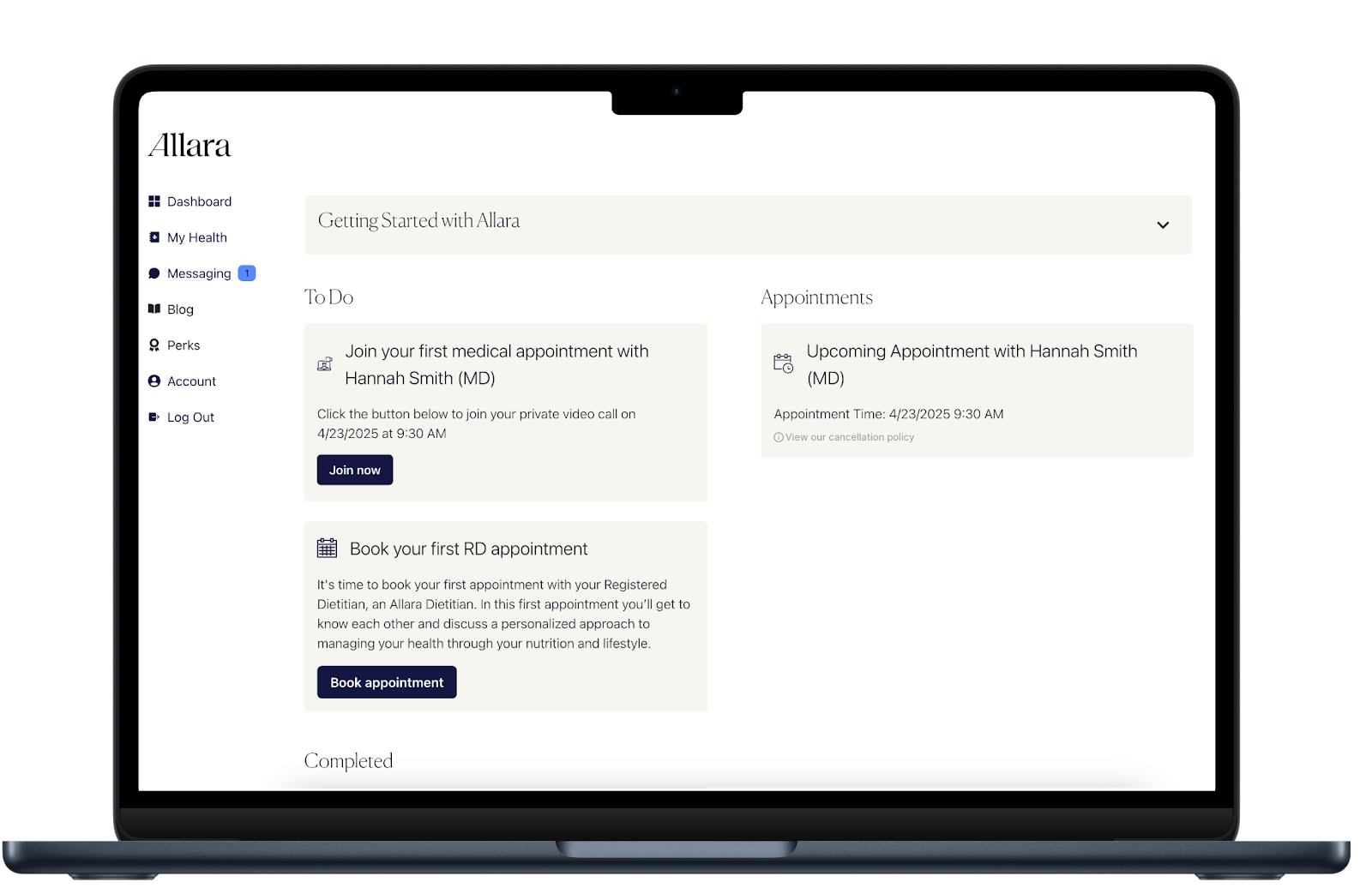
The app is deliberately unromantic. Patients book and join video visits, message the care team, read follow-up notes, inspect labs, manage insurance information, and find recipes and education. That list sounds administrative because chronic care is administrative. The small tasks between appointments are where a treatment plan either becomes a habit or returns to being a PDF.
03 / The evidence
A care plan is only interesting if the numbers move
In 2025, Allara published an analysis of nearly 1,500 patients during their first nine months of care. Among higher-risk groups, it reported a 5 percent mean BMI reduction, a 9 percent decline in HbA1c, and a 12 percent reduction in insulin resistance. Sixty-nine percent of patients who had irregular menstrual cycles reported improved regularity. These are company-reported outcomes, not the final word from a randomized clinical trial, but they are more useful than the usual digital-health currency of downloads and minutes spent in an app.
What moved in nine months
Company analysis of selected patient cohorts. Bars show relative percentage change, not percentage points.
Allara also estimates its model can save more than $3,000 per patient annually by avoiding costs linked to diabetes, obesity complications, and fertility care. That number comes from internal modeling, so it should be read as a hypothesis with arithmetic attached. Still, it explains who else the product is for. The patient wants to feel better. The insurer wants fewer expensive consequences later. Allara needs both desires to point in the same direction.
04 / The business
The decisive feature was an insurance card
Allara began as a self-pay subscription. That made the service quick to launch and easy to understand, but it also limited who could stay. The consequential change came when the company signed contracts with major health plans. By 2023 it was in-network across eight states, representing 30 million covered lives. By early 2025, partnerships included Aetna, Blue Cross Blue Shield, Cigna, Humana, and UnitedHealthcare in ten states. Later that year, care availability reached all 50.
Insurance does not make healthcare simple. Patients may still owe a copay, coinsurance, or deductible; coverage varies by state and plan; medications and some labs can be separate. But it changes Allara from an online wellness purchase into something that can live inside the ordinary healthcare budget. The company says revenue grew fourfold in 2024. In January 2025, Index Ventures led a $26 million Series B, with GV participating.
Monthly provider visits plus ongoing nutrition and lifestyle coaching.
Dedicated nutrition and lifestyle coaching without the complete medical program.
The model also has a sensible boundary. Telehealth is well suited to history-taking, lab review, prescriptions, nutrition work, and frequent follow-up. It cannot perform surgery, ultrasound a pelvis, handle an emergency, or replace every physical examination. Allara's newer partnership with Endometriosis Surgical Specialists International is revealing: one organization handles longitudinal virtual care; the other handles expert in-person surgery. The handoff is designed, rather than left to the patient.
Allara is strongest when a chronic condition needs repeated interpretation, coaching, and adjustment. It is weaker when the decisive information must come from imaging, a procedure, emergency evaluation, or a hands-on exam - and when insurance or local provider availability breaks the continuity it promises.
05 / The lesson
Copy the connective tissue
The part worth copying is not “put doctors on Zoom.” That technology is now ordinary. The more transferable move is to watch what customers do after the official service ends. Blank carried messages between specialists, researched conflicting advice, tracked her own response, and decided what to try next. Allara brought that invisible labor inside the product.
For another company, the pattern might be an accountant reconciling five exports, a parent translating between teachers and therapists, or a contractor chasing three suppliers. The opportunity appears when the customer becomes the human API. Build the shared record. Assign ownership for the next step. Make follow-up part of the service. Charge for the continuity, not merely the encounter.
This approach does not work everywhere. It depends on a problem that unfolds over time, specialists whose work genuinely overlaps, enough patient volume to support a focused team, and payment that rewards prevention or retention. It also depends on clinical humility: a virtual platform has to know when the next useful thing is not another message but a room, a machine, and a local doctor.
Allara's most interesting achievement is therefore not its app, its supplement shop, or even its nationwide map. It is that it made coordination visible enough to sell. The patient still does the difficult work of living with a chronic condition. She just no longer has to chair every meeting.