The trouble with stealing a minute is that nobody notices the first one. A physician opens a chart, fixes a code, checks a referral, completes a note. Each task looks small enough to tolerate. Across a day, then a group practice, then a health system, the missing minutes become an industry. Jim Boswell spent decades watching that arithmetic from the inside. By the time he founded Onpoint Healthcare Partners in 2019, he had come to a clear conclusion: the most valuable thing software could give a clinician was not another feature. It was time that could be used again.
Boswell is an unlikely character for the standard artificial-intelligence origin story. He did not emerge from a research lab with a model in search of a market. He studied finance at Louisiana Tech University, earned an MBA in corporate finance at the University of Chicago, and began his career in mergers and acquisitions at Whirlpool. His path into healthcare ran through balance sheets, operating structures, acquisitions, and the stubborn details by which large organizations either work or politely pretend to.
At Caremark, he served in physician-services finance. At Baptist Memorial Health Care, he moved into the leadership of physician services and Baptist Medical Group. Public accounts from that period show a multispecialty organization growing through partnerships and acquisitions across the Mid-South. Boswell was learning a lesson that later became Onpoint's product brief: clinical work is surrounded by an elaborate backstage, and the backstage has a habit of wandering onto the stage.
An operator's route to AI
Finance and mergers-and-acquisitions work at Whirlpool, including responsibility in Greater China.
Chief financial officer for physician services at Caremark.
Physician-services leadership and the building of Baptist Medical Group.
Onpoint Healthcare Partners begins with a workflow problem, not a software category.
Boswell moves from CEO to chief strategy officer and remains on the board.
The buyer crosses the table
Boswell describes his years before Onpoint as time on healthcare's “buy side.” The phrase is useful because it strips away the romance. Buyers see the demo, but they also see implementation, compliance, budgets, interfaces, adoption, and the quiet rebellion of a workflow that does not want to be rearranged. His founding insight was born from that view. He had worked beside physicians, nurses, and administrators and watched administrative requirements pull attention from the encounter itself.
The simplest version appears in an essay he wrote under the title “Goodbye, Dr. Data Entry.” Doctors did not train to become data-entry clerks, he argued, and administrators did not hire them for that purpose. The line is almost comic because the mismatch is so plain. Yet whole systems had learned to treat the mismatch as normal.
“Our expertise in healthcare operations allows us to design technology that intelligently integrates into daily workflows.”Jim Boswell
Onpoint began by offering clinical-support and practice-management services. Its technology effort became Iris, a virtual clinical assistant built to capture an encounter and prepare documentation for review. The differentiating choice was not to pretend that automation made judgment obsolete. The system used AI for much of the repeatable work, then routed the last, consequential stretch through employed clinicians and quality reviewers. In Boswell's telling, the machine could accelerate the task without being asked to impersonate accountability.
That hybrid design is the biography made technical. A career operator is inclined to distrust any plan in which the difficult part has been removed by vocabulary. Boswell has spoken often about accuracy, security, and the need to fit existing electronic records. He likes innovation, but his language keeps returning to integration and outcomes. The product must arrive where the work already lives.
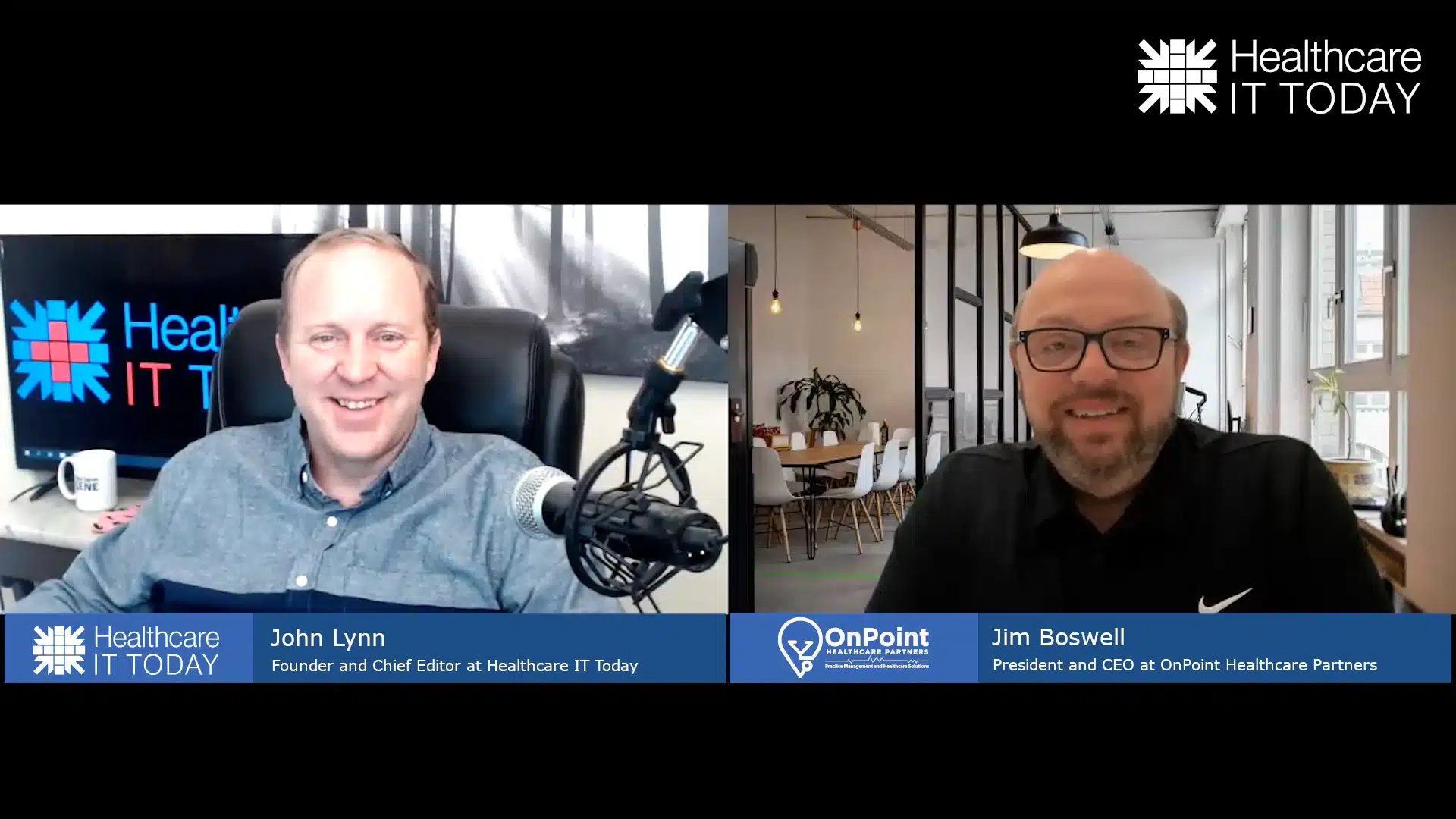
A company born at an awkward moment
Onpoint arrived just before the pandemic, a wonderful time to sell change to institutions with no attention left to spare. Healthcare organizations were absorbed by immediate operational demands. A young company asking them to reconsider documentation and workflow had to prove that it would reduce burden rather than become another burden wearing a clever badge.
Boswell's answer was persistence and an insistence on practical measures. Iris was discussed in minutes required to review a note, the proportion of work handled by the system, the number of electronic-record platforms it could enter, and the accuracy checked by clinical reviewers. Company claims grew as the platform matured, but the unit that mattered remained ordinary: what happened to the working day?
When Peloton Equity led a growth investment in early 2024, Boswell's public note did not perform the familiar founder trick of turning a collective effort into a personal revelation. He thanked the team, investors, vendors, and clients. In four years, he wrote, they had assembled technology, a global delivery engine, a client base, and the teams required to connect them. “Hard work, trust & integrity does payoff!” he added, with the grammar of somebody too pleased to wait for an editor.
The list tells us more than the exclamation point. Boswell sees a company as a chain of promises. The software promises useful output. The clinical reviewer promises scrutiny. The vendor promises reliability. The client promises enough trust to change a routine. Break one link and the grand talk about transformation becomes an expensive screensaver.
Even the geography reflects that chain. Onpoint is based in the Dallas area, with operations also listed in Hyderabad, Mexicali, and Monterrey. Distributed delivery gives the company reach, but it also makes process discipline unavoidable. A handoff across teams and time zones cannot depend on intuition alone. Boswell's finance-and-operations background, once far removed from the fashionable edge of AI, looks rather well suited to the unromantic work of making a global service behave consistently.
Beyond the note
Clinical documentation was an entrance, not the whole building. Boswell came to argue that a note accounts for only part of the administrative problem. Around it sit coding, referrals, medication requests, prior authorizations, care coordination, and revenue-cycle work. Fix the note alone and the queue simply begins at the next door.
Onpoint therefore widened Iris from a virtual assistant into what it calls a medical-agent platform, with workflows spanning charting, coding, care, and network operations. In 2025 the company described a broader Practice Management as a Service model. The terminology grew more ambitious; Boswell's governing idea stayed compact. Build from the inside out. Start with the people doing the work, understand the sequence, and use technology where it can remove friction without removing responsibility.
“This isn't just another AI layer on top of healthcare.”Jim Boswell on the expanded Iris platform
There is a useful tension in that sentence. Every platform wants to be indispensable, while every well-run practice has reason to be suspicious of one more layer. Boswell's answer is that the product must execute work, not merely advise. He prefers completed tasks to sparkling suggestions. It is the instinct of someone who has sat through enough operating meetings to know that a dashboard can describe a queue with great elegance and still leave the queue untouched.
The founder moves one chair over
In October 2025, Onpoint announced that Sean Carroll would become chief executive and chairman. Michael Clark became president and chief operating officer. Co-founder Rodney Haynes moved from operations into a chief customer role. Boswell became founder and chief strategy officer, remained on the board, and took charge of commercial strategy, key relationships, and long-term product vision.
Founder transitions invite melodrama because business writing is fond of thrones. This one reads more like an operating decision. The company had reached a stage that called for executives experienced in scaling technology platforms. Boswell kept the pieces closest to his history: understanding buyers, shaping partnerships, and deciding which part of the workflow the product should tackle next.
His aspiration is visible in the sequence. Documentation becomes a foothold. Connected administrative tasks become a platform. The platform becomes an operating model for a practice. Whether Onpoint can carry that ambition at scale will be decided in details that rarely make a launch announcement: integrations, edge cases, reviewer judgment, customer adoption, and the daily accumulation of minutes.
That is also why Boswell remains an interesting guide to the current AI moment. He is neither a machine evangelist nor a nostalgic defender of manual work. His formula keeps both sides at the table. Let software do what software can repeat. Let trained people inspect what requires context. Judge the combination by the work it finishes and the time it returns.
The stolen minute, multiplied across years, gave Boswell his company. The returned minute is harder to market. It does not glow. It may look like a clinician leaving a screen sooner, an authorization moving before somebody asks, or a referral closing its loop. Small things, in other words. Boswell has spent a career learning how large organizations are made of them.