The first person to meet Eva did what most of us do when a strange recorded voice calls about health insurance: they hung up. This was 2019. Ankit Jain and Shyam Rajagopalan, longtime friends and former Googlers, had not yet built the company that would become Infinitus. They had built a test. The machine introduced itself as Eva, said it was calling UnitedHealthcare on behalf of Bruce Willis, and asked to collect benefits. Click.
It was a comically efficient rejection of the business plan. Jain wondered whether they had found a terrible idea. Rajagopalan suggested the founders perform the least glamorous maneuver in entrepreneurship: dial again. The second insurance representative stayed on the line and talked to the machine. That conversation changed their minds. The important discovery was not that artificial intelligence could sound human. It was that a human in the machinery of American healthcare might cooperate with it long enough to get useful work done.
The short version
- Infinitus automates the coordination work between patients, providers, pharmacies, drugmakers, and health plans.
- Its agent Eva verifies benefits, follows authorizations, navigates phone trees, and hands tricky moments to people.
- The company sells enterprise software and managed operations, not a consumer app.
- Its edge is healthcare-specific data, integrations, guardrails, and millions of completed conversations.
- The copyable move: test the ugliest assumption cheaply, then build around the workflow rather than the model.
The overlooked job between yes and treatment
Jain’s original spark came a year earlier. Google had demonstrated Duplex making natural-sounding calls to book restaurants and spa appointments. His wife, Shailvi, who knew healthcare operations, asked the obvious impolite question: why use that technology for a massage when healthcare workers spend entire days on hold? Jain called Rajagopalan. The pair had worked on search, security, and consumer products used at enormous scale. Now they chose a problem measured in hold music.
A doctor can prescribe a specialty medicine. The medicine can exist. A support program can have money. Still, the patient may wait because somebody must confirm coverage, collect copay details, learn whether prior authorization is required, chase the status, and return the answer to the right system. The clinical work is finished. The coordination work has barely begun.
Infinitus began by automating benefit verification and prior-authorization follow-up. Its software accepts a task through an API or portal, places the call, survives the interactive voice response maze, speaks with the person who answers, collects the required fields, and returns structured data. The early product, DynamoBV, supported more than 35,000 providers by 2021. Eva Lightyear - yes, the name is a Buzz Lightyear joke - had made roughly 250,000 calls by then.
“The first agent we called hung up on us.”Ankit Jain, recalling Infinitus’s first test
A machine with excellent patience
There are two ways to misunderstand Eva. One is to picture a general-purpose chatbot with a phone. The other is to picture a dialer. The useful thing sits between them. Infinitus runs a multi-model, multimodal system supported by a healthcare knowledge graph: phone numbers, opening hours, payer rules, plan behavior, therapies, procedures, and the residue of past calls. If the graph already holds a recent, high-confidence answer, the system may return it in under a second and skip the call. If not, Eva dials.
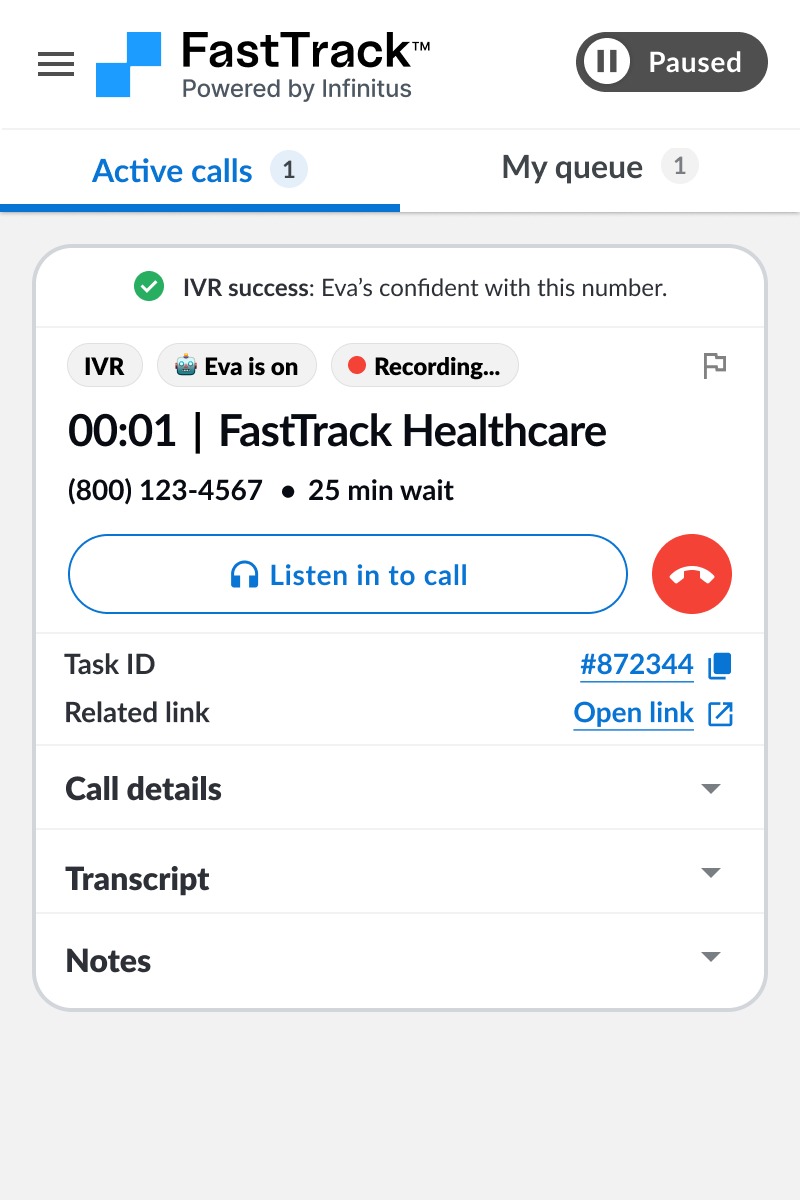
FastTrack, launched in 2024, keeps the judgment-intensive part with the employee. It can initiate several calls, choose the right number and time, navigate more than 1,000 payer phone trees, distinguish ads from hold music from a live representative, and then bring the reimbursement specialist into the call. The company says teams complete at least 25 percent more calls. The worker still talks to the insurer. They simply stop donating the first 25 minutes to a flute arrangement of “Careless Whisper.”
The economics are boring. That is the appeal.
Infinitus does not publish a menu price. It sells to pharmaceutical manufacturers, specialty pharmacies, patient-support programs, health plans, provider groups, and hospital systems. The unit of persuasion is not seats or tokens. It is a completed verification, a shorter turnaround, one fewer outsourced call, or one more patient reached without hiring a seasonal army.
Bars use separate scales and compare reported changes, not like-for-like measurements.
Amgen offers the cleanest example. In a proof of concept around one major therapy, Infinitus returned completed benefit data in an average of eight and a half hours. The integrated program later brought verification within 48 hours or less and, according to Amgen, saved thousands of employee hours during the first year. A different top-ten pharmaceutical manufacturer reported halving benefit-verification time and achieving a 400 percent return. Another biotech customer handled a 144 percent January surge during a blizzard without adding staff.
These figures are customer stories, not a universal law. The system works best when the job recurs at volume, the required data is knowable, the phone or digital endpoint is reachable, and success can be defined before anyone dials. It is a poor fit for a one-off conversation whose value lies entirely in empathy, novel clinical judgment, or a relationship no customer wants automated. Infinitus’s recent product design quietly acknowledges that boundary.
The clever part is knowing when Eva stops
Healthcare voice AI has an awkward choice. A fully scripted agent is controllable but brittle. A fully generative one is fluid but capable of inventing an answer at precisely the wrong moment. Infinitus now calls its compromise Agentic Response Control. A question about parking can receive a natural response. A question about dosage triggers approved language or a handoff. Clinical Escalations monitors conversations for risk and routes the patient to a person with the context attached.
That is the company’s competitive claim: not merely a pleasant voice, but the plumbing around it. Infinitus combines payer intelligence, direct data connections, a knowledge graph, CRM and EHR integrations, HIPAA-oriented controls, audit trails, and people in the loop. Competitors can offer contact-center automation, electronic benefit checks, or generic voice agents. Infinitus is trying to own the messy seam where all three meet.
The most important feature of a healthcare AI agent may be its ability to notice that the conversation has become too important for AI.
From phone call to coordination layer
By 2026 the company had widened its ambition. Studio lets healthcare teams describe an agent, attach operating procedures or APIs, simulate thousands of conversations, and deploy without hand-writing a giant configuration. Lens analyzes conversations against healthcare-specific quality and compliance rules. Workflows coordinates agents, employees, APIs, copilots, and systems across an entire patient journey. The new AI-first, human-backed support hub goes further: AI absorbs routine volume around the clock while certified specialists take ambiguity, clinical issues, or any patient who simply asks for a person.
Can an insurer complete a useful conversation with a machine?
DynamoBV blends calls and digital sources for benefit verification.
FastTrack removes dialing, phone trees, and hold time from an employee’s day.
Studio, Lens, Workflows, and clinical escalation connect conversations to outcomes.
The company says it has automated 350 million healthcare interactions, works with more than half of Fortune 50 healthcare companies, and serves eight of the ten largest drugmakers. It has raised $102.9 million, including a $51.5 million Series C led by Andreessen Horowitz in 2024. The money matters because healthcare procurement is slow, integrations are fussy, and production voice systems must cope with accents, interruptions, bad audio, changing phone trees, privacy rules, and the difference between “fifteen” and “fifty.” A dazzling demo gets you to the lobby. Reliability gets you renewed.
Make the second call
The most portable Infinitus lesson has little to do with voice models. Jain describes it as leading with the customer pain point. The founders did not begin with a broad promise to transform medicine. They found a repetitive workflow, asked whether the party on the other end would cooperate, and tested the dangerous assumption before building the company.
Others can copy the sequence. Choose work people hate but still must complete. Make success observable. Start with a narrow transaction. Keep a person close to the edge cases. Let every completed job improve the map. Integrate the result into the system where work already lives. And if the first stranger hangs up, do not write a manifesto about disruption. Check the number and call again.