A prediction arrives in a conference room. It says a promotion will fail, a customer will leave or a shipment will be late. Then the meeting begins. Sales distrusts the inputs. Finance wants a different margin assumption. The regional manager has an exception. Nobody owns the final call. By lunch, the expensive model has become one more tab in one more dashboard.
Fractal has spent 26 years living in that awkward distance between knowing and doing. The company was founded in Mumbai in 2000, when “data scientist” was not yet a fashionable job title and five business-school classmates were wondering whether anyone would pay them to sell mathematics. Today Fractal Analytics Limited is a public company, listed in India, with more than 6,000 professionals and a client list tilted toward large global enterprises.
Its work is easiest to understand as decision plumbing. For a consumer-goods company, Fractal might connect retailer data, promotion history and inventory signals so a commercial team can decide what to discount. For an insurer, it can place a natural-language layer over policy and annuity data. For a call center, it built a generative-AI knowledge assistant that users reported cut handling time by as much as 15 percent. The model matters. So do permissions, data definitions, interfaces, training and the nerve to change a workflow people have defended for years.
They did not start with artificial intelligence
Srikanth Velamakanni and Pranay Agrawal met at the Indian Institute of Management Ahmedabad, then worked in finance. The founding group quit their jobs before settling on analytics. Their early pitch was more basic: companies had growing piles of transaction data, and mathematics could reveal what customers might do next. One prospect asked why a six-person startup could beat more than 100 PhDs working on the same problem. Process, not swagger, became the answer.
The first plan was to establish Fractal in India and then expand. The founders changed their minds. Larger American companies had more data, larger budgets and more mature processes for putting analytics to work, so Fractal moved toward the US in 2005. The Americas still produced 67.3 percent of the core Fractal.ai segment’s FY26 revenue. This was not merely geographic arbitrage. It was a hunt for customers capable of absorbing what the company sold.
“A bad decision taken in time is better than none at all.”Srikanth Velamakanni, reflecting on the cost of slow leadership
The first thing to fail was Fractal’s own decision system. Its five equal partners each ran a region, argued for resources and avoided naming one chief executive. Decisions slowed. An internal election made Velamakanni CEO, but the damage was done; two founders left. He later described the rupture with unusual economy: “In hindsight, it was all ego.” The company that wanted to improve corporate decisions had learned, painfully, that analytical talent does not settle questions of authority.
The product is a changed decision
Fractal now sells a wide stack of services: data engineering, cloud modernization, machine learning, design, behavioral science, governance and AI implementation. That breadth can look like a catalog until you notice the organizing idea. Fractal tries to follow data all the way into action. Its specialists do not only estimate demand; they work on how a planner sees the estimate, which exceptions require review and how the result reaches another system.
The enterprise AI relay race
Cogentiq, launched in 2025, is Fractal’s attempt to package this relay race as an agentic platform. Its newer applications target e-commerce profit signals, sales work and finance processes. Asper.ai handles revenue-growth decisions for consumer brands. Vaidya.ai is a medical multimodal model and health assistant. PiEvolve automates parts of machine-learning experimentation. LLM Studio, built around NVIDIA tools, helps enterprises customize and run language models. Analytics Vidhya supplies education and community. Qure.ai, the radiology company Fractal incubated and later spun out, shows the venture-building instinct at its most ambitious.
The products do not erase Fractal’s services DNA. They grow from it. A team observes the same expensive decision across several customers, encodes some of the repeated work, and returns with something closer to software. That makes product discovery unusually grounded. It also means growth is not frictionless: the platform often arrives attached to integration, customization and change management.
Sticky clients, concentrated stakes
Fractal’s customers include large enterprises in consumer goods and retail, technology, media and telecom, healthcare and life sciences, banking, insurance and industrial sectors. It says it has worked with more than 170 Fortune 500 companies. In Q3 FY26, 58 clients generated more than $1 million each, and six generated more than $20 million. A 114 percent net revenue retention figure suggests existing accounts were expanding faster than contractions and losses.
The same closeness creates risk. Fractal’s IPO documents showed its top 10 core-segment clients contributing a little more than half of segment revenue. A delayed budget or lost relationship can be felt. It also complicates the “pure-play AI” label. Fractal competes with analytics specialists such as Mu Sigma and Tredence, global consultants such as Accenture and Deloitte, IT-services firms such as TCS and Infosys, software platforms and clients’ own internal teams. Its distinction is the combination of domain knowledge, behavioral science, design and engineering. Its constraint is that much of that combination still travels through people.
The financial results are more grounded than the category hype. Fractal reported ₹27.6 billion of consolidated revenue in FY25. Q3 FY26 revenue reached ₹8.544 billion, up 21 percent year over year, with profit after tax of ₹1.001 billion. Q1 FY27 revenue was ₹9.125 billion, roughly 20 percent higher than a year earlier. These are substantial growth rates for an established services-led business, not the near-zero-marginal-cost curve investors associate with a breakout software product.
What the ₹28.3 billion IPO bought
Fractal had already taken the private-equity staircase: $25 million from TA Associates in 2013, $100 million from Khazanah in 2016, $200 million from Apax in 2019 and a $360 million TPG transaction in 2022 that made it a unicorn. In February 2026, it sold 31.5 million shares at ₹900 apiece. The total offer was ₹28.339 billion, although only ₹10.235 billion was fresh capital; the rest went to selling shareholders.
The shares opened below the offer price. That small piece of market discipline sharpened the question Fractal must answer as a listed company: how much of its accumulated knowledge can become reusable intellectual property rather than another well-run project? Fresh proceeds were earmarked for debt repayment, equipment and offices, research, sales and marketing, and acquisitions. The company says it invests more than 6 percent of revenue in R&D. In 2026 alone it pushed out an open reasoning model, a machine-learning agent, a healthcare model update, LLM Studio and several Cogentiq applications.
Partnerships offer distribution and technical leverage. Fractal works across Microsoft Azure, AWS and Google Cloud; pairs with NVIDIA on accelerated AI; joined Anthropic’s network as a preferred services partner; and has publicized enterprise adoption work involving OpenAI and Philips. This cloud-agnostic posture suits customers that already own a crowded technology estate. Fractal’s role is less to replace that estate than to make it produce a decision.
A culture designed to remove small permissions
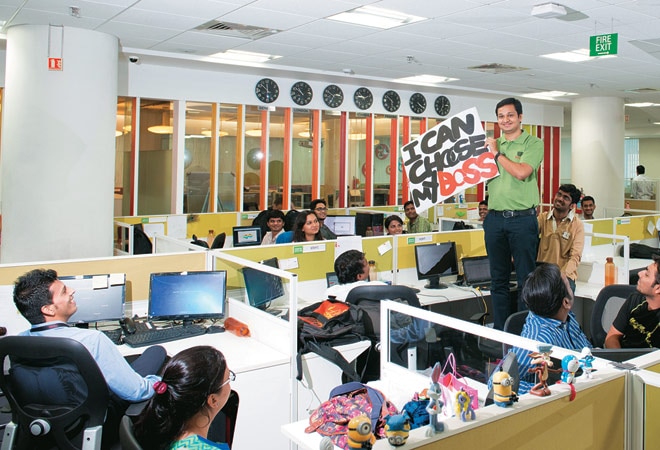
Fractal once attracted attention for letting employees choose their manager, project, hours and work location. Policies could be edited wiki-style. Leave was not tracked. Expense claims were trusted. Employees assessed their own goal achievement. The company called the philosophy its People Principle; the current umbrella is “The Fractal Way.” The point was to remove low-value permission seeking from people hired to solve ambiguous problems.
Freedom is easier to describe at 700 employees than at more than 6,000, and no public accolade can settle what daily work feels like. Still, the design is revealing. Fractal’s culture and its product thesis share a belief: better decisions require clear context, capable people and room to act. A model without agency becomes a report. An employee without agency becomes a ticket queue.
The copyable playbook - and its limits
- Start with a repeated decision, not an AI capability. Price changes, inventory moves and retention offers have owners and measurable consequences.
- Map the last mile before building the model. Know who sees the result, who can override it and which system records the action.
- Productize repetition. Custom work becomes an advantage only when recurring patterns turn into reusable components.
- Measure adoption and economics together. Accuracy is not value if nobody changes behavior.
- Do not copy this when data is inaccessible, leadership cannot name a decision owner, the workflow is politically frozen or the use case cannot support integration costs.
The honest market position
Fractal is not a frontier-model laboratory in the mold of the companies training the largest general systems. It is not a conventional software vendor that hands over licenses and leaves. It is not merely a body shop, either: its research, products and healthcare spinout are evidence of real intellectual ambition. Fractal sits in the middle - close enough to clients to understand a decision, technical enough to build the machinery around it, and increasingly motivated to turn that machinery into products.
That middle is crowded and sometimes inelegant. It is also where enterprise AI becomes useful. The company’s future will not be decided by how many agents it announces. It will be decided by whether those agents shorten a cycle, improve a margin, prevent a loss or give a human enough confidence to act before the next meeting. Fractal has spent 26 years learning that the last mile is the whole business. Public investors will now measure how repeatable that lesson can become.