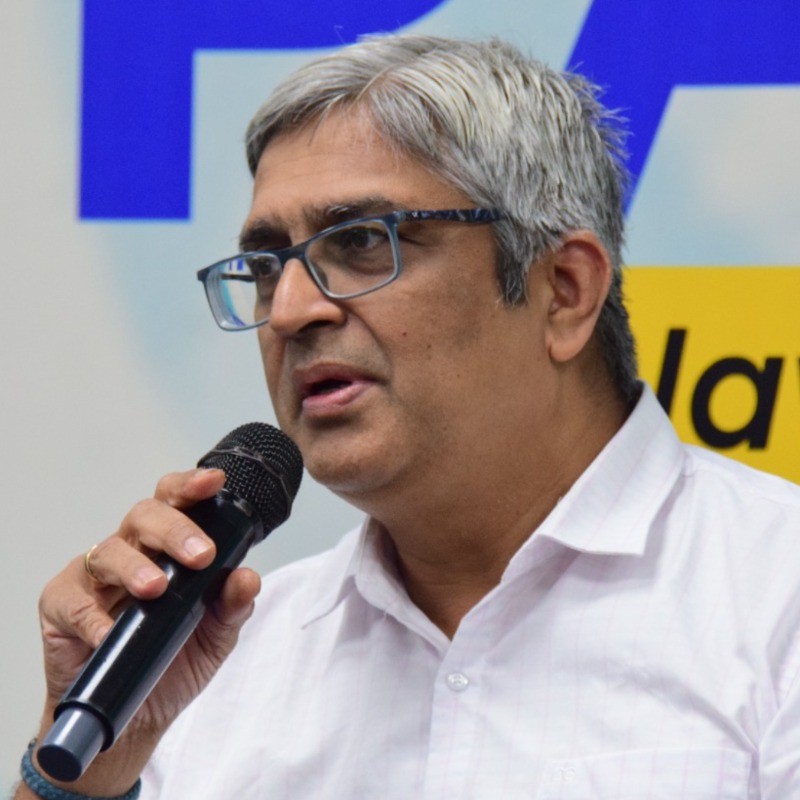
The Man Who Counted the Casualties in Enterprise AI - Then Fixed It
On August 16, 1994, Gopalakrishna Kuppuswamy showed up for his first day at CMC Limited, one of India's original technology research firms. He didn't just enter a job. He entered a three-decade education in what it actually takes to build software systems that hold up. The internet was barely a concept for most people that morning. By the time it matured into something that could carry AI workloads at enterprise scale, Kuppuswamy had clocked more hours in the engine room than most analysts have spent reading about it.
Today, he's Co-Founder and CTO of Cognida.ai, a Sunnyvale-headquartered enterprise AI company that closed a $15 million Series A from Nexus Venture Partners in February 2025. The company is valued at $113.1 million. Its ARR sits at $37.7 million. And it operates on a premise that should embarrass the broader AI industry: of the 87% of enterprises that invest in AI, only 20% ever see it reach production.
Cognida.ai exists because of that 67-point gap. Kuppuswamy built the technology to close it.
We are genuinely AI-native - not retrofitting old approaches. Our Silicon Valley product DNA, combined with a hyper-growth, agile mindset, means we architect AI solutions at the speed of innovation.
- Gopalakrishna Kuppuswamy, Co-Founder & CTO, Cognida.aiFrom Global Delivery to Ground Zero
The decade Kuppuswamy spent at Hitachi Vantara as Vice President of the Global Delivery Center in India wasn't a detour. It was a masterclass in what enterprise companies actually need versus what AI vendors typically sell them. He led the Technology Solutions Organization for Hitachi's Digital Solutions Business Unit - managing global development and delivery for accelerators and solutions at one of Japan's largest tech conglomerates. He built the Outsourced Product Development business from scratch, turning it into a delivery engine for independent software vendors worldwide.
He also mentored university graduates through Hitachi's Consulting Core program, which tells you something about how he thinks about scale. Getting 250 engineers to work toward the same outcome requires the same skill as getting a single intern to write their first production-ready line of code: clarity of purpose, patience with process, and zero tolerance for theater.
When he left to co-found Cognida.ai in 2022 - alongside CEO Feroze Mohammed and five other co-founders - he brought all of that with him. Not as a nostalgic reference point, but as a live database of what breaks when enterprises try to bolt AI onto legacy systems. The answer, consistently: everything.
Zunō: The Platform Built for the 80%
The Zunō agentic AI platform is where the engineering thesis plays out. It comprises five distinct modules - each targeting a different chokepoint in the enterprise AI adoption pipeline. Zunō.predict handles predictive analytics with automated ML pipelines. Zunō.lens takes on computer vision and deep learning. Zunō.assist addresses enterprise generative AI and knowledge management. Zunō.fuse handles data integration. Zunō.synth generates synthetic data. Together, they compress a typical 6-to-8-month implementation cycle into 10 to 12 weeks.
The results aren't theoretical. A manufacturing client reduced invoice processing time by 70% while hitting 99% accuracy. A video surveillance equipment manufacturer improved inventory forecasting by 45%. A third client used generative AI to accelerate quote generation for RFQs - contributing to more than $10 million in new revenue. These are not pilot programs or proofs of concept. They are production deployments at 30+ leading organizations across healthcare, manufacturing, finance, and deep tech.
87% of enterprises invest in AI, but only 20% successfully deploy to production.
- Gopalakrishna Kuppuswamy, on the gap Cognida.ai was founded to closeTwo Master's Degrees, Two Continents
Kuppuswamy holds a Master's in Computer Applications from the University of Hyderabad and a Master's in Computer Science from the University of Illinois Urbana-Champaign - two institutions on opposite ends of the world that shaped his thinking in ways that complement rather than duplicate each other. The Hyderabad degree gave him roots in India's computing tradition; the UIUC degree gave him a foothold in the institution responsible for a disproportionate share of the computer science breakthroughs that power modern AI. UIUC alumni include Marc Andreessen, who co-wrote Mosaic, the first widely used web browser. The campus has a specific gravity in the technology world that Kuppuswamy has carried into his work without advertising it.
He still lives in Hyderabad. The company's registered address is in Sunnyvale. That tension - operating across time zones, cultures, and development philosophies - is exactly the kind of complexity Cognida.ai was engineered to absorb.
What Actually Happened in February 2025
The $15 million Series A from Nexus Venture Partners wasn't a bet on a promise. It was a validation of a track record. By the time the round closed, Cognida.ai had already deployed its platform at 30+ enterprise accounts and was generating $37.7 million in ARR. Nexus - the firm behind Delhivery, Unacademy, and Postman - doesn't typically back companies still looking for product-market fit. The investment said something specific: Cognida's method works, and the market for it is large.
The total funding reached $24.4 million. The company employed 250 professionals. The valuation landed at $113.1 million. Three years from founding, Kuppuswamy and his co-founders had built something that the market was willing to price at nine figures. Not on hype - on deployments, on ARR, on the kind of measurable enterprise outcomes that board decks get built around.
He received the Dean's Community Award for Pioneering Practical Solutions from Imperial Business School around the same period - a recognition that understates the scale of what "practical" means in his context. Practical, for Kuppuswamy, means a manufacturing company's invoices get processed 70% faster. Practical means a client's RFQ process generates eight figures in new revenue. Practical is the word people use when the alternative - months of consulting, stalled pilots, and executive frustration - has become too expensive to ignore.
The Specific Gravity of August 16, 1994
Most founders narrate their career as a series of pivots toward the inevitable. Kuppuswamy's reads more like a long preparation. The date he started at CMC Limited - August 16, 1994, precise to the day - is a detail he has cited publicly. It's the kind of specificity that comes from someone who keeps track of where things begin. Silicon Graphics, Hitachi Vantara, and then Cognida.ai: each chapter was longer and more operationally complex than the one before. Each produced a narrowing conviction that AI deployment wasn't a technology problem. It was an execution problem. And execution problems have engineering solutions.
In 2017, when the AI boom was still mostly conference-circuit speculation, he gave an interview on IoT sensors in public safety. In the same period, he was writing Hitachi think-pieces on smart disaster management and real-time governance. He was building the mental model for Zunō before Zunō had a name. That's not hindsight - it's what 30 years of attention to how technology actually functions inside large organizations produces.
The mission Cognida.ai operates under - "No business left behind" - is three words that contain the entire arc of his career. It's not a tagline. It's the conclusion he arrived at after three decades of watching enterprises buy technology and then fail to use it. He built a company to change that outcome. He hired 250 people to change that outcome. He raised $24 million to change that outcome. The question isn't whether Gopalakrishna Kuppuswamy believes in the mission. The question is whether the other 80% of enterprises will get there before their competitors do.