At Mission Hospital in California, the equipment problem had acquired a peculiar habit: it made people hide the equipment. Staff spent time looking for movable medical devices. Worried about the next search, they hoarded what they found. Each sensible little act of self-preservation made the hospital’s collective predicament worse. A device could be somewhere in the building and still be unavailable to the person who needed it.
That is the sort of problem CenTrak sells an answer to. Its real-time location systems, or RTLS, attach digital identities to physical things and people. Tags, installed infrastructure and software turn movement into information. The interesting part comes afterward: whether that information changes what a hospital does.
- CenTrak combines locating hardware, software and clinical consulting for hospitals and senior living.
- Its distinctive option pairs infrared location signals with active RFID for room- and bay-level visibility.
- Customer savings depend on distribution, training and maintenance as well as tracking.
- Halma bought the company for $140 million in 2016; CenTrak now reports use in more than 2,000 healthcare facilities.
The shortage that staff made worse
Mission’s losses exceeded $150,000 a year, according to CenTrak’s published case study. Nurses, biomedical staff and equipment managers all spent time searching. Rental costs added to the trouble. Purchasing decisions were made without a reliable picture of how much equipment was actually being used.
The hospital chose CenTrak’s Gen2IR and active-RFID technology to track equipment location, cleaning and maintenance. VIZZIA Technologies installed the system and configured its software. The case study reports $200,000 in annual savings and a fall in the lost-or-stolen device rate from 13.8% to zero. Those are results from this deployment, reported by the vendor; they are useful evidence of what changed at Mission, rather than a forecast for every hospital.
The more revealing detail is behavioral. Staff no longer needed to hoard devices once equipment was readily located and available. Buying extra equipment would have addressed the anxiety by enlarging the pile. Making the pile visible addressed the reason for the anxiety.
The intervention: make equipment visible, then keep clean devices circulating.
Piedmont Healthcare’s experience adds another twist. It had begun using passive RFID in 2006, but locating equipment did not give it enough insight into utilization and distribution. The first approach left an operational question unanswered: how do clean, working devices reliably reach the people who need them?
Piedmont redesigned its processes and standardized CenTrak’s enterprise location services as it acquired hospitals. VIZZIA maintained the technology and supplied analytics. CenTrak’s account describes approximately $510,000 in annual savings from reduced losses, rentals, fleet size and maintenance costs. It also reports a 78% reduction in rental expenses. Technology, software, training and changed processes all belong in that sentence.
Approximate annual savings across equipment loss, rentals, fleet size and maintenance.
Why the room matters
A hospital is a demanding place to put a dot on a map. For an equipment search, being near the right room may be helpful. For documenting a caregiver’s arrival, a neighboring room is a consequential error. CenTrak’s case for its clinical locating technology rests on resolving those boundaries.
Its Gen2IR system combines second-generation infrared signals with active RFID. Installed devices identify spaces; tags detect those identifiers and send location information onward. CenTrak offers segmentation down to rooms, beds and bays. It also offers Bluetooth Low Energy options, including the plug-and-play platform announced in March 2025. Buyers can select infrastructure to suit the coverage and workflow they actually need.
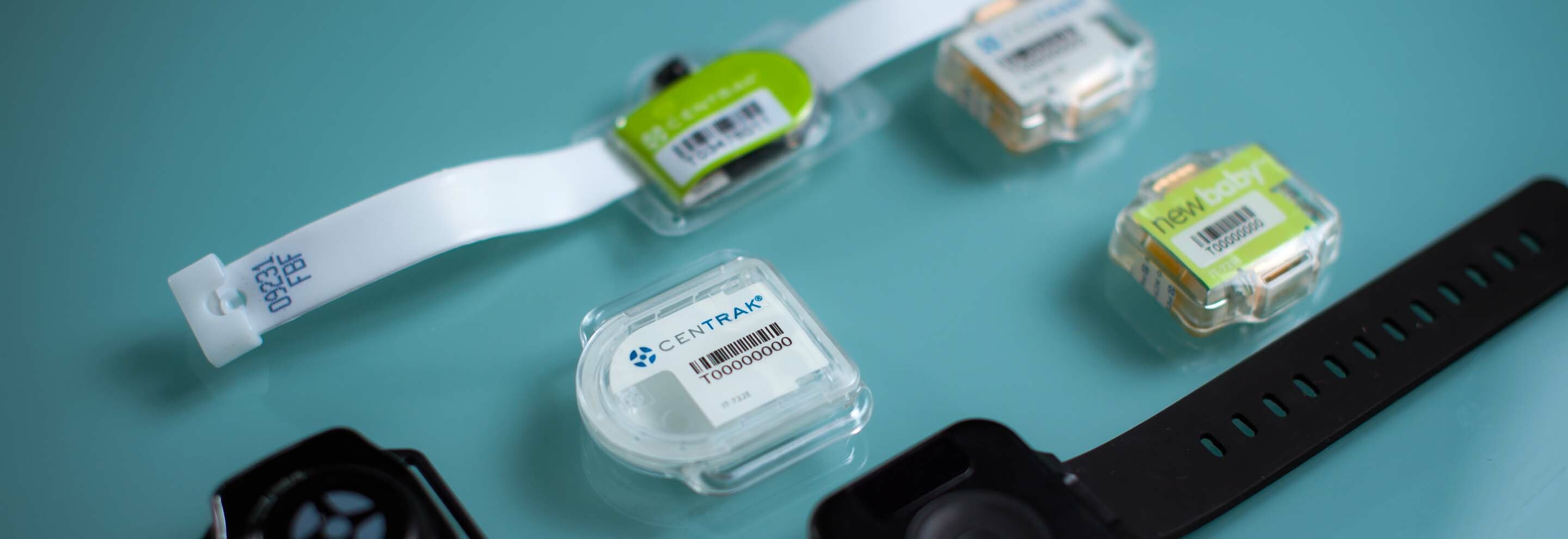
That range matters commercially. CenTrak occupies the space between a hardware supplier, a healthcare software vendor and an operations consultant. Sonitor is an alternative with ultrasound-based locating; Securitas Healthcare, Midmark and HID also serve healthcare RTLS use cases. A useful comparison starts with the job: equipment search, infant protection, staff safety or clinical workflow. A general accuracy claim says less than a demonstration in the buyer’s own environment.
The portfolio spreads well beyond wandering pumps. Staff duress tools let a caregiver request help and communicate location. Nurse-call integrations can record response and cancel a call when the appropriate staff presence is detected. Environmental monitoring records temperature, humidity and differential air pressure, serving refrigerators, laboratories and specialized rooms. Senior living offerings cover resident locating, emergency calls and wander management.
Each use case has a different last mile. Finding a pump requires somebody to fetch it. A duress alert requires somebody to respond. A temperature excursion requires somebody to protect the stock. The same location network can support several applications, but each application needs its own operating agreement.
Selling the work around the sensor
In November 2021, CenTrak acquired Infinite Leap, a healthcare consulting and services company. The announcement explicitly described a transition from IoT devices toward an end-to-end enterprise solution. Infinite Leap brought solution design, implementation, training, operational support and managed services.
The purchase is the clearest expression of a change in emphasis. A sensor company can sell the ingredients for improvement. A service business must help its customer cook. CenTrak expanded the people and support around its technology so that the installation would have a better chance of producing an operational result.
Today, the business model combines physical devices, software and services, delivered with a partner ecosystem. ConnectRT is its cloud platform for applications and system administration. CenTrak also supports third-party RTLS software and integrations with existing healthcare systems. A buyer may need a complete program or a location layer that works with tools already in place.
Its expertise follows that combination. The company describes a team containing healthcare practitioners, workflow and process engineers, developers, trainers and support staff. Consulting begins with a facility’s workflows and requirements. Implementation puts the design into the building. Success management addresses adoption and continuing performance. None of those jobs disappears because the tag is small.
“Grow fast, but hire slow.”
Gideon Naim, co-founder, discussing CenTrak’s scaling challenge in a Direct Recruiters interview
The ownership story supplies an unusually concrete price. Halma announced its purchase of CenTrak for $140 million in cash consideration in February 2016, subject to a net-asset adjustment. At that point Halma reported over 600 healthcare installations. It disclosed 2015 revenue of $43.8 million, excluding net deferred income, and pretax profit of $10.2 million. These are historical business figures, not the price of installing a hospital system.
The bill, the batteries and the promises
For a hospital, the cost question is a design question before it is a procurement question. Coverage, the number and type of tags, software, integrations and ongoing services shape the scope. CenTrak describes customized cost-benefit assessments. A projected saving needs to be placed beside the installation and running costs, with an agreed way to measure the result.
The practical arithmetic should include the unglamorous work: assigning badges, replacing batteries, keeping equipment records accurate, teaching staff and maintaining alerts. A hospital that cannot support those routines may collect a handsome set of dots without changing the availability of a single clean device. That is an operational inference from how the system works, and a useful question for any prospective buyer.
There is also independent evidence to temper the demonstrations. KLAS’s July 2024 RTLS report described CenTrak customers valuing accurate room- and bay-level infrared coverage. It also reported concerns about broken tags, battery life, project management, communication and training. Only 37% of interviewed respondents said the vendor kept its promises. The report noted some improving support and hope around leadership changes; that survey describes its respondents at that time.
Those findings make the purchasing lesson rather specific. Ask who owns maintenance, what training follows go-live and how escalation works. Put the promised workflow through a realistic trial. Inspect performance after staff have used it for a while. The demonstration proves a capability; the operating plan determines how consistently the hospital can use it.
The map moves into the workflow
CenTrak’s March 2026 announcements show where it wants the information to go next. At HIMSS it showcased mobile duress alerts, a safety bracelet, AI-enhanced asset search and reporting, and disposable BLE sticker tags. These were announced demonstrations and product developments, rather than proof of a particular customer outcome.
On March 24 it announced Epic Toolbox designation for RTLS and completed Rauland VIP validation for Responder Enterprise interoperability. The proposed advantage is straightforward: bring location information into clinical systems and link it to nurse-call cancellation, response documentation and staff duress alerts. Information becomes more useful when it reaches the place where someone is already working.
The lesson a reader can copy is smaller than CenTrak’s catalog. Pick a repeated failure of coordination. Measure the waiting, searching or rental expense it creates. Decide what action better information should trigger, and give somebody responsibility for that action. At Mission, the telling outcome was that hoarding became unnecessary. A hospital had changed the circumstances under which sensible people made a costly choice.
Follow the moving parts
CenTrak website · Company news · Blogs and resources
LinkedIn · Twitter / X · Facebook
YouTube product videos · Watch: CenTrak at Mackenzie Health · Asset management webinar