The visitor has an appointment. The guard has a telephone. Somewhere inside the factory, someone has the authority to say yes. The building may contain precision machinery, yet its entrance still depends on a small relay race. Anyone who has waited at a reception desk knows the rules: stand politely, repeat your name, admire the plant.
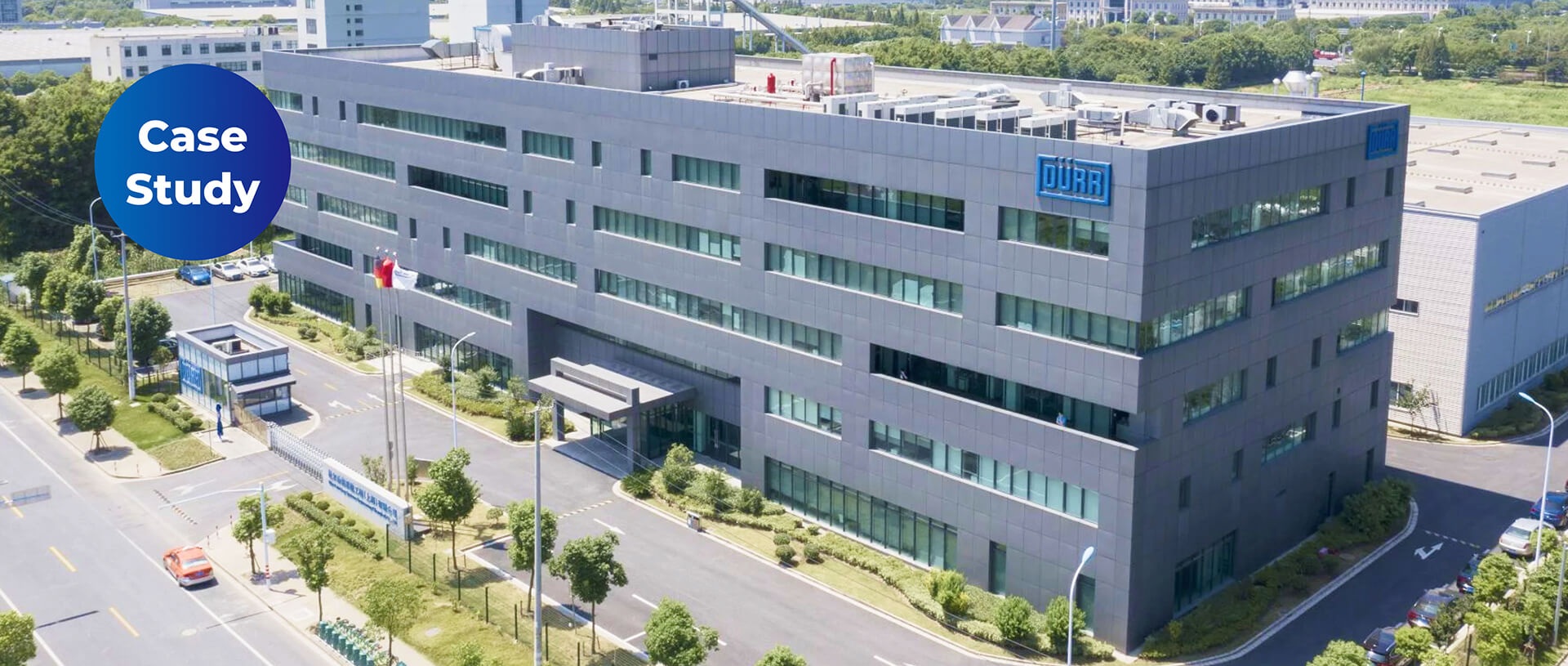
Anviz’s account of its work with Dürr China offers a way out of this ceremony. Visitors upload photographs before arriving; an administrator sets a period during which they may enter. FaceDeep 5 handles recognition at the gate. The interesting change is permission arriving before the person, rather than being chased down afterward.
The story in four points
- Anviz makes the hardware and the management software: biometric readers, attendance systems and video security.
- Its customers buy fewer administrative handoffs: a visit, a shift or an access event should become a usable record.
- Cloud expansion has a specific price: $99 a year per additional device; $199 per additional administrator.
- The useful lesson: test the complete workflow, including what happens when a record is wrong.
01 / PERMISSION BEFORE ARRIVALThe visitor who stopped waiting
In the Dürr case, Anviz reports an investment below RMB 1 million and annual savings approaching RMB 3 million. It says the security team went from 45 people to 10, with 35 employees trained and reassigned to production. These are the vendor’s reported results from a particular installation. They make the proposition unusually tangible: the return comes from rearranging work around the entrance.
The broader lesson travels better than the savings figure. Before changing a reader, ask who approves the visit, when approval happens and how the gate learns about it. A quick face match cannot rescue a permission request sitting unanswered in someone’s inbox. The bottleneck may be a decision.
02 / FROM MATCHING TO MANAGEMENTAn algorithm finds a business
Anviz began in Shanghai in 2001. Its 2014 brochure identifies Michael Qiu as founder and president and dates the release of its BioNANO biometric algorithm to 2002. Recognition was an early technical foundation: determine whether the person presenting a credential is the person enrolled in the system.
That foundation has acquired a substantial wardrobe. Anviz now offers face and fingerprint terminals, RFID readers, palm-vein recognition, attendance software and video surveillance. Official announcements place it within Xthings, whose portfolio connects commercial security with a wider collection of smart-device businesses.
Its expertise sits at the join between an identity decision and workplace administration. CrossChex Standard provides desktop management of people, access and attendance. CrossChex Cloud handles attendance through a browser, with schedules, reports and device management. IntelliSight adds cameras, network recording, software and event notifications. The company sells several ways to observe an arrival, then software that makes the observation useful.
One arrival / three jobs
Match the face, fingerprint, palm or card.
Apply the permission or attendance rule.
Give a manager an event to review.
Conceptual workflow. Available functions depend on the terminal and software configuration.
03 / THE CREDENTIAL MENUThree ways to be yourself
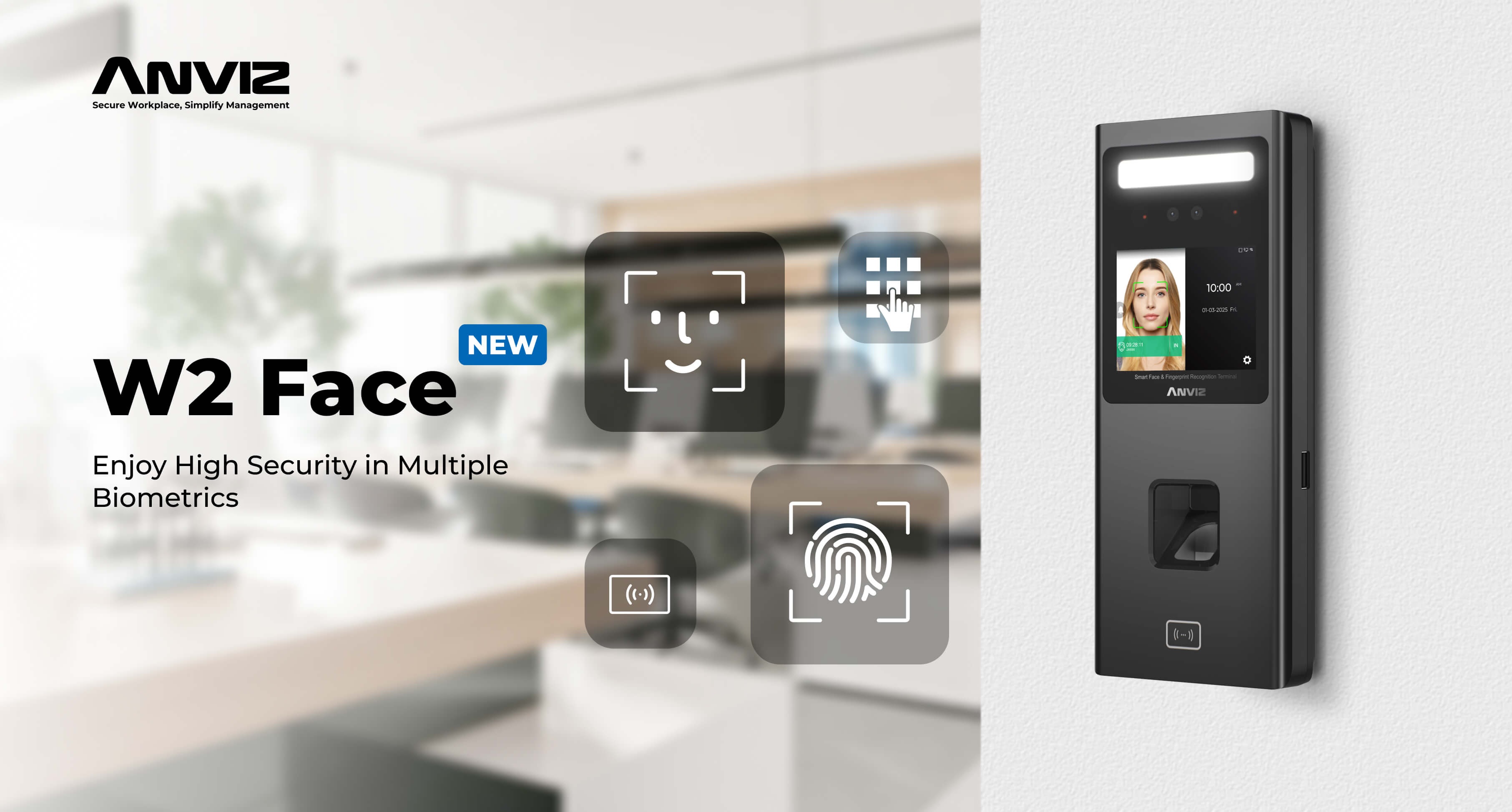
Consider the W2 Face, introduced in May 2025. It combines face recognition, fingerprints and RFID in a compact terminal, with Ethernet and Wi-Fi connectivity. Anviz lists capacity for 200 faces, 200 fingerprint records and 200 cards. Those are separate credential capacities; they should not be added together into a promise of 600 distinct employees.
This is a practical pitch to smaller workplaces. People can present different credentials, while the business uses the same device. Anviz’s launch announcement points to demand for contactless operation, flexible authentication and affordable systems. The hardware choice acknowledges that a workplace seldom consists of one kind of user doing one kind of job.
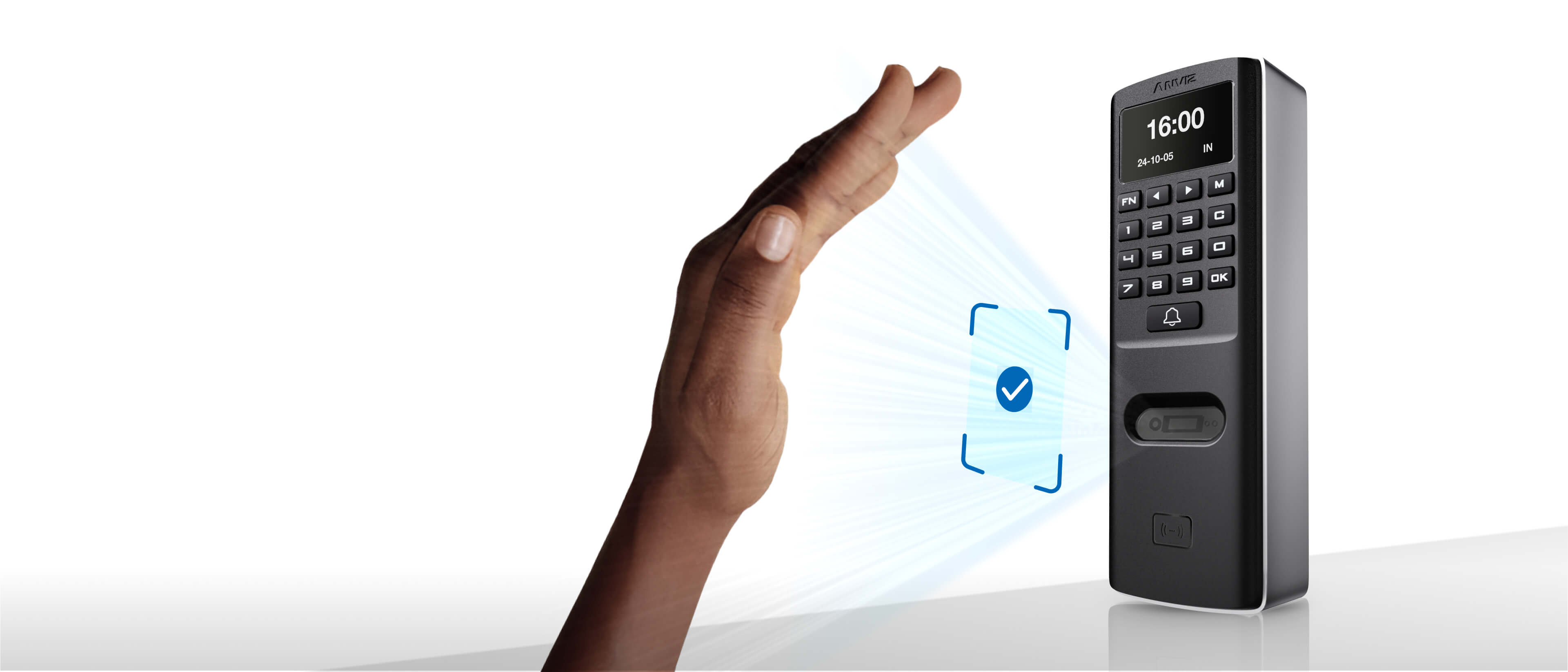
The M7 Palm takes a different route. Near-infrared light reads vein patterns inside the hand, without touching a sensor. Its published specifications include Power over Ethernet, IP66 ingress protection, IK10 impact protection and 500 palm users. RFID and PIN options remain available. A buyer planning an outdoor installation gets a list of constraints to inspect, alongside the novelty of waving a hand.
04 / THE PAYROLL CONNECTIONThe record has to travel
At Nael General Contracting in the UAE, the problem described in Anviz’s case study was an unreliable attendance process at a site with nearly a thousand workers. Records were disputed, HR spent time sorting clock data and salary payments were delayed. What failed first was trust in the record.
The deployment paired FaceDeep 3 with CrossChex Cloud, adding recognition, centralized reporting, scheduling and administrator action logs. The lesson extends beyond a construction site: identifying a worker is only the first step. The resulting timestamp needs to reach the people calculating wages, with a process for correcting missed punches and reviewing changes.
Provis, a UAE property manager, faced another version of the same difficulty. Anviz’s case describes separate terminals and software that could not connect event records and share data effectively. Its integrator partners brought FaceDeep 3 and CrossChex into the workflow to centralize information.
“we always struggled with the data integration of multi-point control”
PROVIS ACCOUNT MANAGER / QUOTED IN ANVIZ’S CUSTOMER CASE
These accounts explain the customer mix: factories, building operators and construction employers, alongside the schools, shops and healthcare facilities Anviz addresses. They have different entrances but similar questions about identity, timing and responsibility. A disconnected system gives each department a little truth of its own.
05 / THE EXPANSION BILLFree has a floor plan
Anviz’s business combines hardware sold through distributors and resellers with software and integration. CrossChex Cloud’s published basic tier covers one connected device and one administrator without a software subscription charge. The support FAQ lists annual charges of $99 for each additional device and $199 for each additional administrator.
For three devices and two administrators, that arithmetic produces $397 a year in expansion licenses. It is a software subtotal. Terminals, installation, networking, taxes and any project services sit outside it. A free account is a useful starting point; the installed system has a longer shopping list.
CrossChex Cloud / expansion arithmetic
First device and administrator included in the basic tier. Calculation: (devices − 1) × $99 + (administrators − 1) × $199. Published FAQ rates; hardware, services and taxes excluded.
06 / THE LESS PHOTOGENIC PARTThe wire deserves a vote
Anviz shares its market with companies such as Suprema and ZKTeco, which also offer biometric access products. Face recognition alone is therefore a weak distinction. Anviz’s proposition is the combination of terminal choices, attendance management, access control, surveillance and a network of installation partners.
Its December 2024 OSDP announcement illustrates why the connection matters. Traditional Wiegand communication sends reader data without encryption. The OSDP solution supports encrypted, bidirectional communication between components. A reader’s ability to identify someone and the protection of its message are separate parts of the buying decision.
Anyone copying the approach should start with one complete journey: enrollment, permission, arrival, report and correction. Try it with actual users and shifts. Check capacity, outdoor conditions, the chosen controller and software compatibility. CrossChex Cloud depends on internet connectivity for cloud communication; desktop management offers another deployment path. If existing systems cannot exchange the required data, or a site cannot support the chosen network arrangement, a new terminal will leave the administrative problem waiting at reception.
07 / A SMALL, REVEALING UPDATEEven a smart door needs the right time
In May 2026, Anviz announced a change from coin-cell clock backup batteries to supercapacitors in attendance and access devices. Its notice cites reliability and easier shipping, then gives distributors a wonderfully unglamorous instruction: customers may receive a device showing the wrong time.
Anviz’s initial charging guidance: set the correct time, then keep the device powered on. The notice says clock retention afterward is approximately 7–10 days during temporary power interruptions.
Clock retention does not mean the whole security system runs without power. It means the time survives. For an attendance business, that is a consequential distinction. A correctly identified person attached to an incorrect timestamp can still become someone else’s payroll headache.
This modest update captures the company’s useful idea. Recognition gets the demonstration. Permissions, records, communication and maintenance determine whether the demonstration becomes a working day. The door opens in a moment. The business has to account for everything afterward.
Follow the products & the conversation
Watch it work / official videos