Deputy CEO, Hirsch Group 30+ years in security technology Identiv tech in ~1/3 of U.S. embassies Yale engineer, Stanford MBA Born in Sicily, built in Silicon Valley SCM Microsystems · ActivCard · Identiv · Hirsch Deputy CEO, Hirsch Group 30+ years in security technology Identiv tech in ~1/3 of U.S. embassies Yale engineer, Stanford MBA Born in Sicily, built in Silicon Valley SCM Microsystems · ActivCard · Identiv · Hirsch
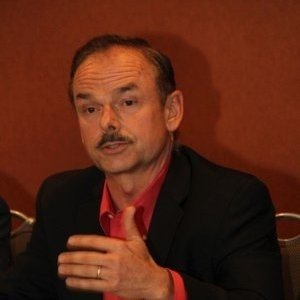
Steven Humphreys
Steven Humphreys - the door he watches is the one between atoms and bits.
The Identity Architect

Steven Humphreys

For three decades he has answered one question for governments, embassies, and high-security sites: who is allowed in, and how do you prove it?

Access ControlDigital IdentitySmart CardsRFIDHirsch / Vitaprotech
Dispatch · Silicon Valley

Somewhere right now, a badge taps a reader, a green light blinks, and a door unlocks. It feels like nothing. It is, in fact, the end of a very long chain of decisions about trust - and Steven Humphreys has spent his career building that chain link by link. His job title today is Deputy CEO of the Hirsch Group, the French-headquartered security company that absorbed his old firm in 2024. His real job, the one he has held under five different company names, is deciding who gets in.

The technology is invisible by design. You will not find his name on the smart-card reader plugged into a federal laptop, or on the credential system humming inside a U.S. embassy, or on the perimeter sensors strung along a sensitive site. But the logic underneath - the quiet certainty that the right person, and only the right person, is getting through - has his fingerprints all over it.

He is not a household name. People who run access control to embassies rarely are. That is the point.

Identiv's vision is to bring the benefits of the digital world to the physical world. - Steven Humphreys
By the numbers
30+
Years in security tech
~1/3
U.S. embassies running his tech
1996
On the board ever since
$185M
Revenue of the merged Hirsch
What he's building now

One platform to watch the whole perimeter

In September 2024, two companies on opposite sides of the Atlantic decided they were stronger as one. Vitaprotech, a French specialist in high-security perimeter protection and intrusion detection, merged with Identiv's physical and cyber security business. The combined company relaunched a storied American brand - Hirsch, a name that has been trusted with U.S. government access control since 1981.

The result is a roughly 700-person operation, about $185 million in revenue, and more than 100 software engineers, headquartered in France with a deep Silicon Valley spine. Humphreys, who had run Identiv as CEO from 2015, stepped into the Deputy CEO seat alongside CEO Eric Thord.

What they are assembling is unglamorous and enormous: command-and-control software, access control, video surveillance, credentialing, door readers, sensors, intercoms, perimeter protection, and FIDO2 cyber keys - stitched into a single high-security stack. The pitch is that you should not have to bolt twelve vendors together to protect one building.

The merge logic

"This merger with Vitaprotech allows us to take our product range to the next level. Together, we are the security the world needs."

The hard part

"As security continues to be a priority for organisations, it also becomes more complex." Simplifying that complexity is the whole job.

The promise

"We provide the platform to ensure that only the right people are getting in at the right time."

The long way around

A mechanical engineer who ended up guarding identity

Start with the unlikely part: he was born in Sicily and raised across Europe, then landed in the one zip code on earth most likely to turn a curious engineer into a serial CEO. His training is almost stubbornly classical. A bachelor's in mechanical engineering from Yale. A master's in industrial engineering from Stanford. An MBA from the Stanford Graduate School of Business. Then a full decade inside General Electric - the corporate equivalent of boot camp - before he ever touched a startup.

That order matters. Most digital-identity executives arrive from software. Humphreys arrived from machines and systems, from the discipline of making physical things work reliably at scale. It shows in how he talks about security: less as code, more as infrastructure - plumbing for trust.

His first turn in the chair came in 1994 at Caere Corporation, an optical character recognition company teaching computers to read. Then, in 1996, the thread he is still pulling: he joined SCM Microsystems, an early developer of the smart-card readers that the U.S. government would standardize on for its CAC and PIV credentials. He ran it as president, then chairman. In 2001 he took the helm at ActivCard - later ActivIdentity - building the software side of digital identity management.

And in 1996 he joined a board he has never really left: the one that would become Hirsch, then Identiv, then Hirsch again. Decades in the same fight. Companies were renamed and reassembled around him, but the question stayed the same.

By his own account in interviews, the early chapters were brutal - he has described himself as an orphan who at one low point lived out of his car. It is a startling thing to read next to a resume this polished, and it reframes the whole arc. The composure that reads as boardroom calm was forged somewhere far less comfortable.
Timeline
1980s-90s
~10 years at General Electric
1994
President, Caere Corporation (OCR software)
1996
President & Chairman, SCM Microsystems; joins Hirsch/Identiv board
2001
Chairman & CEO, ActivCard / ActivIdentity
2015
CEO of Identiv
2024
Deputy CEO, Hirsch Group (post Vitaprotech merger)
Where the work shows up

You've walked past it a thousand times

The strangest thing about a career like this is its invisibility. The more dangerous the place, the more likely his technology is already there - and the less likely you'll ever know it.

In his words

The Humphreys doctrine

"We see a major market opportunity as the physical world goes online, and we want to be the leading platform."
"We provide the platform to ensure that only the right people are getting in at the right time."
"As security continues to be a priority for organisations, it also becomes more complex."
"Together, we are the security the world needs."
The throughline

Identity, turned into infrastructure

There is a tidy way to read this whole career, and Humphreys says it himself: bring the benefits of the digital world to the physical world. For thirty years that meant taking something humans do badly - deciding, in the moment, whether to trust a stranger at a door - and handing it to machines that do it the same way every time.

Smart cards. Biometric readers. RFID transponders that can give any physical object a digital voice. Video analytics that watch the cameras so humans don't have to. Credentials that live on a phone. Each is a different answer to the same ancient problem of the gate.

The newest wrinkle is that the gate and the firewall are becoming the same thing. A badge is now also a login. A door is now also an endpoint. The merger that produced today's Hirsch is, in a sense, just Humphreys following that convergence to its logical conclusion: one company that secures both the lobby and the laptop.

We see a major market opportunity as the physical world goes online, and we want to be the leading platform. - Steven Humphreys
Footnotes worth keeping

Five things that stick

01

An American Deputy CEO of a French security group - who works out of Silicon Valley.

02

He's run at least five companies most people have never heard of, whose tech they pass through daily.

03

Same boardroom since 1996 - longer than some of his engineers have been alive.

04

Sicily to Yale to Stanford to GE. A spectacularly indirect route into digital identity.

05

Trained on machines, not software - which is exactly why he thinks of security as plumbing.

Find & follow

Go deeper

Share this profile
in · LinkedIn X · Twitter f · Facebook Instagram