The modern office lobby is a small museum of systems that refuse to speak to each other. A badge opens a turnstile. A second machine decides which elevator to send. A camera records the scene. A visitor tablet prints a sticker. Somewhere behind the desk, an operator pivots between screens and hopes the timestamps agree. BluB0X Security looked at this expensive choreography and reached a wonderfully blunt conclusion: the building does not need more boxes. It needs the boxes to share a brain.
That brain is BluSKY, the Andover, Massachusetts company's cloud platform for access control, alarms, video, visitors, biometrics, intercoms and elevators. BluB0X supplies the software, edge controllers and unusual pieces of lobby hardware, then sells subscriptions, credentials, support, hardware-as-a-service and integration work through security partners. The pitch is enterprise security without a local server farm or a collection of separate databases.
This is not a young founder discovering doors. CEO and co-founder Patrick Barry previously spent 15 years at Touchcom, where he helped build an early cloud security platform before G4S acquired the business in 2008. Sean Dyer, now BluB0X's president and chief software architect, worked there too. BluB0X calls itself their second act. Its name came from the literal blue moving boxes the team carried away after losing their old jobs. They swapped the O for Ø, a typographic wink that is either charming or a permanent tax on keyboard users.
The first thing to fail was the old architecture
BluB0X was incorporated in 2013, BluSKY entered operation in September 2014 and its first customer system went online the next February. The opening was not invented by AI. It was created by aging panels, local servers and point products that had reached the end of their useful lives. At 11 Times Square, BluB0X framed the problem plainly: the legacy security system was at end of life. In a later financial-services deployment, more than 50 sites used different vendors, software versions and manual processes. Audits took weeks. Downtime was counted in hours per month per site.
The company's technical answer was a cloud-native overlay. Keep compatible field hardware when practical, push administration into one web application, and let access events, alarms, video and identities use a common clock and database. A manager can apply a policy across sites; an operator can click from a forced door to the relevant clip; human-resources systems can add or remove a credential without another round of typing. The product's most valuable feature may be the disappearance of swivel-chair work.
Seven boxes become one operating view
shared identity + event layer
The proof is easier to see in a tower than in a spec sheet. A San Francisco project combined a 48-story property, 24 elevators, more than 50 tenants, eight Gunnebo turnstiles and 126 camera sensors. Person Readers handled identity at the lobby, parking and upper floors. BluSKY passed authorized destinations to Otis elevator dispatch, issued visitor QR codes into Apple or Google Wallet, joined intercoms and tenant apps, and gave guards a pair of large touchscreens. A person could be recognized, admitted and routed upward as one transaction.

The business model had to change, too
What changed Barry's mind was not merely that cloud technology became acceptable. It was discovering that managed security behaves like a different business. He told SDM in 2019 that his team initially tried to operate the service like its conventional installation business. That did not hold. A recurring product, he said, cannot be operated like a traditional six-door access sale. Contracts must define availability. Support cannot grow one technician for every new customer. Integrators have to value the lifetime account, not only the installation margin.
If you are only selling security hardware, software and installation services, then you are in a race to the bottom.Patrick Barry, CEO and co-founder
BluB0X's response is physical security as a service. Integrators sell the installation and recurring subscriptions while BluB0X handles the shared platform, automatic updates, monitoring and remote diagnostics. The company also offers credentials-as-a-service, support, professional services and hardware-as-a-service. Open APIs and support for third-party locks, identity providers and elevator systems reduce the fear of another proprietary island. A demonstration environment lets resellers and prospective customers try the workflow before committing.
What does it cost? There is no public menu because a four-door office and a 48-story tower are not the same order. Buyers pay some mix of controllers, readers, cameras or integrations, plus licenses, credentials and services. BluB0X claims its platform can reduce operating expense by $30,000 to $50,000 or more per site per year. Treat that as a vendor estimate, not a universal coupon. Savings depend on retiring servers, reducing manual administration and preventing truck rolls. A site with little complexity has less waste to remove.
Scale figures are company-reported in BluB0X's 2026 performance snapshot. Public revenue, valuation and standard customer pricing are not disclosed.
AI arrives after the plumbing
In 2025 the story moved from unified control to explanation. The Building Oracle connects access, video, alarm, visitor and facility data, then produces summaries and answers natural-language questions. BluB0X also showed an AI-driven mobile interface, voice-enabled turnstiles and intelligent elevator kiosks. The sensible order matters. An assistant cannot explain a building until someone has reconciled its identities, timestamps and device states. BluB0X spent a decade on that unglamorous foundation.
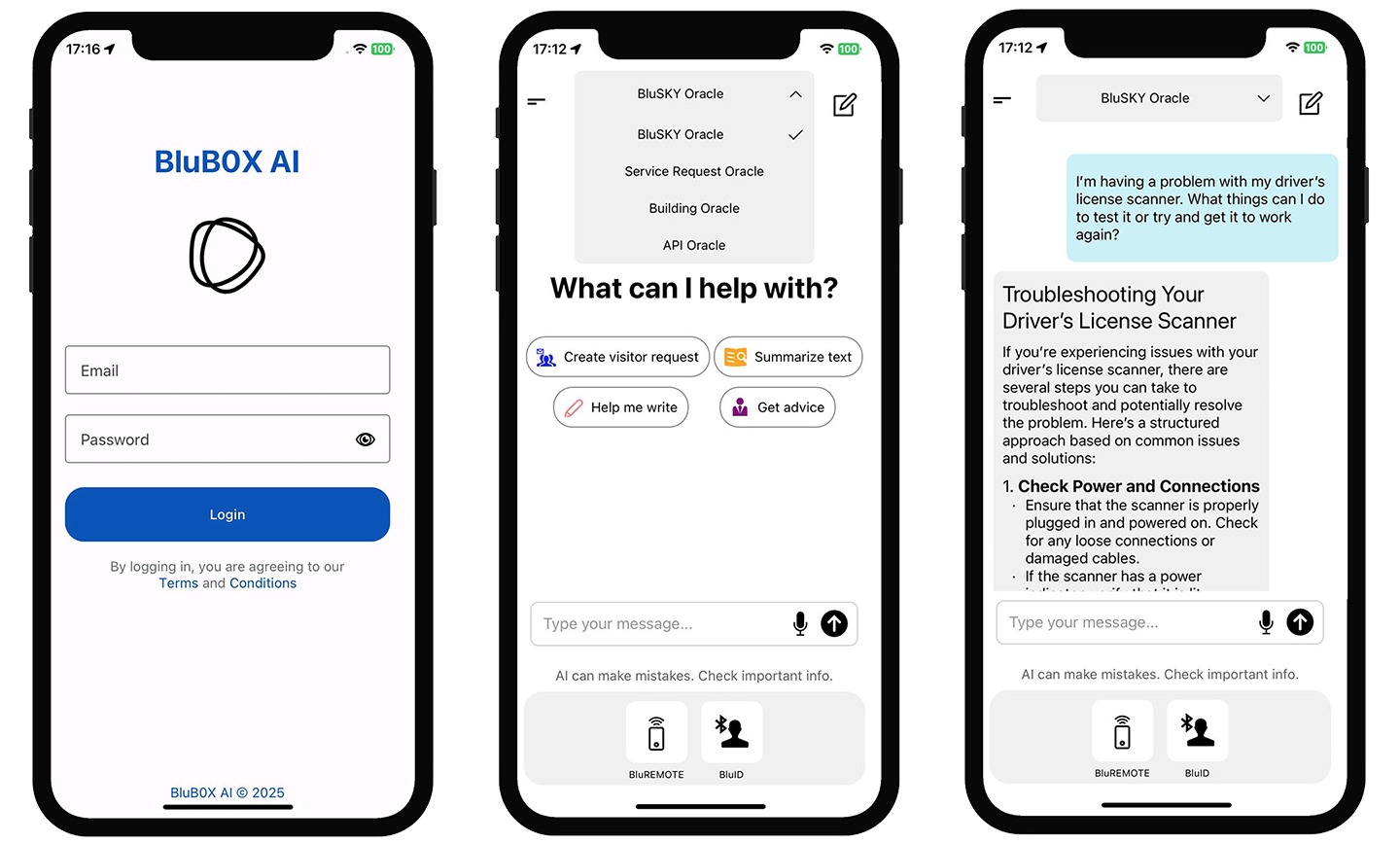
The result is meant to shift a security team from searching to deciding. Instead of matching an alarm log to a camera archive, an operator could receive a linked incident summary. Instead of inspecting every device, the system can flag unusual behavior and automate a response. BluB0X says its cloud now processes more than 80 million access events daily, manages over 55,000 active devices and indexes 30 million video events per month. Those are company-reported figures, but they make the AI ambition legible: this is a data-volume business wearing a card-reader uniform.
The market is crowded, but the elevator is a wedge
BluB0X sits between cloud access specialists such as Brivo and Verkada and broad enterprise platforms from Genetec, LenelS2, Johnson Controls and Honeywell. Many rivals can manage doors, cameras or visitors. BluB0X's sharper distinction is the combination: one data model, open edge hardware, biometric readers and unusually deep elevator destination dispatch. The humble elevator is a useful wedge because it turns security from a checkpoint into a building experience. Nobody enjoys tapping twice.
Its customers are the people paid to make complicated properties feel uneventful: security directors, property managers, engineers, reception teams and the integrators who install their equipment. Named references include CommonWealth Partners and R1, alongside manufacturing, financial, government and healthcare deployments. The CommonWealth portfolio spans landmark offices in New York, Los Angeles, San Francisco, Seattle and Bellevue. R1's security director credited the unified portal and support team with maintaining controls through planned and weather-related power interruptions.
The culture borrows from the product. BluB0X describes itself as virtualized, worker-owned and customer-first. It calls its people “BØXERs,” offers try-before-you-buy access, and publishes a remarkably deep knowledge base. That last detail is easy to underrate. Enterprise buyers do not merely buy features; they buy the confidence that an obscure alarm at 2 a.m. has a documented answer.
The copyable playbook
Five moves worth stealing
- Find a workflow where customers swivel between three or more systems.
- Build a shared identity and event layer before adding an AI assistant.
- Preserve compatible installed hardware so modernization is not demolition.
- Turn channel partners into recurring-revenue owners, not one-time installers.
- Let buyers test the real workflow and document the strange edge cases in public.
When the playbook does not travel
Cloud physical security is not an automatic upgrade. It weakens when a site lacks dependable connectivity, when latency-sensitive functions cannot fail safely at the edge, or when data-residency and biometric-consent rules remain unsettled. Existing hardware may be too proprietary to preserve. A tiny property with one entrance may never recover migration and subscription costs through administrative savings. And a buyer who wants several best-of-breed systems may prefer integration over one vendor's unified model.
There is also a governance problem hiding inside the convenience. Faces, voices and movement patterns are not resettable passwords. Organizations need clear enrollment rules, retention limits, fallback credentials and an honest explanation for occupants. The Building Oracle adds another layer: summaries must show their evidence, preserve human judgment and avoid turning a plausible sentence into an unquestioned incident record. The better the interface becomes, the easier it is to forget how consequential the underlying data is.
Still, BluB0X has located a durable enterprise truth. The costliest part of old software is often the human labor between applications. By joining a badge, a visitor, a video clip and an elevator ride, the company makes physical security look less like a cabinet of electronics and more like an operating system. Its next test is whether AI can compress that system without concealing the details operators need. In a business built around locked doors, transparency may be the feature that opens the most.