The camera is awake. Its little light is on. Somewhere else, a recorder is meant to preserve what it sees, storage is meant to hold it, and an application is meant to make the footage available. An inventory can count the camera. A security team can flag its outdated firmware. Neither observation settles the question that matters when someone needs the recording: did the whole arrangement work?
Viakoo has made that awkward space its business. The company manages the security and operational health of connected enterprise devices, particularly the equipment that runs physical services: cameras, access-control systems and other OT/IoT infrastructure. Its Action Platform discovers devices, updates firmware, manages credentials and certificates, and checks the services those devices support. A warning becomes a job with an outcome.
- The job: automate device maintenance across vendors and locations.
- The wrinkle: a patched device must still work with its application.
- The buyer: enterprise IT, security and operations teams with distributed fleets.
- The next move: configuration-drift controls, announced for Q4 2026.
The maintenance queue has a geography problem
A firmware update sounds like a small errand. Download the right file, install it, check the result. Now give the errand several thousand addresses and a collection of manufacturers, each with its own management conventions. The task becomes a scheduling problem, a permissions problem and an argument about whose budget pays for the technician.
Viakoo tackles that repeatable work from a central management interface. Its Device Firmware Manager checks firmware compliance, manages updates and preserves a history of changes. The company describes a chain-of-trust process for deploying valid firmware. The attraction is straightforward: a team can manage remote device updates without treating every location as a separate expedition.
That makes the platform relevant to organizations where the network extends beyond laptops and servers. A hospital, a campus or a data center can have equipment owned by several operational departments. The device is part of the enterprise’s exposure even when the person responsible for it does not sit in the IT department. Maintenance has to cross that organizational boundary too.
The camera has colleagues
Viakoo calls some of these arrangements “tightly coupled” systems. The phrase is useful because it redirects attention from the object to its collaborators. A camera works with an application, a recorder, storage and a network. Changing one participant can affect the others. The sensible unit of management is the service they produce together.
Its Direct Query Manager, marketed as High Fidelity Discovery 2.0, uses application-aware discovery and information from multiple data sources. Viakoo also integrates with network discovery platforms. The aim is to gather enough detail to act on a device, rather than merely infer that something exists at an address.
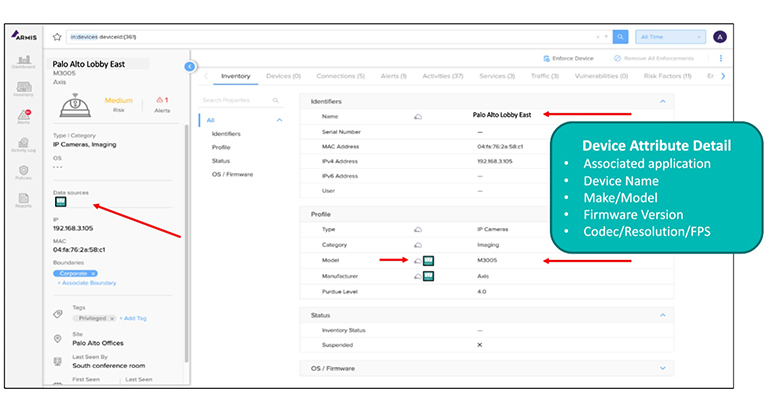
There is a second distinction inside the architecture. Viakoo says it collects system metadata rather than production video, audio or sensor output. It maintains current and historical system views in a digital-twin model. In this context, the twin is a record of how the infrastructure is configured and behaving, useful for diagnosis and reporting.
And “agentless” deserves careful reading. Viakoo does not require an agent on every managed endpoint. Its service still uses local collection software. The 2025 service terms describe installing and activating that software. For a buyer, the useful question is where software runs, what it can reach and which data leaves the environment.
Three chores, one console
Firmware is only one route into trouble. Device Password Manager checks for default or commonly used passwords, verifies policy compliance and records changes. Device Certificate Manager handles provisioning, refreshing and revoking certificates. Those certificates help authenticate devices and support controlled network access, including 802.1x and TLS use.
- 01DiscoverDevice + application
- 02RemediateFirmware / identity
- 03VerifyService still works
- 04RecordHistory + audit
Editorial illustration of the platform’s operating logic.
The operational side comes through Service Assurance Manager. It reports on video and access-control uptime, checks whether streams are being recorded and retained for the intended period, and generates diagnostic fix-it plans and tickets. It can connect to third-party ticketing systems, including ServiceNow and Remedy. A device’s network presence is one signal; the service outcome demands more evidence.
Viakoo uses the word “repatriation” for returning remediated devices to useful network participation. It is a rather grand word for bringing a camera back to work. But it captures a real requirement: a security change must leave the equipment able to perform its assigned function.
Two people, ten sites
Viakoo’s 2023 case study describes an unnamed Silicon Valley technology company with nearly 9,000 IoT devices at ten sites. Its original update practices had not kept pace as manufacturers shifted from occasional functionality releases to more frequent vulnerability fixes. A consultant estimated that the manual approach would require 86 additional full-time professionals and leave patches waiting more than six weeks.
The 86-person figure was a modeled staffing requirement, not an existing team replaced by two employees.
The board demanded a faster plan. The company selected Device Firmware Manager; Viakoo reports deployment within days, a two-person firmware team, updates implemented within days of availability and a 30% reduction in the device-maintenance budget. The case establishes neither a universal savings rate nor the contract price. Its useful lesson is to measure the queue: staffing, travel, update delay and service maintenance together.
From missing video to missing security
Viakoo was founded in 2013. In a later retrospective, CEO Bud Broomhead dated its video-surveillance SaaS launch to April 2014. The early concern was missing data: an IP surveillance network could disappoint its owner long before the failure became obvious.
In a 2022 interview, Broomhead described the original idea as turning IoT metadata into useful uptime and performance information. Customers then asked the company to address cyber issues. The expansion followed the infrastructure Viakoo already understood. Operational knowledge became a way to perform security maintenance with an awareness of what could be interrupted.

Founder and CEO. His company biography also lists seaplane piloting. Distributed systems, different altitude.

Co-founder and Chief Scientist. A physics PhD with a background in networking and storage performance.
The team’s experience helps explain the emphasis. Broomhead worked in enterprise storage; Liu held technical roles at Intransa, Cisco and Seagate. Co-founder David Nelson-Gal led high-availability product work at Sun Microsystems. These are backgrounds in keeping systems available, where a successful change needs a working aftermath.
In October 2021, Viakoo announced a $10 million Series A led by Shasta Ventures, alongside existing investors Stanley Black & Decker, PivotNorth Capital and Blue Fog Capital. The funding accompanied the Action Platform cyber-module launch and was earmarked for leadership, product development and go-to-market work.
The alert vendors become the partners
Viakoo fits into the broader market for protecting cyber-physical systems. Its alternatives include manual maintenance and manufacturers’ own tools. Discovery and threat platforms occupy adjacent territory. Armis, Forescout, Nozomi Networks and Claroty appear in Viakoo’s partner ecosystem: visibility and threat context can feed remediation. A buyer may use them together.
The company sells subscription software directly and through service providers and integrators. Its February 2025 terms ordinarily specify prepaid subscriptions of at least twelve months, unless agreed otherwise. Fees belong to the customer order. The buying calculation therefore needs the actual fleet and maintenance workload, not a price extrapolated from a brochure.
Viakoo’s historical company-authored Gust profile names customers including Oracle, HP, Cisco, Harvard and Anthem. Its current site reports more than two million managed devices and over three billion cumulative management hours. Those are vendor-reported usage measures; hours accumulate across devices and time. They describe experience, not a count of customers.
The distribution story became more concrete in March 2026, when Siemens Smart Infrastructure agreed to offer the Action Platform to its customers. Viakoo also expanded its Hanwha Vision collaboration in 2023 to include cyber hygiene alongside service assurance. These relationships put continuing maintenance closer to the companies already supplying or servicing the equipment.
The settings do not stay put
The newer products address two ways good intentions decay. DFM-AutoMode, announced in September 2025, prepares firmware remediation using AI-assisted automation, with human approval before action. That approval boundary matters when an update affects an operating physical system.
“Configuration drift is a silent epidemic across OT and IoT infrastructure.”
Bud Broomhead / August 2026 DXM announcement
At Black Hat in August 2026, Viakoo announced Device Configuration Manager, with availability planned for Q4. Its stated job is to monitor baselines, detect configuration drift and correct settings according to policy. Installation establishes an intended state. Local changes and maintenance can gradually undo it. DXM targets that slow disagreement between the approved plan and the actual device.
The practical adoption test is specific. Select a representative fleet, verify support for its makes and applications, test the maintenance workflow, and check the service afterward. Automation needs a usable update, access to the device and an approved window for change. A physical fault or unsupported endpoint still requires another route. The habit worth copying is to give every alert an owner, every change a verification step and every completed job a record. The camera’s little light can stay on. Now someone has checked what it means.