The ordinary hospital network is a small city with terrible census records. Laptops and phones share streets with infusion pumps, imaging machines, badge readers and building controls. Some residents have agents watching them. Others run old software, cannot be rebooted during business hours and arrive with a support contract that treats modification as a minor act of war. A factory is the same city, only the irritable citizens are robots and programmable controllers. Elisity, a San Jose cybersecurity company, has built its business around one blunt truth: not everything can be patched, but everything can have its travel restricted.
Its product is identity-based microsegmentation. The phrase is an expensive mouthful for digital fire doors. If a device is compromised, the attacker should not be able to stroll sideways through the network looking for a domain controller, a production system or another vulnerable machine. Elisity identifies the device, works out what it is supposed to communicate with, and gives it only those routes. The intriguing part is where enforcement happens. Rather than put software on every endpoint or insert a fleet of new appliances, Elisity uses compatible switches the customer already owns.
The founding insightThe endpoint agent stops where the interesting mess begins
Elisity began in 2018 with three Cisco veterans: Burjiz Pithawala, Sundher Narayan and Srinivas Sardar. Their collective résumé made the wager legible. Enterprise networks already contained a large distributed machine capable of enforcing traffic rules. The waste was forcing customers to reconstruct that machine before security policy could use it. Elisity’s stated vision is to untangle security from those underlying network constructs - VLANs, addresses and location - while still making the network do the blocking.
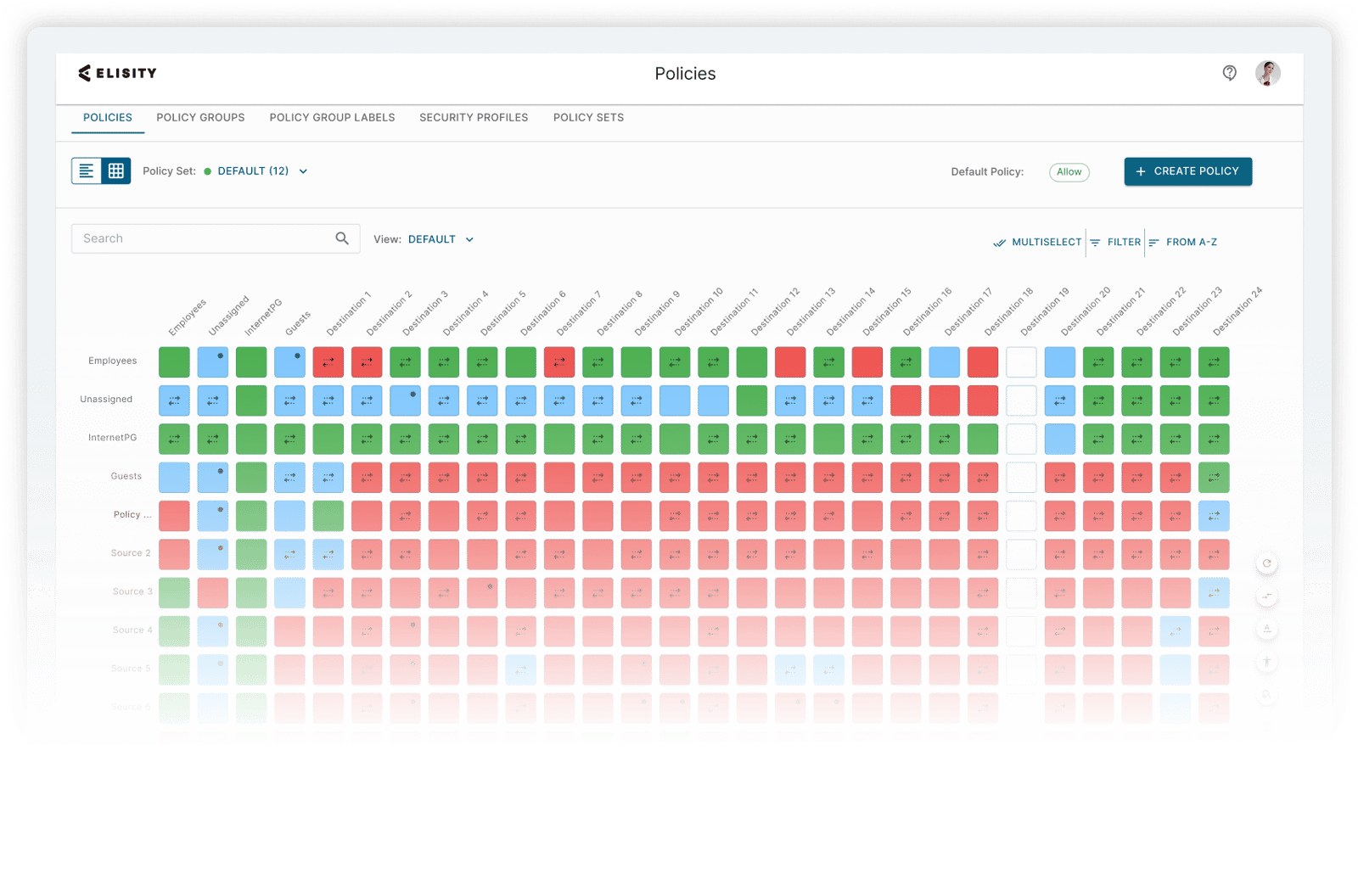
The platform has four working parts. IdentityGraph continuously discovers users, workloads and devices, then correlates metadata from systems such as Active Directory, Armis, Claroty, CrowdStrike, Nozomi Networks and ServiceNow. Cloud Control Center is the administrative console. A dynamic policy engine turns identity and risk into least-privilege rules. Virtual Edge connects the control plane to supported network hardware. In practice, an infusion pump may reach its clinical gateway but not a finance server; a plant controller may reach its historian but not the corporate laptop fleet.
What failed firstThe old plan needed 14 specialists and $38 million
Security products make handsome claims in a demo. The sharper evidence comes from the project they displaced. One top-ten U.S. health system compared Elisity with a legacy approach that would have required months of network re-addressing and 14 specialists. The customer said Elisity achieved the work with two engineers, discovered 99 percent of its medical devices without disruption and cut planned implementation cost from $38 million to $9 million. That is a 76 percent reduction - a claim from an Elisity customer story, not an audited industry average - but it shows why the architecture gets budget meetings.
Main Line Health supplies the more human version. Its traditional network-access-control effort was slow, demanded expertise the organization did not have lying around and risked change windows in an environment where downtime can touch patient care. The health system already used Armis for device intelligence. Elisity could ingest that context, simulate policies and enforce them through Cisco Catalyst switches. The first policies arrived in hours. The work later helped Main Line Health earn CSO50 and CIO 100 recognition.
“We made more progress in 2 days with Elisity than we did in 2 years with our previous solution.”Customer statement featured by Elisity
At GSK, the mind-changing event happened outside the company. Merck’s 2017 NotPetya attack produced a widely reported $1.4 billion loss. GSK’s board wanted stronger separation across manufacturing and research without turning a security program into a production outage. The resulting Dynamic Edge Segmentation work with Elisity focused on automatic discovery, least privilege and rapid rollout. Elisity now says GSK can integrate a site in under 30 minutes and add three sites a week. The lesson worth copying is not a particular vendor command. It is the order of operations: observe first, enrich identity from systems already trusted, simulate the proposed boundaries, then enforce at the closest practical network edge.

The businessSell the control plane, spare the capital project
Elisity is enterprise SaaS, sold by quote to large organizations with complicated estates and serious downtime costs. The company does not publish a rate card. Its economic case rests on avoided work: no endpoint agent deployment, no new inline hardware, no additional VLAN maze and no broad re-IP project. The customer still pays for software, planning, integration and policy design. The distinction is that those expenses do not arrive attached to a network reconstruction.
The company raised a $26 million Series A in 2021, co-led by Two Bear Capital and AllegisCyber Capital, and a $37 million Series B in 2024 led by Insight Partners. Atlantic Bridge participated in both; TCV and Chevron Technology Ventures later made undisclosed investments. Elisity says total funding exceeds $72 million. It has used the capital to broaden switch support, deepen integrations and add AI-assisted classification and policy work.
Growth has been conspicuous. Elisity ranked No. 13 in Deloitte’s 2025 Technology Fast 500 after reporting 8,860 percent revenue growth from 2021 to 2024. In 2026, Inc. ranked it third among fast-growing private companies in the Pacific region. More telling for a product that promises speed, Elisity reported that 83 percent of enterprise customers completed a full segmentation rollout within 90 days.
Where it sitsNot the alarm system - the set of doors
Elisity competes with firewall-heavy segmentation, traditional NAC and software microsegmentation from companies such as Akamai Guardicore, Illumio, ColorTokens, Zero Networks and VMware. Its point of difference is the combination of identity correlation and enforcement through existing access infrastructure, particularly for unmanaged equipment. That makes healthcare, pharmaceuticals, manufacturing and critical infrastructure natural markets. These buyers own devices that are valuable, fragile, long-lived and allergic to endpoint agents.
The company is also careful, at its best, about the boundary of the product. Claroty, Nozomi, Dragos and Armis can provide deeper device intelligence, protocol analysis, vulnerability context and threat detection. CrowdStrike provides endpoint state. Elisity consumes those signals and converts them into who-can-talk-to-whom policy. It is less a replacement for every security tool than the enforcement layer that lets their findings matter on the network.
Its latest AI work follows the same division. Elisity Intelligence answers questions, suggests device classifications and recommends policy changes in a private, single-tenant setup. Changes wait for an administrator. In August 2026, the company released an open command-line interface with 466 commands so customers can point their own AI agents at the platform. Elisity chose an invoked CLI over an always-on Model Context Protocol server, arguing that the caller’s credentials, limited execution window and mandatory approval are easier to audit. In a market full of agents itching to click the button, restraint is a product feature.
Where the shortcut stops working
- The switching estate must be supported and correctly licensed. Some remote or legacy sites may remain visibility-only.
- IdentityGraph improves messy records; it does not make bad asset data harmless. Policy quality still depends on trustworthy inputs and patient baselining.
- A company seeking deep OT protocol inspection, vulnerability management or endpoint prevention will still need complementary tools.
- Least privilege requires owners to decide which business conversations are legitimate. Software can recommend that judgment, but operations must approve it.
The copyable playbookBuy fewer objects; make the ones you own more useful
Elisity’s most portable idea is architectural thrift. Start with an enforcement surface already deployed everywhere. Pull identity and risk from the systems that already know pieces of the truth. Build policy in simulation, close the most dangerous lateral paths first and expand site by site. Measure time to first policy, percentage of devices identified, people required, outages, sites enforced and exceptions granted. Those numbers expose a pretty demo quickly.
That playbook will not make every network simple. Hospitals still contain mysterious devices. Plants still have production cycles longer than software companies have existed. But it changes the proposal from “rebuild the city” to “teach the traffic lights some names.” For Elisity, that difference has been enough to turn neglected switches into a growing software business - and an old network constraint into the reason the product exists.