The first Brivo was a box. Not a metaphorical box, not a server rack - a waist-high parcel container intended to sit outside a house so a courier could leave a delivery while nobody was home. Around 2000, roughly 100 Washington-area households tested the idea. The web would authorize the delivery; the box would open; the package would wait safely. It was clever, connected and too early in several directions at once.
The box did not become the enduring company. The permission system did. Brivo's founders saw that remote authorization mattered more than the container and moved into commercial access control. By 2002, the company was selling a cloud-managed platform for buildings. This was when many customers still heard “cloud security” as a contradiction. Brivo had to explain why the server controlling a door might be safer and more useful somewhere other than the customer's utility closet.
Today Brivo is a private physical-security company headquartered in Bethesda and Austin. Its Security Suite puts access control, video intelligence, visitor management, intrusion monitoring, alarms and analytics in one cloud console. Readers, panels, cameras and locks live at the site. Permissions, alerts, identities and evidence live in software. A facilities manager can revoke a credential in Maryland, inspect a propped door in Milan and issue a temporary mobile pass in Melbourne without visiting any of them.
Those are Brivo's current website figures, and its post-merger corporate profile uses still larger counts under different definitions. The honest reading is not that every number reconciles neatly. It is that this is no longer a smart-lock experiment. It is an installed network spanning commercial offices, apartment portfolios, schools, retailers, warehouses, gyms, financial institutions and healthcare sites.
The product is the boring work that disappears
A mobile badge gets the demo applause. The real value arrives in the surrounding chores. A new employee can receive access before day one. A departing contractor can lose it immediately. A gym membership can switch a door permission on and off through a Mindbody integration. Okta or Microsoft Entra ID can synchronize employment status with credentials. If a door opens at 2:13 a.m., the access event can be paired with the relevant video instead of forcing an investigator to match timestamps across two systems.
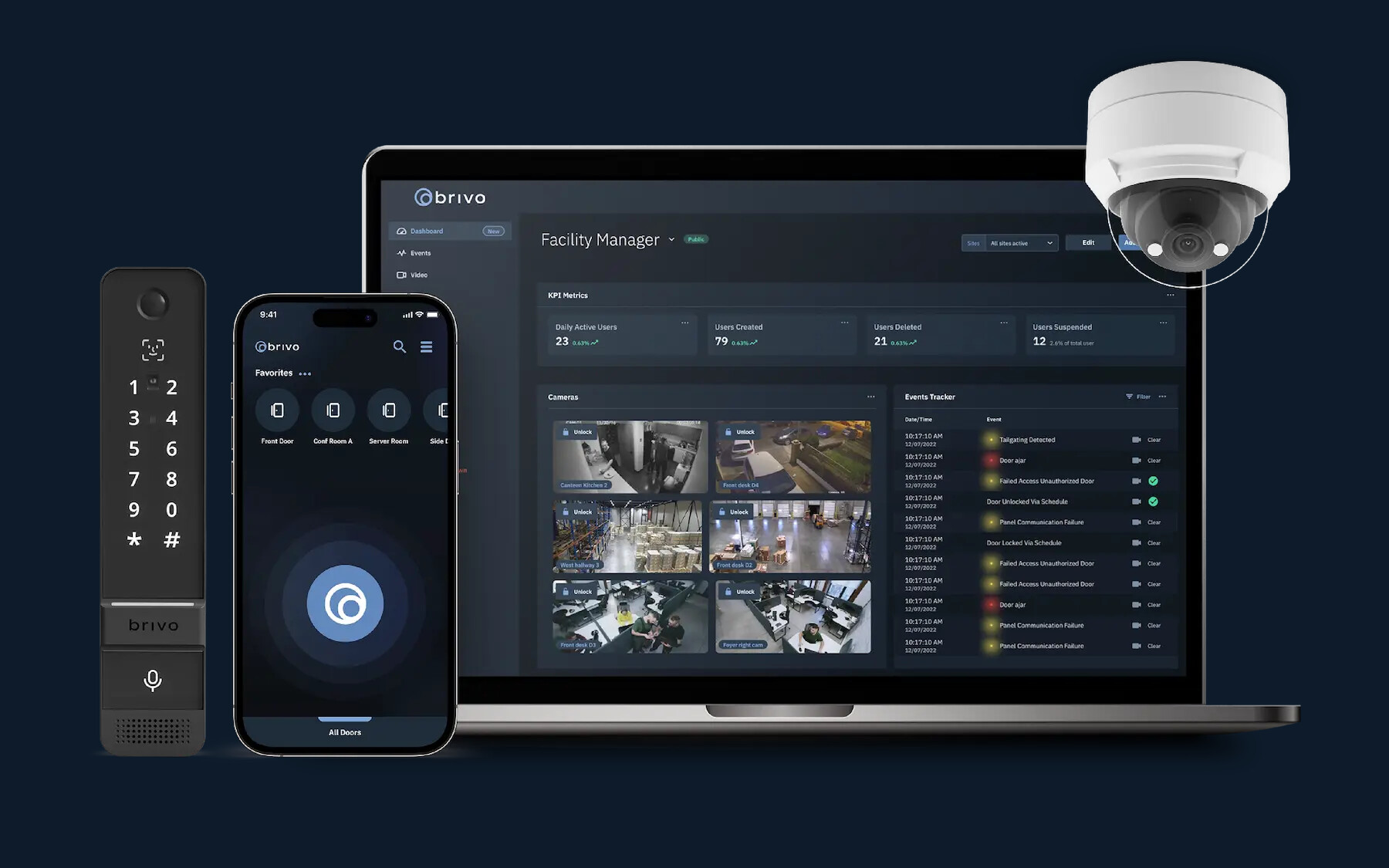
Brivo Access remains the administrative center: doors, schedules, roles, users, alerts and audit history. Mobile Pass turns phones into credentials; Wallet Pass puts an employee badge in Apple Wallet, including Express Mode and limited access after an iPhone needs charging. Brivo Visitor handles guests. Control panels connect physical readers and locks. Video adds visual verification and analytics. Public mobile SDKs and an open API let developers put access into another app rather than demanding that every user live inside Brivo's.
The distinction from a conventional access-control system is centralization. A legacy setup often means an on-site server, locally administered credentials and separate video. Brivo moves administration to a multi-tenant cloud service and connects the pieces. Against newer cloud competitors such as Verkada, Openpath, Kisi and Genetec, the argument is less “cloud versus server” and more openness, channel reach, breadth of hardware and how smoothly access and video behave as one product.
The business is half SaaS, half ladder
Brivo makes recurring revenue from cloud software and credentials while also selling or supporting the panels, readers, cameras and devices needed at the edge. It does not publish a universal price list. A project changes with every door, controller, installation hour, software tier, mobile credential, integration, camera and retention policy. That is why “what does it cost?” has a dull but accurate answer: a partner has to scope the building.
The installer channel is not an accessory to this model. It is the model's physical half. Security dealers survey doors, run cable, mount equipment, commission panels and provide local support. Brivo gives them certification, technical help, deal registration and recurring-revenue products. The arrangement lets a software company reach concrete walls without building a national army of technicians, while giving integrators a service relationship that continues after installation.
All of our call centers and distribution centers use Brivo today. We've been able to run a highly efficient operation by having the security team focus on their core responsibilities instead of managing a database.John Owad, Director of Loss Prevention at URBN
This is the bit another founder can steal. Find hardware that is permanent, operationally important and painfully administered. Put a cloud control plane around it. Recruit the specialists who already know how to install it. Then open an API so the product can join the customer's identity, property and workflow systems. Each layer makes the others harder to displace: the software accumulates rules and history, the hardware remains bolted down, the integrator maintains the relationship, and the integrations spread switching costs across the stack.
Copy this
- Sell the admin time removed, not the shiny device.
- Give field partners recurring upside.
- Make integrations part of distribution.
- Use one event record across products.
It breaks when
- The site is tiny and rarely changes.
- Connectivity or installation is unreliable.
- Recurring fees outweigh remote value.
- Privacy and cyber governance are weak.
Two failures, one patient direction
The parcel box was the first idea to fall away. The more public stumble came two decades later. In November 2021, Brivo agreed to combine with Crown PropTech Acquisitions in a deal implying about $800 million in equity value. The route promised a New York Stock Exchange listing. Then the financing deteriorated. A $68 million PIPE-note commitment was terminated after the transaction missed a deadline. The combination still had not closed by its August 2022 outside date, and Brivo elected to terminate it.
There is no need to romanticize that outcome. A public listing did not happen. Yet the operating thesis did not depend on the ticker. In November 2022, Brivo secured a $75 million senior credit facility from Runway Growth Capital. In May 2023, Japanese security group SECOM put $92 million of strategic equity into Brivo, part of a combined $192 million investment in Brivo and Eagle Eye Networks. Strategic capital replaced the failed public-market route.
What changed their mind? The public record supports a narrower conclusion: deal conditions changed, financing deadlines passed, and Brivo chose a different capital path. The strategic destination stayed recognizable. Dean Drako had bought Brivo for $50 million in 2015 while owning Eagle Eye, his cloud-video company. The two businesses integrated products and shared ownership for a decade. In December 2025, they finally merged, with Drako as chief executive and Brivo founder Steve Van Till as president.
The camera completes the sentence
Access control answers who was permitted to enter. Video answers what occurred. Combining them is operationally obvious and technically messy: different clocks, interfaces, devices, permissions and support teams turn a simple investigation into tab-juggling. The merged Brivo promises one business relationship and a single cloud-native suite spanning access, video, intrusion, visitors and AI analysis. It also says the platform will continue supporting third-party video and access products.
That last promise matters. Openness helped Brivo grow from an outsider in a conservative industry. A customer may prefer a particular lock, identity provider, camera or property platform. An integrator may serve buildings with mixed generations of equipment. If “unified” becomes “replace everything,” the pitch gets expensive quickly. The test after the merger is whether Brivo can make its own combined stack more convenient without making alternatives second-class.
The model also has natural limits. A two-door shop with five trusted employees may do fine with simple keys or a standalone keypad. Cloud management is strongest when credentials change often, sites multiply, audit trails matter and remote response saves travel. It assumes reliable network design, competent installers, subscription tolerance and serious cybersecurity. Centralization creates leverage for operators, but it also concentrates responsibility for uptime, privacy and access data.
Brivo's achievement is less cinematic than the marketing phrase “smart building.” It made a stubborn category legible to software: a person, a permission, a door, a timestamp, a clip, an action. The company endured because it did not need every building to become futuristic. It needed ordinary buildings to become remotely manageable, one unglamorous entrance at a time.