A room full of wires is an unlikely place to begin a story about ambition. Rohin Parkar remembers one containing door controllers, fire alarm panels and lighting controls, with cables running across the building’s floors. The equipment occupied an entire room. To someone who had spent years developing wireless technology, this was an invitation to ask a fairly awkward question: why did a building need quite so much furniture to decide who could come in?
Parkar and his co-founder, Malcolm Dsouza, imagined devices communicating over a wireless mesh instead. They would begin with access control. It was a manageable entrance to a larger problem: buildings whose separate systems were expensive and cumbersome to connect. The door became their starting point. Behind it sat a much broader ambition to simplify how buildings worked.
The problem brings two parts of Parkar’s career together. His subject is the invisible movement of signals. His company has to make something happen in the physical world, reliably, at the moment someone reaches a door. There is very little room for a philosophical discussion with a locked entrance.
A short assignment, twelve years abroad
In 2005, Parkar arrived in Chicago with his wife, Vaibhavi, for what he expected to be a short Motorola assignment. Two decades later, flying into O’Hare on his way to New York, he saw the skyline and remembered that first arrival. A temporary project had become the beginning of a long American chapter. In his own telling, the curiosity that took him there remained recognizable years later.
The itinerary included Motorola, Nokia and Broadcom. He joined Nokia in 2007 and moved to California in 2012. Before those corporate campuses came the Bhabha Atomic Research Centre, where he began his career working in radio-frequency engineering. The progression took him from scientific work into the practical business of developing wireless products.
Different employers brought different applications, but the underlying subject kept following him: how signals travel, how devices communicate, how hardware behaves outside a neat diagram. By the time he returned to India in 2017, he had spent twelve years in the US. Starting again would mean putting that accumulated experience to work under a name of his own.
- 2002Begins his career at BARC
- 2005Moves to the US for work with Motorola
- 2007Joins Nokia
- 2012Moves to California
- 2017Returns to India
- 2026Spintly announces an $8M Series A
Goa was part of the proposition
Parkar’s return came with a specific intention: to build technology products in India. He wanted a company capable of developing hardware as well as software, rather than supplying just one piece of somebody else’s product. Dsouza brought complementary experience in firmware and wireless systems. Their friendship preceded the business. Spintly emerged from their work together in 2017, with operations launched in August 2018.
The place mattered. The founders recruited graduates from engineering colleges in Goa and trained them to develop connected products. Building the team meant developing skills alongside the product. Vaibhavi Parkar and Joann Fernandes also took on important functions in the company. The undertaking drew on people who had known one another before there was a startup to introduce at a conference.
Goa supplied more than a pleasant address. Spintly worked with local incubation organizations, including Ignite-EDC Innovation Hub, CIBA and FiiRE. Parkar’s route back to the state also had an earlier marker: in August 2013, while working at Broadcom in the US, he gave a lecture on RF and wireless technology at Goa University. Years before the company, there was already a connection between his overseas work and students at home.
How to persuade a door
Access control sounds forbiddingly administrative until you have lost your badge. Then its requirements become beautifully clear. Someone needs permission to enter. A device at the entrance needs to recognize that permission. An administrator needs a way to grant or withdraw it. The experience should be simple even when the machinery underneath is complicated.
Spintly’s approach connects readers through a Bluetooth Low Energy mesh network, with a gateway linking the network to its cloud system. A smartphone can carry the credential. Parkar’s technical background fits the problem: the product depends on making wireless communication useful in an environment of walls, floors and existing infrastructure.
Recognition arrived in February 2022, when Spintly announced that it had won the Thread Group Innovation Enabler Award. The program gives early-stage companies access to the group’s network and resources. For Parkar, Thread fitted the direction he wanted to take: secure connectivity built around Internet Protocol and devices that could work within a wider ecosystem.
The distinction is worth making carefully. Bluetooth mesh describes one part of Spintly’s approach; Thread represented another development path. The larger ambition was to reduce the complexity of access installations and make the system easier to connect with other technology. A door is a small object to build a company around. A building contains plenty of them.
The engineer’s other subject: people
Parkar had been thinking about company culture before Spintly grew into its later form. In an essay first shared on LinkedIn in November 2017, he compared the approaches of Amazon, Virgin and Google. His interest was in how founders treated employees, customers and other stakeholders, and how those choices shaped the business.
He argued that a founder should communicate why the company exists and give employees the resources to act on that purpose. He also made room for mistakes. A team frightened of consequences, he reasoned, would struggle to try anything new. The essay ends with an uncomplicated statement: “People are the real strength of any successful company.”
“People are the real strength of any successful company.”Rohin Parkar · How to build a great company
His later account of hiring is practical. Candidates work on a live project over several days; he places more weight on their thinking and attitude than on marks. Asked to describe his leadership style, he chose “Compassionate.” Asked what drew him to entrepreneurship, he answered, “Hunger to Learn new things.” These are his descriptions of himself, and they sit neatly beside the engineer’s continued appetite for unfamiliar problems.
There is also a community chapter outside the company. He chaired the organizing effort for the 2016 Goan Convention in America. Bringing people together had a place in his life before it became a CEO’s daily responsibility.
He also credits people who have helped him learn the business side. Dheeraj Pandey, the Nutanix founder and DevRev co-founder, investor Deepak Kamlani and investor Justin Barney are among the mentors he has named. Their contribution, in his account, includes advice on strategy, growth and difficult decisions. The network around the company supplies experience that complements the founders’ engineering backgrounds.
His description of moving from employee to entrepreneur emphasizes responsibility for the team. Technical experience travels with you; responsibility for keeping a company moving adds another kind of work. The decisions now involve people, customers, capital and timing. That helps explain why his account of leadership gives so much space to consultation and adaptability. He describes gathering information and talking with key colleagues, while accepting that some decisions must be made before every uncertainty disappears.
The badge moves into the phone
Spintly’s integration with Apple Wallet takes the original idea into a familiar everyday gesture. An employee sets up a badge through the Spintly app, then holds an iPhone or Apple Watch near an NFC-enabled reader. With Express Mode, the employee does not need to unlock the device to use the badge.
The company’s announcement also describes Power Reserve access when a supported iPhone needs charging. That detail belongs to the unglamorous end of product design, where an elegant demonstration meets someone who forgot a cable. For access technology, these small contingencies are part of the job.
Parkar has described Spintly’s offices as places where the team uses its own systems every day. Making your own colleagues live with the product brings a certain discipline. They will have opinions. They also know where to find you.
Another change widened the customer proposition. In 2024, Spintly announced a foundational platform approach for the US market, offering hardware and software components through partnerships and white-label arrangements. Other businesses could incorporate the technology into their own offerings. The company that began by imagining a different system for buildings was also becoming a supplier of pieces other companies could build with.
Eight million dollars, and the work ahead
In February 2026, Spintly announced an $8 million Series A led by Accel, with participation from Enrission India Capital, SucSEED Ventures, Alumni Ventures and Chakra Growth Fund. The financing followed earlier rounds, including a $2.5 million pre-Series A announced in 2022. These are company funding figures, representing capital for the business Parkar and Dsouza lead.
The 2026 announcement put some detail behind the next phase: 60 percent of the new capital for growth, including sales and marketing; 20 percent for research and development; and 20 percent for operations and infrastructure. India remained its main market, alongside customers in the US and a newer Middle East presence. The proposed spending reflects the tasks involved in taking a working product into more buildings.
- Growth
- Research & development
- Operations & infrastructure
Company’s announced allocation. A spending plan, not a report of expenditure.
That is a different challenge from making an early prototype behave. Manufacturing, distribution, installation and support all become part of the product’s life. Parkar’s career now spans those responsibilities as well as the radio engineering that brought him here.
The origin remains a useful measure of the ambition. An engineer noticed how much effort a building spent connecting its separate parts. He and a friend decided to build a simpler arrangement, then began assembling the people and systems to deliver it. The room full of wires gave them the question. Every installation gives them another chance to answer.
Keep following the story
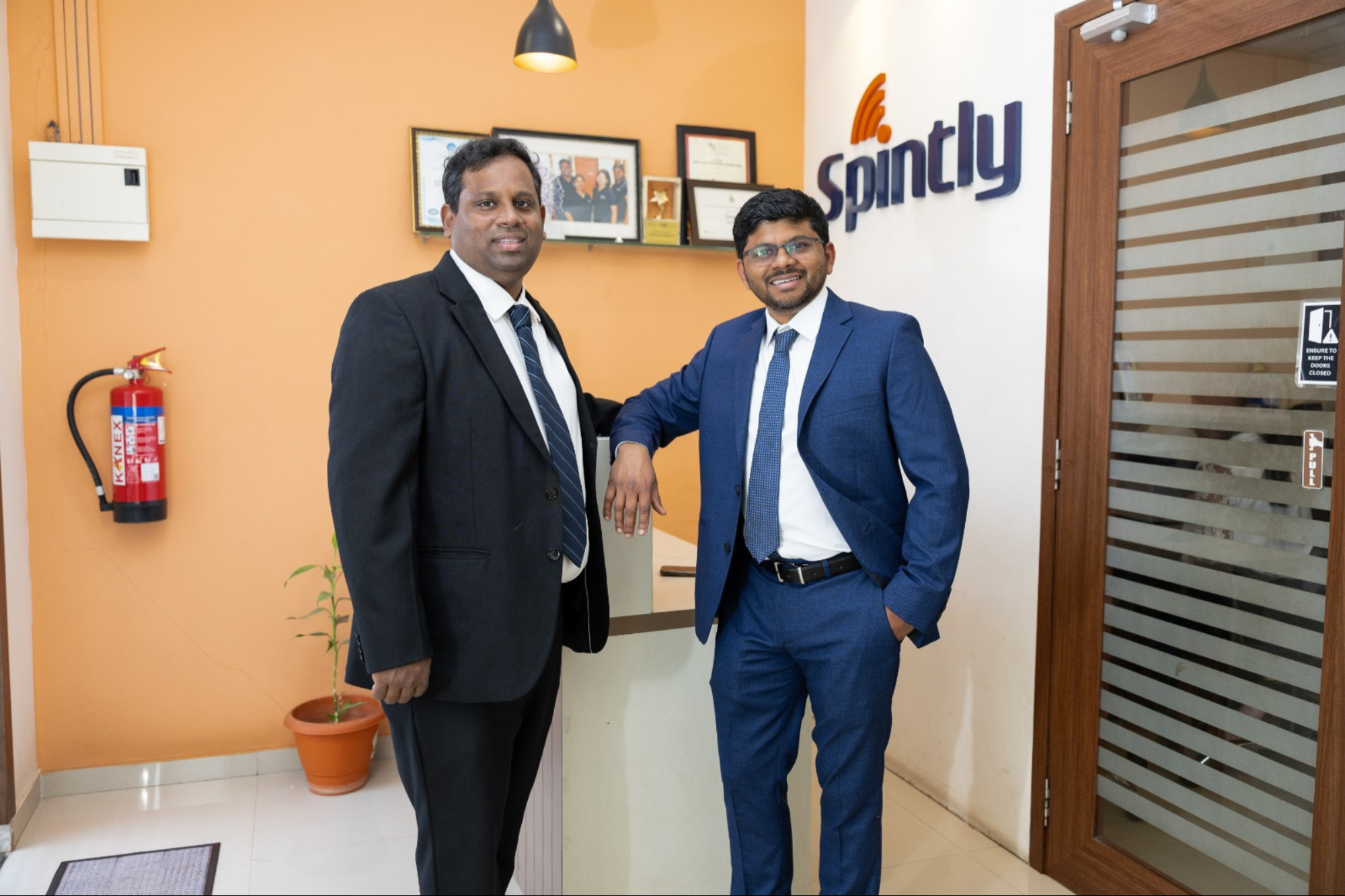
Photograph: Spintly founders, published with February 2026 funding coverage in Entrepreneur India.