He wanted to know if there was a seat in the library. So he built a sensor that reads Wi-Fi. Nine years later, it is plugged into 180 million square feet of the federal government.
Halverson, photographed in the field. He does not watch back his own TV interviews, a fact he mentions unprompted.
In the fall of 2017, Nic Halverson walked into Geisel Library at UC San Diego, a concrete brutalist stack that looks like a spaceship half-buried in eucalyptus, and he could not find a seat. He was an electrical engineering junior with a midterm. He walked every floor. Twenty minutes. Nothing. He told his roommate, Linus Grasel, that he wished the building could just tell him whether it was full before he walked over. The next semester the roommates were counting people by hand and updating a website in real time so that other UCSD students could see the occupancy of every floor.
That website is now Occuspace, a Westlake Village company with 56 employees, a Series A led by Lewis & Clark Ventures, and a General Services Administration contract to instrument roughly the surface area of the island of Manhattan in federal offices. The sensor still plugs into a wall outlet. It still does not use a camera. The measurement problem, Halverson likes to point out, has not really changed since the library: how many humans are in this room, right now, without asking any of them.
Occuspace's sensors listen for the anonymous radio noise your phone and laptop are already broadcasting - Wi-Fi probe requests, Bluetooth beacons - and infer occupancy from the density and behavior of those signals in a 3,000 square foot cell. The pitch to universities and, later, to landlords and CFOs, is that you get to know how your building actually behaves without collecting a single piece of personally identifiable information. This constraint was imposed on Halverson early by UCSD, which would not let its students deploy anything that could identify a person. It turned out to be the moat.
The rest of the market, at the time, was trying to sell buildings a lot of cameras. Halverson was selling them the absence of cameras. The absence sold better.
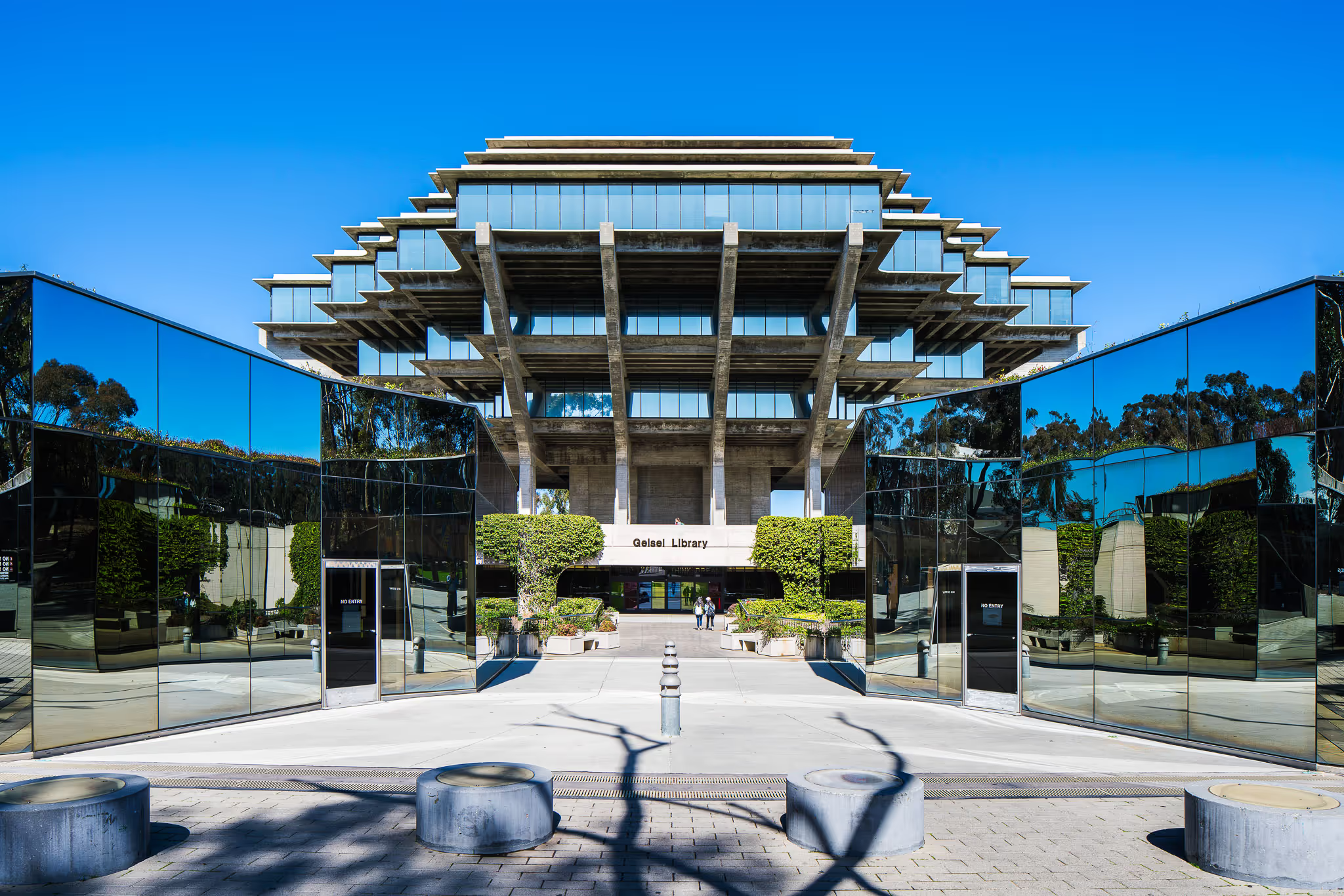
The first minimum viable product was, in a strict sense, not a product. It was two engineering students walking laps. Halverson and Grasel physically counted humans on each floor of Geisel Library, then edited the website. Refresh. Refresh. Ten thousand students downloaded the companion app in its first week. Roughly one in three UCSD undergraduates. Somewhere in there the UCSD vice chancellor asked whether the sensor could be extended across the university's entire four million square feet, and the college project stopped being a college project.
Halverson grew up in a Florida town of about four thousand people. He went west to UCSD in 2013 for electrical engineering, which is a decision he still describes as one of the best of his life. He worked evening shifts at Amazon warehouses while building Occuspace by day. He is married to an aspiring Olympian, whom he credits publicly, at length, with tolerating the sleep loss. He tells interviewers that starting a company involves the sacrifice of sleep, relationships, vacations, and financial stability, and he is not being poetic - he is describing the years 2018 through 2022 with a bookkeeper's precision.
He has said elsewhere that his biggest professional liability is perfectionism, which is a founder confession that reads either as false humility or as a real diagnosis. Given that Occuspace shipped a product that runs on ambient signal-processing math and requires almost no installation, one is inclined to take him at his word.
The device plugs into a wall outlet. There is no ceiling drilling, no cabling, no installer visit that requires a facilities manager's signature. Halverson is fond of the fact that the deployment story fits on a business card: the box arrives, someone plugs it in, the data starts flowing into a dashboard within an hour. This is the sort of detail that makes a CFO nod and a competitor swear.
Halverson leaves small-town Florida for UCSD, planning to study electrical engineering.
Founds Occuspace (initially Waitz) with roommate Linus Grasel after failing to find a seat at Geisel Library.
Free student app hits 10,000 downloads in a week. Wins a UCSD pitch contest.
Pivots hard into occupancy monitoring for social distancing. Baylor Libraries and other early adopters deploy sensors.
Closes a $3.6M seed round to scale higher-ed deployments.
Adds 85+ new university installations in a single year.
Closes a $6M Series A led by Lewis & Clark Ventures, bringing total funding to $14M.
Selected by The Building People and the GSA to help optimize 180M+ sq ft of federal real estate.
Launches Octi, a conversational AI layered on top of the occupancy data.
Halverson stacked packages at Amazon in the evenings while building the first sensor prototype during the day. The company took years to become a full-time job.
The moment the college side project became a company was a single question from UCSD leadership: can this cover our four million square feet.
The university's privacy constraint became the product's most valuable feature. Occuspace measures the room. It does not measure the people.
Halverson learned operations by working in one. It shows in how quickly Occuspace can ship a physical unit at scale.
Halverson has appeared on ABC, NBC, CBS and in the New York Times. He has said, more than once, that he doesn't watch his own interviews.
The 2026 conversational AI product lets a facilities manager type "is the third floor busy right now" and get an answer. Nine years of data made this possible.
A plug-in hardware sensor plus a software platform that reads anonymous Wi-Fi and Bluetooth signals to estimate how many people are in a space in real time. No cameras. No personally identifiable information.
He spent twenty minutes trying to find a seat in Geisel Library at UC San Diego during midterms in 2017. He wanted the building to be able to tell him it was full.
Austin, Texas. Occuspace is headquartered in Westlake Village, California.
About $14 million cumulatively - a $3.6M seed and a $6M Series A closed in March 2025, led by Lewis & Clark Ventures.
Over 100 university campuses, several Fortune 500 employers, and, as of 2025, the US General Services Administration, which is deploying Occuspace across 180 million square feet of federal real estate.