The office door is a poor historian. It remembers nothing of the tenant that moved out on Friday, the contractor due on Tuesday, or the employee whose badge vanished into a taxi. The building manager, meanwhile, must remember all of it. Spintly, a company founded by Rohin Parkar and Malcolm Dsouza, has made that everyday administrative headache its business.
Its offer sounds small: let people unlock doors with a phone. But the work behind that gesture is broader. Spintly sells access readers, a wireless mesh that links them, gateways to the cloud, and software for permissions, visitors, tenants and attendance. The phone is the visible part. The wiring, or the absence of much of it, is where the proposition gets interesting.
- Spintly makes cloud-managed access control for offices, coworking sites and other buildings.
- Its readers use Bluetooth Low Energy mesh, so nearby devices can relay access data toward a gateway.
- Its Smartworks case study covers 95,000+ users and 470+ doors across India.
- The company announced an $8 million Series A in February 2026.
The price of a hole in the wall
A conventional access installation can require controllers, cable runs, conduits and a fair amount of work above ceilings or behind finished surfaces. Spintly’s claim is that its mesh design avoids much of that network cabling. A reader at one door can pass messages along to another; a gateway connects the mesh to the cloud. This does not remove the door’s lock or power requirements. It changes how access devices communicate and how they are administered.
That distinction matters most after a building is already occupied. A new tenant may need a different set of doors. A growing company may take another floor. A site manager may need to revoke one credential at 7 p.m. None of these is a grand architectural event. All of them can become expensive when a physical badge system and its local software must be managed across many addresses.
The route from pocket to permission
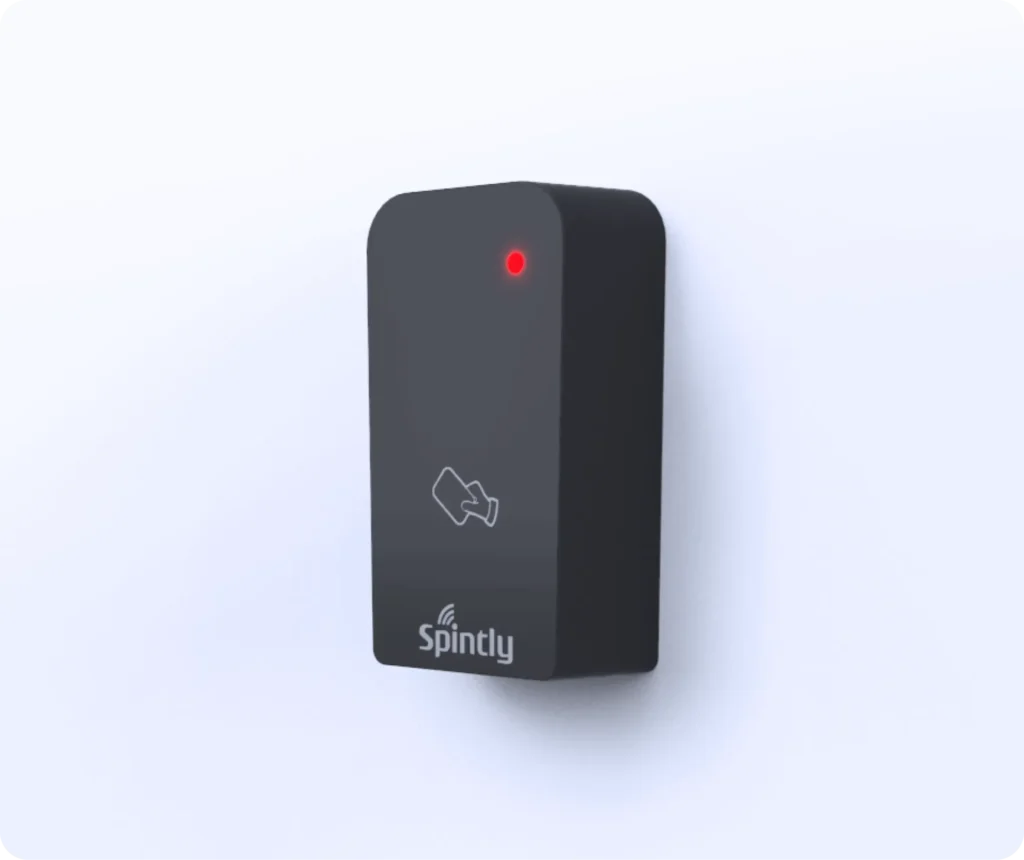
The reader is hardly a minimalist purist. Spintly’s UNO supports phone and card access and can connect with older Wiegand or OSDP controllers. Its wider range includes KREO and ZEON QR readers, an outdoor model, fingerprint and face recognition products, and a Fi-B gateway. The variety says something about the real market: buildings do not upgrade on a single day, and a visitor with a QR code does not have the same needs as a long-serving employee with a card.
The coworking stress test
The clearest public account of what this solves comes from Smartworks, the coworking operator. Its problem was not one stubborn door. It was the combination of access, attendance and tenant management at many sites, with an existing software system that needed to keep up. Its previous approach carried high per-door costs and the expense of cabling, conduits and controller maintenance, according to Spintly’s case study.
Smartworks deployed Spintly Smart UNO readers and the company’s access, attendance and tenant modules. It moved toward mobile credentials and integrated the result with its own software. Spintly reports more than 95,000 users and 470 doors across India in that deployment. Those are case-study figures from the vendor, but they make the unit of difficulty plain: each extra door is an operational relationship with people, schedules and a record of who entered.
What did it cost? Spintly says Smartworks saved substantially by eliminating controllers and wiring, but publishes no invoice or per-door figure. The honest comparison is therefore about the work removed, rather than a promised percentage. Any buyer still has to price the readers, locks, gateways, installation, software and support for its own site.
“Substantial cost savings through the elimination of controllers & wiring.”Spintly’s Smartworks case study
From the badge to the building
The company began in 2018 and says its first products launched in early 2020. The timing gave it an unexpected test. Contactless entry became more appealing during the pandemic, and Spintly reported that adoption increased afterward. By its 2022 funding announcement, it said it had more than 100,000 platform users and that revenue had grown 500% from the previous year. Those figures describe a period, not a current run rate.
The product has since widened beyond a smartphone app. An employee badge can now live in Apple Wallet for a tap with an iPhone or Apple Watch. Visitors can use QR workflows. Partners can use APIs and a mobile SDK to put door access inside their own workplace or residential apps. A 2024 platform document describes white-label software and support for Wiegand and OSDP, an acknowledgement that the buyer may already have hardware, branding and systems it cannot simply discard.
That shift makes Spintly a hardware and software company at once. It sells into a market with cloud-access specialists such as Brivo and Kisi, larger integrated security platforms, and decades of wired equipment already bolted to walls. Its distinguishing idea is the BLE mesh at the center of the installation. Its practical advantage depends on whether the site’s layout, radio coverage, existing door hardware and integration needs suit that architecture. In some buildings, the old wiring is already paid for; in others, opening the walls is the whole problem.
The small lesson hiding in 470 doors
In February 2026, Spintly announced an $8 million Series A led by Accel. Funding can buy sales capacity and product development; it cannot make a complicated installation disappear by decree. That is why the Smartworks example is more useful than the round size. The operator had a named problem, chose a particular reader and software combination, and tied access to the systems it already used.
A facilities team can copy that sequence without buying Spintly: count the doors and user changes, map the old controllers and cables, test credential types against actual occupants, and price installation as well as subscriptions. Pilot a cluster of doors before committing the whole property. Ask what happens when a phone is lost, a network is unavailable, or a tenant leaves overnight. The door will still open and close. The question is whether everyone around it can keep up.