At Friends House Retirement Community, resident information used to travel by flash drive. A change in a clinical system had to make its way into the dining operation through a manual transfer. The kitchen could prepare dinner; the difficult part was making sure dinner belonged to the person whose needs had just changed.
- The job: connect clinical diets, menus, purchasing, kitchen production and dining payments.
- The buyers: healthcare and senior living operators whose meals carry both hospitality and care responsibilities.
- The evidence: customer accounts of less copying, fewer missed charges and more useful service data.
- The catch: accurate records, the right integrations and staff participation still do the heavy lifting.
That little journey is MealSuite’s territory. The company sells foodservice software and hardware for places where a meal is simultaneously a pleasure, an operational expense and part of someone’s care. Its product is easiest to understand by following the information that must accompany the food.
The flash drive at dinner
Friends House adopted MealSuite Connect for PointClickCare, POS and TOUCH. Its published customer account reports roughly 1,650 resident updates processed automatically each month, saving 110 labor hours. Culinary director Jason Rosewag describes a change of diet moving through immediately. The important improvement is the disappearance of a repeated administrative job.
Service data prompted another decision. The breakfast bistro had opened from 6 a.m. until noon; observed peak usage led the team to concentrate service into a two-hour window. A screen made the pattern visible. Someone still had to decide what to do about it.
“If a nurse changes the diet, it immediately goes through.”Jason Rosewag · Culinary Director, Friends House
The account reveals the first thing that had become troublesome: the handoff. Updating a resident, editing a menu and reconciling dining charges were ordinary tasks made cumbersome by separate systems. MealSuite’s opportunity sits in that distance between one department’s accurate record and another department’s usable information.
What travels with a meal
MealSuite’s core functions cover recipes, menu planning, nutritional analysis, food production, inventory and purchasing. Operators can plan against their menus and census, use supplier information for costing, and carry resident preferences and dietary requirements into service. A recipe is connected to quantities and ingredients; a diner is connected to an appropriate choice.
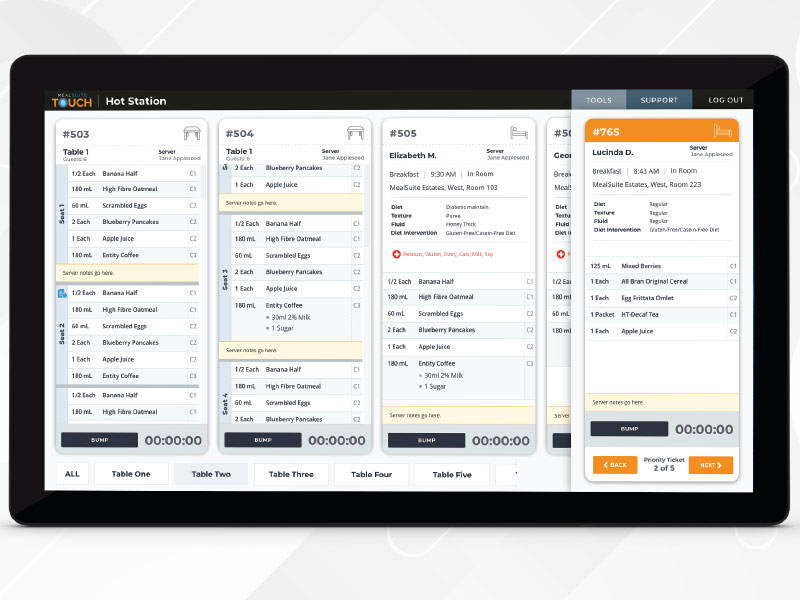
The public product guide describes bedside advance ordering on a tablet, tableside orders sent to the kitchen, digital menu boards and online ordering. The Portal app adds orders from a resident’s own phone, tablet or browser. In a paid service it can handle pickup and delivery purchases; in a clinical meal service it supports advance orders tailored to dietary needs.
That range matters in a continuing care community. Independent living, assisted living and skilled nursing may share an organisation while asking very different things of lunch. Software built around a restaurant table alone has less reason to understand a clinical diet order. Software built around a clinical record alone has less reason to settle a guest’s café bill.
- 01Clinical profileDiet · allergens · preferences
- 02Menu & buyingRecipes · quantities · costs
- 03Kitchen & serviceProduction · ordering · plating
- 04Bill & learnCharges · usage · reports
A conceptual map of connected workflows, not a claim that every integration transfers every field.
The till that knows the resident
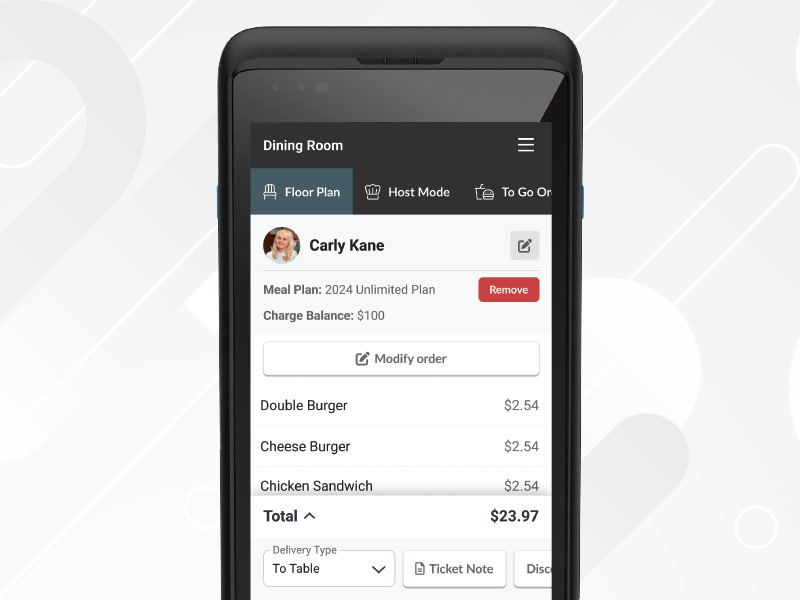
Amica Senior Lifestyles supplies the other half of the argument. Guest meals and extra drinks were being provided, but paper processes did not consistently capture the revenue. Following an RFP, Amica selected MealSuite for the connection between kitchen operations, resident management and financial reporting.
The company’s case study reports nine POS locations and a 126.49% increase in transaction dollar amounts over five months. Its headline calls this a dining-income boost. Read it carefully: the account discusses capturing charges and improving service, and supplies no control group separating those effects. It is a reported customer outcome, not a forecast for every buyer.
Gary McBlain’s rollout advice is wonderfully plain: “Communicate, communicate, communicate.” Culinary, finance, IT and operations all have a stake. A till changes the server’s routine and the finance team’s records. Adoption has to reach both ends of the transaction.
The bill for connecting everything
MealSuite’s commercial route begins with a personalised demonstration. It sells to organisations, with licensed software functionality, connected devices, integrations and support. The sensible buying unit is the operation: which dining locations, which records, which purchasing workflows and which people need to participate?
That makes a feature checklist a poor substitute for a working demonstration. Ask the vendor to follow a changed diet through your actual workflow. Ask how a guest charge reaches finance. Price the modules, hardware, setup and training together, then compare the total with the manual work being replaced. Reclaimed staff time and cash savings are different entries in that calculation.
Integration scope deserves the same scrutiny. MealSuite lists different transferred fields for different EHR providers. Its purchasing partners include US Foods and Sysco Canada; its Gordon Food Service connection is listed for US customers, while the PFG connection is limited to MenuMatrix members. A familiar partner logo is a starting point for questions.
Within the market, CBORD’s NetMenu covers menu planning, costing, forecasting and procurement. Computrition also offers healthcare nutrition, operations and retail tools. MealSuite’s connected proposition therefore competes in an established category. Its case rests on whether its particular combination fits a care community’s service, clinical and financial routines.
An assistant with a recipe problem
The latest generation, MealSuite NXT, places ANDI inside the platform. The initials stand for Automated Nutrition Dining Intelligence. NXT markets role-based assistance for dietitian, foodservice director, chef and procurement work, alongside corporate controls for menus, nutrition standards and buying rules.
The support documentation gives the AI story useful edges. ANDI can extract recipes from imported documents, generate recipe photos and assist with allergen groups. Recipe-photo generation comes with 100 default weekly credits per facility, resetting on Monday; one successful image uses one credit.
Here is the revealing detail: the photo tool does not use the recipe’s portion-size field. If the image needs to show two pieces of food, the documentation says to specify the serving in the description. The output depends on descriptive names, complete ingredients and suitable context. An attractive menu image remains a representation that someone must check.
The practical lesson travels well beyond foodservice. Automation becomes useful when the underlying record is useful. Importing an old recipe faster does not settle whether that recipe is accurate, suitable for a particular resident or correctly prepared. Those judgements remain part of the operation.
The people behind the screens
MealSuite dates its history to 1989. Its CEO biography says Sean Rowe acquired the business in 2016 and pursued a connected ecosystem of software and hardware. The company describes a team with healthcare experience and registered dietitians; its published values include ownership, integrity and growing together.
That expertise has a practical expression. In a recent essay, Jon Williams, its director of RD consulting services, argues that operators still need people who visit the building, see the work and help staff prioritise improvements. The technology makes problems visible; an onsite relationship helps turn that visibility into action. It is a persuasive admission from a software company.

For an operator, the copyable approach is modest: identify a repeated transfer, record its workload, connect it, then measure what changes. Include the person who enters the information and the person who relies on it. If records are unreliable or frontline staff cannot use the new process, joining the screens merely gives the confusion a faster route.
A new country, the same handoff
On September 30, 2026, MealSuite announced Australian availability, supported by a local team in Macquarie Park, Sydney. The announcement says implementation was already underway with a first major Australian customer across 39 sites, and reports more than 4,700 communities served in North America.
Scale adds another test: a standard menu must coexist with local preferences, and a corporate rule must survive the journey into a working kitchen. That is the distinctive promise of MealSuite. It asks what happens to a piece of information after somebody enters it. For the person waiting for dinner, the answer should be pleasantly uneventful: the right meal arrives.