In the summer of 2012, Pelu Tran was learning a peculiar lesson about medicine. The patient had a story. The computer required a record. The doctor had to attend to both, and the computer was remarkably persistent. On his Stanford clinical rotations, Tran saw how record-keeping could crowd out the encounter it was supposed to preserve. He and Ian Shakil founded Augmedix that year. Their proposed remedy came with a camera, a small display and a rather conspicuous pair of glasses.
- The job: turn a patient conversation into a medical note.
- The choice: AI drafting, specialist assistance or dedicated live support.
- The proving ground: real hospital workflows, including interrupted emergency visits.
- The business turn: Commure bought Augmedix in 2024 for about $139 million in equity value.
A pair of glasses meets a wall of paperwork
Shakil’s account of discovering Google Glass has the appealing informality of an idea that escaped a conference room. He encountered Google employees in San Francisco’s Dolores Park. They let him try their prototype. “They had Glass in their backpacks. And they let us try it on,” he later told KQED. He saw a medical use for a device being imagined for consumers. A doctor could face a patient while somebody elsewhere handled the record.
The early arrangement was less magical, and more interesting, than an automated doctor. Glass streamed the encounter to a remote scribe. That person assembled the note and could retrieve information from the chart. The physician supplied clinical expertise; the scribe supplied attention to documentation. Augmedix was reorganizing work around the expensive person in the room.
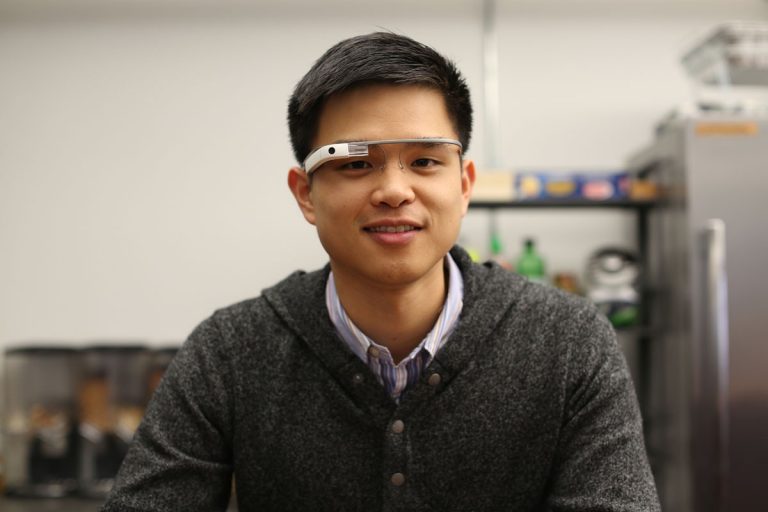
In 2015, Stanford described the service as a monthly subscription. Tran had taken leave from medical school in spring 2013 to work on it. Google Glass, meanwhile, struggled to become an ordinary consumer habit. Its awkward public reception makes Augmedix’s early choice memorable: a device could disappoint shoppers and still be useful inside a carefully organized job. The hospital needed less glamour and more completed paperwork.
That distinction survived the hardware. Today Augmedix describes mobile and web applications, speech recognition and language models. The interface changed from something worn on the face to something accessed through a phone. The original question remained: how much of the doctor’s attention must the record consume?
Three ways to finish the note
Augmedix sells to healthcare organizations and practices. The clinician uses it; the organization weighs the bill against documentation work, staff capacity and operational needs. Its products translate that broad calculation into three levels of assistance. The important difference is who does the work after the software has produced a draft.
Go
AI drafts.
The clinician edits.
Assist
AI drafts.
A specialist helps.
Live
A dedicated specialist supports the visit.
Go is the self-service option. It converts the recorded encounter into a draft, leaving the clinician to review it and handle remaining tasks. Assist adds human specialist support with editing and work such as data entry or referral letters. The current product description promises Assist notes ready for sign-off within an hour. Live supplies a dedicated medical documentation specialist who supports the clinician before, during and after a visit.
Those are meaningful distinctions for a buyer. A clinician who wants a first draft may need Go. Someone whose paperwork includes a procession of orders, letters and follow-up tasks may value the additional help. Human support costs resources, but it can also remove work that survives the first burst of automation. A neat paragraph does not necessarily close a chart.
The commercial model follows this ladder: recurring subscriptions, with service scope and support hours shaping the arrangement. The public Go schedule places pricing in the service order. A sensible evaluation therefore compares the contracted service with the work it actually removes. The subscription invoice is visible. The minutes spent correcting and completing notes deserve to be equally visible.
The emergency room refuses to be a demo
An emergency visit need not proceed as one uninterrupted conversation. There can be an initial examination, a test, a return visit, a change of plan and another exchange amid surrounding noise. A useful documentation system has to preserve that sequence without pretending the encounter arrived as a tidy monologue.
HCA Healthcare became a particularly consequential partner. In April 2023, HCA and Redmile Group participated in a $12 million strategic financing. HCA also helped develop the acute-care product. By August, HCA described a pilot involving approximately 75 emergency physicians at four hospitals, working with Augmedix and Google Cloud. The process included physician review and finalization before notes entered the electronic record.
- ListenCapture the conversation
- DraftOrganize medical notes
- ReviewClinician checks and approves
- RecordComplete the EHR workflow
Augmedix announced general availability of Go for emergency departments in April 2024. Its launch description emphasized multiple recordings and non-sequential interactions with the same patient. That is a revealing piece of product detail. The engineering problem was not merely recognizing a voice. It was making something usable when clinical work stopped, restarted and changed direction.
For another software builder, the lesson is practical: enlist customers who can expose the awkward cases. HCA was an investor, a buyer and a development partner. That gave the product a route into actual work, although a partnership announcement should never be mistaken for a measured outcome. Pilot size, purchasing access and deployed users are different numbers.

Growth had a bill attached
Augmedix’s financial history makes the story less comfortable and more useful. Its audited 2023 revenue was $44.855 million, up from $30.933 million in 2022. It also recorded a $19.2 million net loss. Demand was growing. Profitability had not arrived.
In May 2024, the company reduced its full-year revenue guidance from $60-$62 million to $52-$55 million. Its merger filing records a closing share price of $2.34 on May 13 and $1.15 the next day. The board’s account of the sale also identified the substantial capital raise needed before cash break-even as a risk of remaining independent.
These facts do not establish a secret moment when the founders lost faith. They establish what the board had to consider: execution risk, financing and competition alongside the opportunity. Commure announced an approximately $139 million all-cash acquisition in July. It completed the deal on October 2, 2024, and Augmedix became a wholly owned subsidiary. Shareholders received $2.35 per share.
The parent brought a wider healthcare technology business to the combination. Later that month, Commure announced HCA had selected it to develop and deploy an ambient platform, with a formal enterprise agreement still being negotiated. The distinction matters. A plan to expand through a hospital network is a plan, even when the network is large.
A hospital buys the last mile
The market around Augmedix has become crowded. Abridge, Suki and Microsoft Dragon Copilot also offer clinical documentation technology. Human scribes and dictation remain alternatives. Capturing a conversation is consequently an opening requirement. Buyers must also examine integration, correction burden and how much surrounding work the service can handle.
Augmedix’s notable positioning is the range from AI-only drafting to dedicated human support, combined with its experience in remote documentation and acute-care workflows. That range gives a hospital choices. It does not prove superiority over competing products; the useful comparison happens inside the buyer’s own specialty, record system and working day.
In January 2025, Augmedix announced a Vizient contract covering Go, Assist and Live. It opened a purchasing channel, rather than establishing that Vizient’s entire membership used the software. A later Commure customer account described roughly 200 ambient users across HCA North Texas, following a pilot at Medical City Dallas. That is evidence about the parent’s rollout, not Augmedix’s total customer count.
“I never want patients to feel like I’m rushed.”Dr. Geoffrey Burnham, in Commure’s August 2025 customer account
The same account describes direct physician feedback to engineers on templates and inpatient documentation. The detail is useful because adoption involves small frictions: where a note goes, how it reads and what a clinician must still do. An elegant demonstration can leave all three unresolved.
For a team evaluating the service, a workable test is to time the complete job, compare drafts with signed notes and track how much editing remains. Try routine visits and complicated ones. Check whether integration removes duplicate entry. If correction consumes the saved minutes, or a clinician still has to reconstruct missing context, the economics weaken. Those are evaluation criteria, not reported Augmedix failure rates.
The company’s history offers a copyable habit: keep returning to the work the customer wants finished, even when the fashionable tool changes. Glass, remote specialists and language models have each occupied a place in that effort. The final test is satisfyingly ordinary. Can the clinician finish the record and still have attention left for the person who supplied its story?